4.1 - Density
What density is and what it depends on
- Density is the mass per unit volume of a substance - a measure of how tightly packed its particles are.
- Density depends on what a material is made of and how its particles are arranged - the more tightly packed the particles, the denser the material.
- Solids are generally the densest state of matter, liquids slightly less dense, and gases much less dense.
Density depends on the material, not the size or shape
- Density is a property of the material itself.
- A large block of iron and a small iron nail have the same density, even though their masses and volumes are different.
- Cutting an object in half halves both its mass and its volume, so its density stays the same.
Density and floating
The average density of an object determines whether it floats or sinks in a fluid:
- An object floats if its average density is lower than the density of the fluid.
- An object sinks if its average density is greater than the density of the fluid.
- A less dense liquid floats on a more dense liquid, provided they don't mix (e.g. vegetable oil on water).
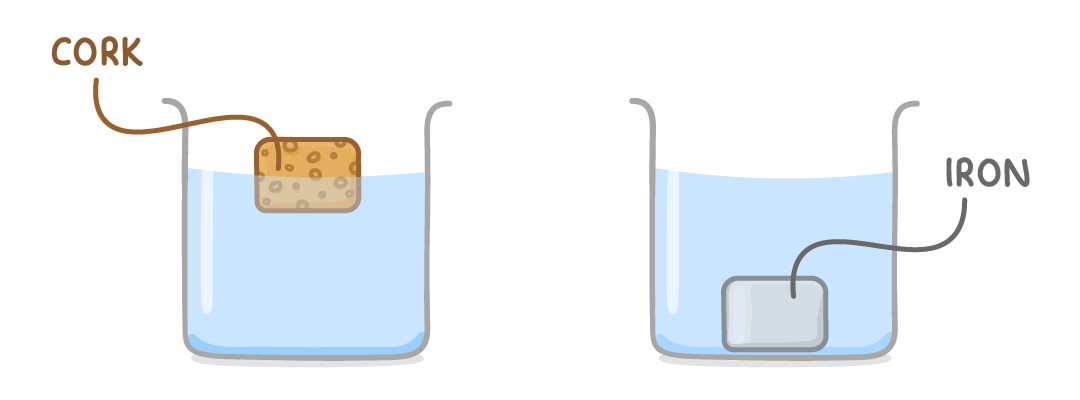
Cork is less dense than water, so it floats; iron is denser and sinks.
Formula for density
Where:
- = Density, using the Greek letter rho, in kilograms per cubic metre (kg/m3) or grams per cubic centimetre (g/cm3)
- = Mass, in kilograms (kg) or grams (g)
- = Volume, in cubic metres (m3) or cubic centimetres (cm3)
Converting between units
1 g/cm3 = 1,000 kg/m3
For example, water has a density of 1 g/cm3, which equals 1,000 kg/m3.
Worked example - Using the density formula
Copper has a density of 9.0 g/cm3. Find the mass of 5 cm3 of copper.
Step 1 - Formula
Step 2 - Rearrange the formula
Make mass the subject:
Step 3 - Substitution and calculation
So 5 cm3 of copper has a mass of 45 g.
The mass and volume must be in units that match the density. Here density is in g/cm3, so mass is in grams and volume in cubic centimetres.
Measuring the density of solids and liquids
- To find the density of any substance, measure its mass and its volume and use .
- Mass is measured using a balance.
A regularly shaped solid
- Measure its mass on a balance.
- Measure its dimensions with a ruler, Vernier callipers, or a micrometer, and calculate the volume:
- Cuboid: volume = length × width × height
- Cylinder: volume = π × radius2 × height
- Calculate the density using .
An irregularly shaped solid
- Measure the mass of the object on a balance.
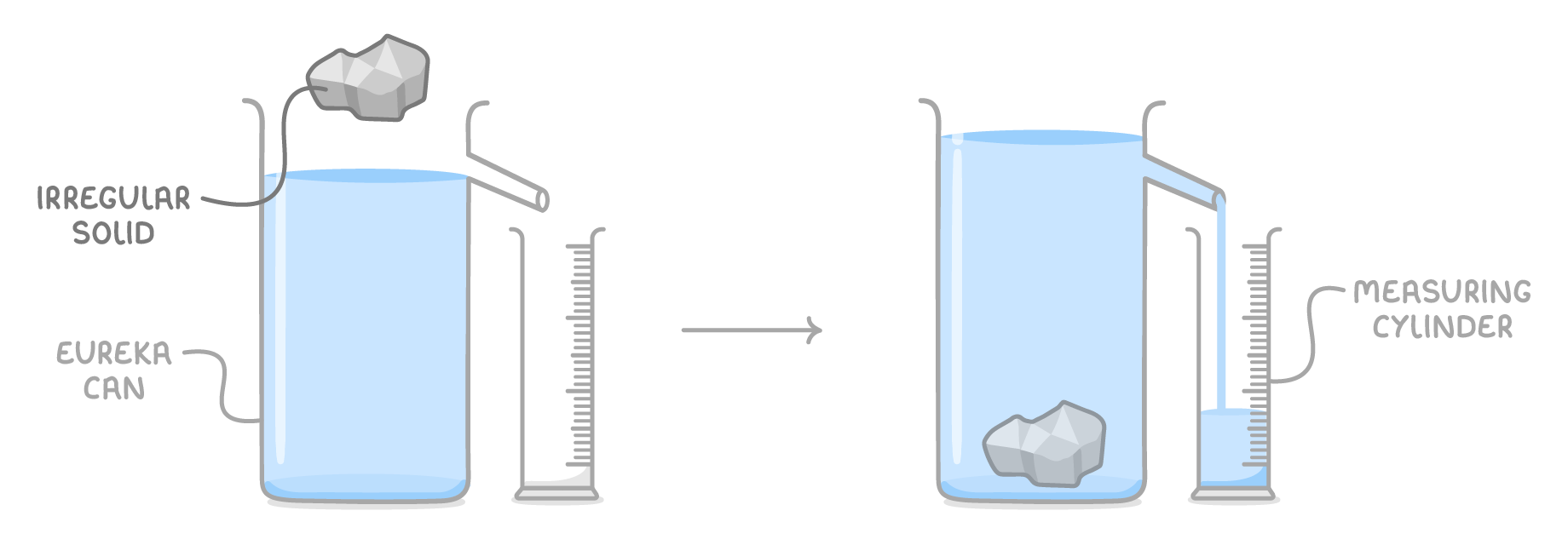
- Fill a displacement (eureka) can with water up to the spout, and place an empty measuring cylinder under the spout.
- Lower the object gently into the can - the water it displaces flows out of the spout into the measuring cylinder.
- Read the volume of water collected - this equals the volume of the object.
- Calculate the density using .
This method only works if the object sinks.
A liquid
- Place a measuring cylinder on a balance and zero it (or record the mass of the empty cylinder).
- Pour a measured volume of the liquid into the cylinder and record the mass.
- Calculate the density using .
Reading density from a mass-volume graph
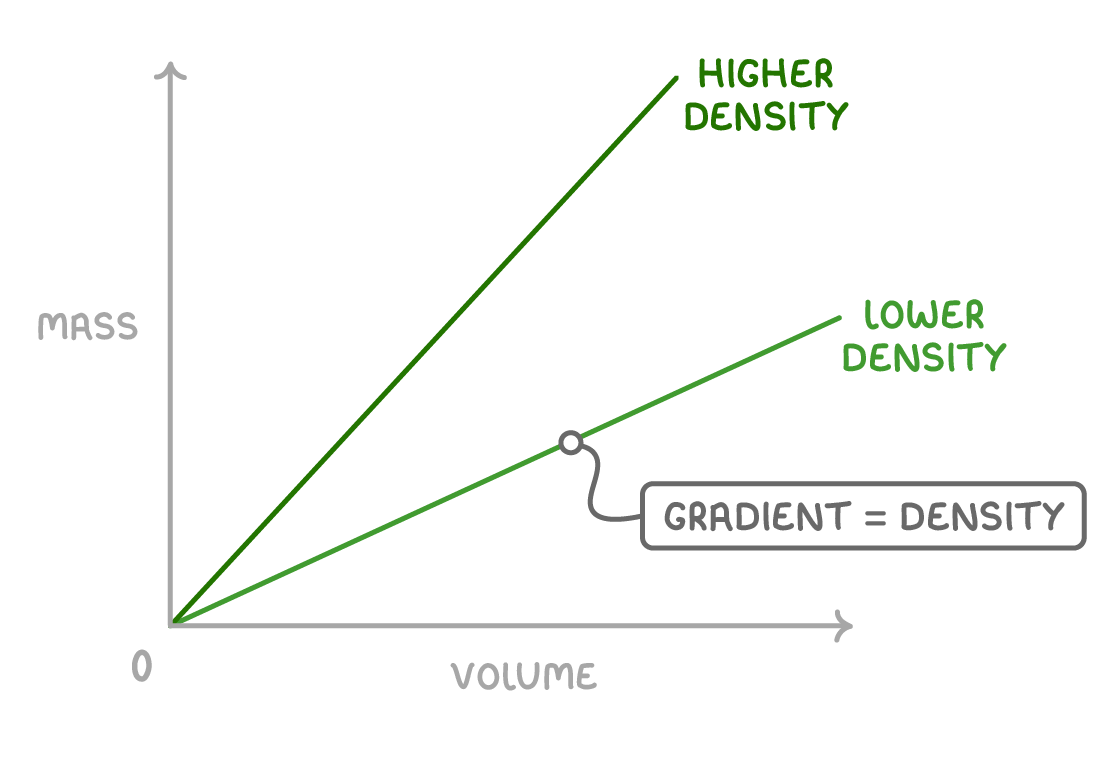
- A plot of mass against volume gives a straight line through the origin.
- The gradient of the line is the density of the material.
- A steeper line represents a higher density.
TermDefinition
DensityThe mass per unit volume of a substance.