14.1 - Electromagnetic Waves
EM waves transfer energy from a source to an absorber
- Electromagnetic (EM) waves are transverse waves that transfer energy from a source to an absorber.
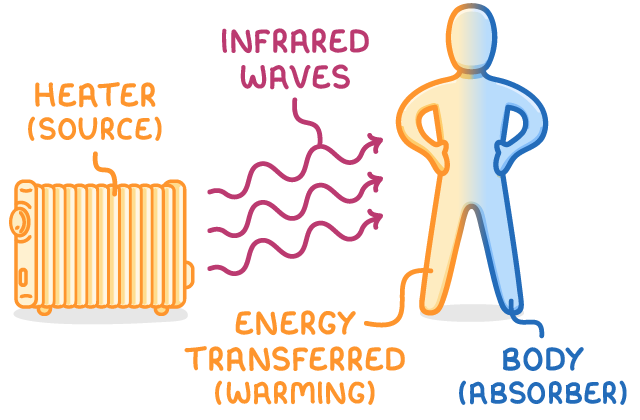
- For example, an electric heater (source) emits infrared waves that are absorbed by your body (absorber), warming you.
- EM waves are vibrations of electric and magnetic fields, not particles, so they can travel through a vacuum (such as empty space).
The speed of EM waves
- All EM waves travel at the same speed through a vacuum (and through air): 3.0 × 10⁸ m/s (the speed of light).
- EM waves travel at different speeds in different materials.
EM waves form a continuous spectrum of seven groups
- EM waves cover a wide range of wavelengths and frequencies.
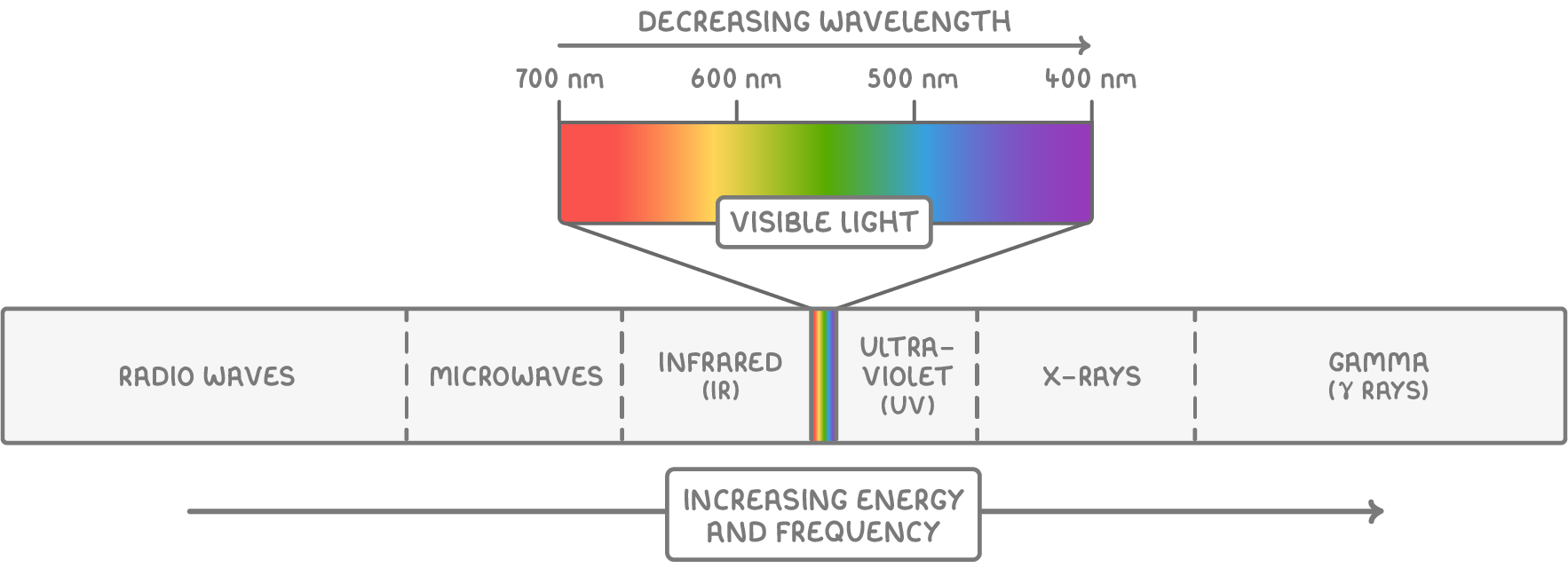
- They're grouped into seven bands, with no sharp boundaries between them, forming a single continuous spectrum.
In order from longest wavelength (lowest frequency) to shortest wavelength (highest frequency):
radio waves → microwaves → infrared → visible light → ultraviolet → X-rays → gamma rays
As wavelength decreases, frequency increases across the spectrum (since ).
Visible light
- Our eyes detect only visible light, which is a narrow band of the spectrum.
- Within visible light, the colour depends on the wavelength. From longest wavelength to shortest:
red, orange, yellow, green, blue, indigo, violet
Interactions at a boundary
- Different wavelengths interact differently at a boundary between materials.
- A wave may be absorbed, transmitted, reflected or refracted, depending on both the material and the wavelength.
TermDefinition
Electromagnetic waveA transverse wave that transfers energy from a source to an absorber and travels at the same speed as all other electromagnetic waves in a vacuum.
Continuous spectrumA spread of wavelengths and frequencies with no gaps or sharp boundaries between the different bands.