21.2 - Nuclear Fission
What nuclear fission is
- Nuclear fission is the splitting of a large, unstable nucleus (such as uranium-235 or plutonium) into two smaller nuclei, releasing energy.
- Spontaneous fission - Where a nucleus splits on its own - is rare. Usually the nucleus has to absorb a neutron first.
How fission is triggered
- A slow-moving neutron is absorbed by the nucleus, making it even more unstable and causing it to split.
- A neutron is absorbed easily because it has no charge, so it isn't repelled by the positive nucleus.
- Nuclei like uranium-235 that can absorb slow neutrons this way are described as fissile.
What fission produces
- The heavy nucleus splits into two lighter daughter nuclei, roughly the same size as each other. These are usually radioactive.
- Two or three neutrons are also released, along with a large amount of energy.
- Most of the energy ends up as kinetic energy of the fast-moving fission products; some is carried away as gamma radiation.
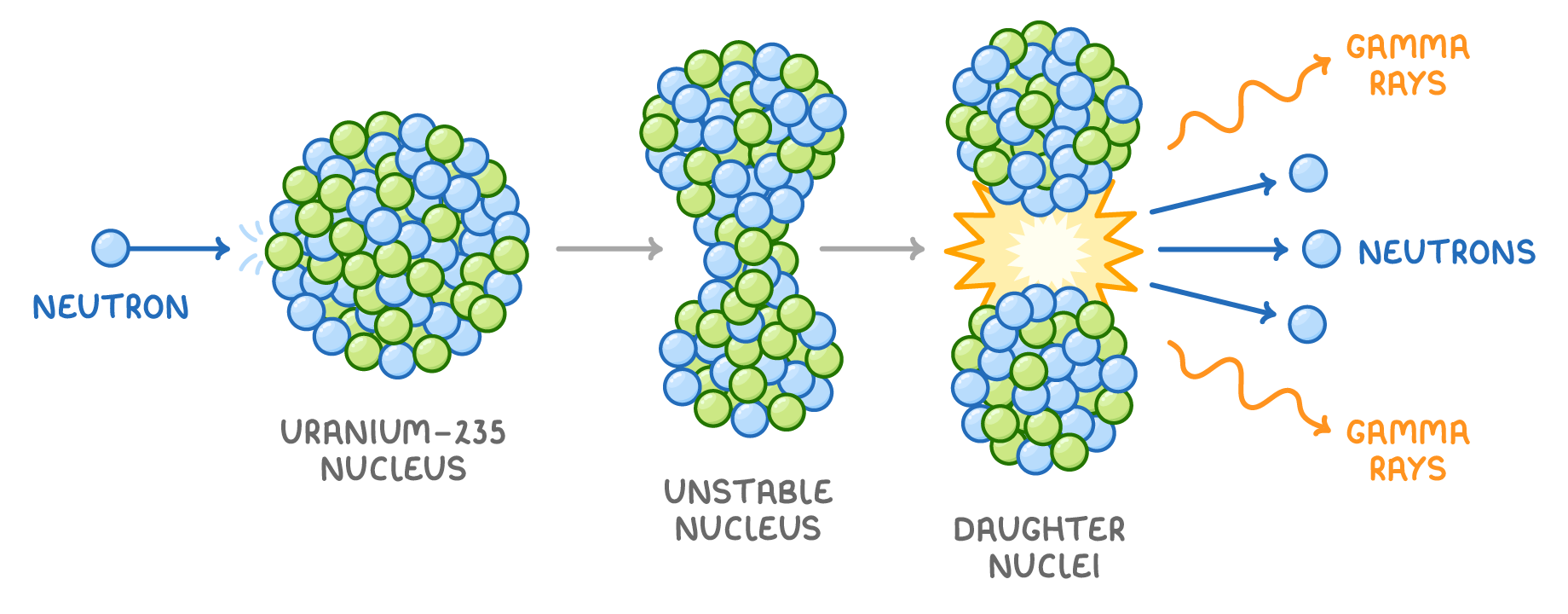
Mass and energy in a fission reaction
- A fission equation must balance: total mass number on the left = total mass number on the right, and total proton number on the left = total proton number on the right.
- Counting the nucleons on each side lets you work out the number of neutrons released.
Balancing an equation
- Mass numbers balance: 235 + 1 = 91 + 143 + 2 + 0
- Proton numbers balance: 92 + 0 = 36 + 56 + 0 + 0
Where the energy comes from
- The total mass after fission is slightly lower than before, because some mass is converted into energy.
- Some of this energy becomes kinetic energy of the products (the lighter nuclei and the neutrons); some is carried away by gamma rays.
Generating electricity from fission
- The energy released by fission heats water into steam.
- The steam drives a turbine, which turns a generator to produce electricity.
Using a coolant
- In many reactors the energy isn't passed straight to the water.
- A coolant (such as carbon dioxide) is pumped around the reactor core to carry heat to a heat exchanger, where it boils the water into steam.
- This keeps the water supply separate from the reactor core.
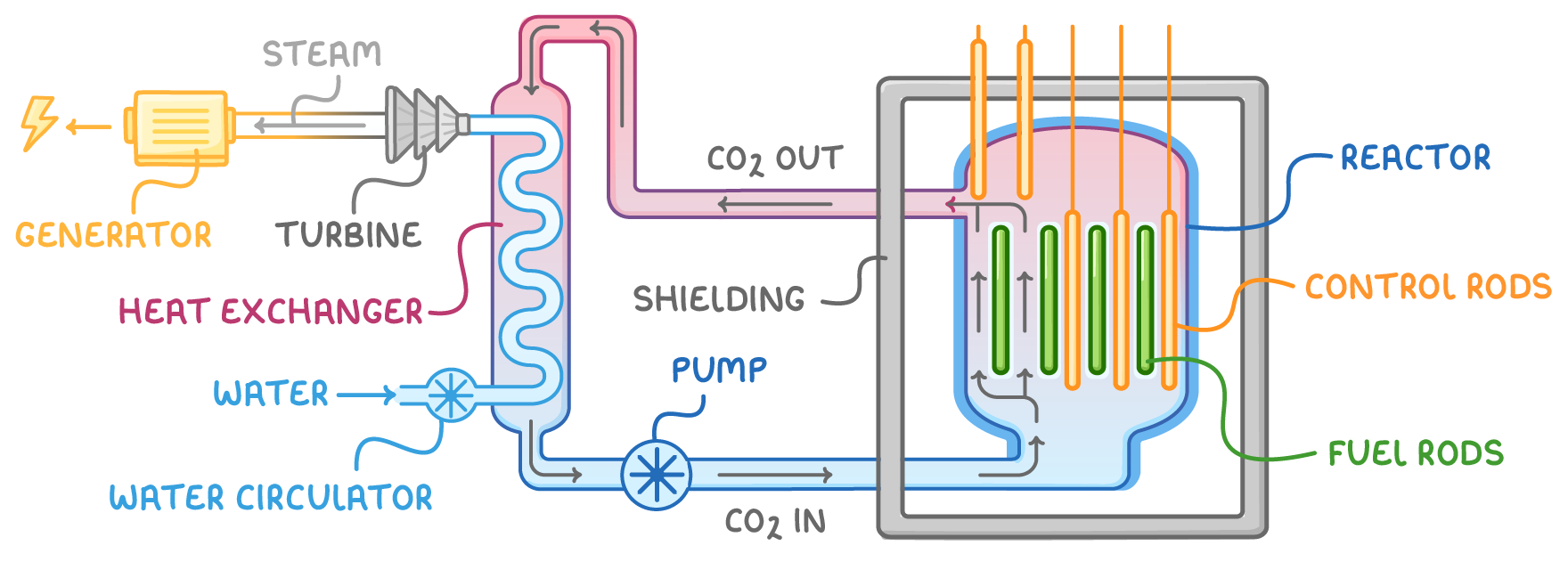
TermDefinition
Nuclear fissionThe splitting of a large, unstable nucleus into two smaller nuclei, releasing energy.
Daughter nucleiThe smaller nuclei formed when a larger nucleus splits during nuclear fission.