7.11 - Energy Resources Introduction
Non-renewable resources will run out one day
- A non-renewable energy resource is one that's used up faster than nature can replace it, so it will one day run out.
- The non-renewables are the fossil fuels and nuclear fuel.
- The three main fossil fuels are coal, oil, and (natural) gas. These formed underground over millions of years and are burnt to release their energy.
- The nuclear fuels are uranium and plutonium.
What they have in common
- Reliable - Power stations keep fuel in stock, so they can generate electricity whenever it's needed. Gas power stations can also respond quickly when demand increases, but nuclear power stations are slow to start up.
- Will run out - They're being used far faster than they form.
- Damage the environment - All non-renewables harm the environment.
Renewable resources will never run out
- A renewable energy resource is one that's replenished as fast as (or faster than) it's used, so it will never run out.
- The renewable energy resources are:
- The Sun (solar)
- Wind
- Water waves
- Hydroelectricity
- Tides
- Biofuels
- Geothermal
How they compare with non-renewables
- They do less harm to the environment than fossil fuels, though most still cause some damage.
- Several are less reliable, because they depend on the weather and can't always produce energy on demand.
- Many produce less energy than a fossil-fuel or nuclear power station, but they have low running costs once built.
Uses - Electricity, transport and heating
- Both renewable and non-renewable resources are mostly used to generate electricity, which can then be sent wherever it's needed.
- The two other major uses are transport and heating.
Transport
- Petrol and diesel vehicles (including most cars) use fuel made from oil.
- Many vehicles run on a mix of biofuel and petrol or diesel, or on pure biofuel.
- Electricity can power vehicles such as trains and cars, generated from either renewable or non-renewable resources.
Heating
- Natural gas is the most widely used fuel for heating UK homes - the gas heats water, which is pumped to radiators.
- Coal can be burnt in a fireplace, and burning biofuel can also heat homes.
- A geothermal heat pump uses geothermal energy to heat buildings.
- Solar water heaters use the Sun to heat water that's pumped to radiators.
- Electricity from any resource can be used for heating (e.g. in electric heaters).
In terms of energy stores
- A fuel holds energy in its chemical energy store.
- Burning it transfers that energy to the internal (thermal) energy store of its surroundings.
- From there it can transfer to other useful stores, such as the kinetic energy store of a moving vehicle.
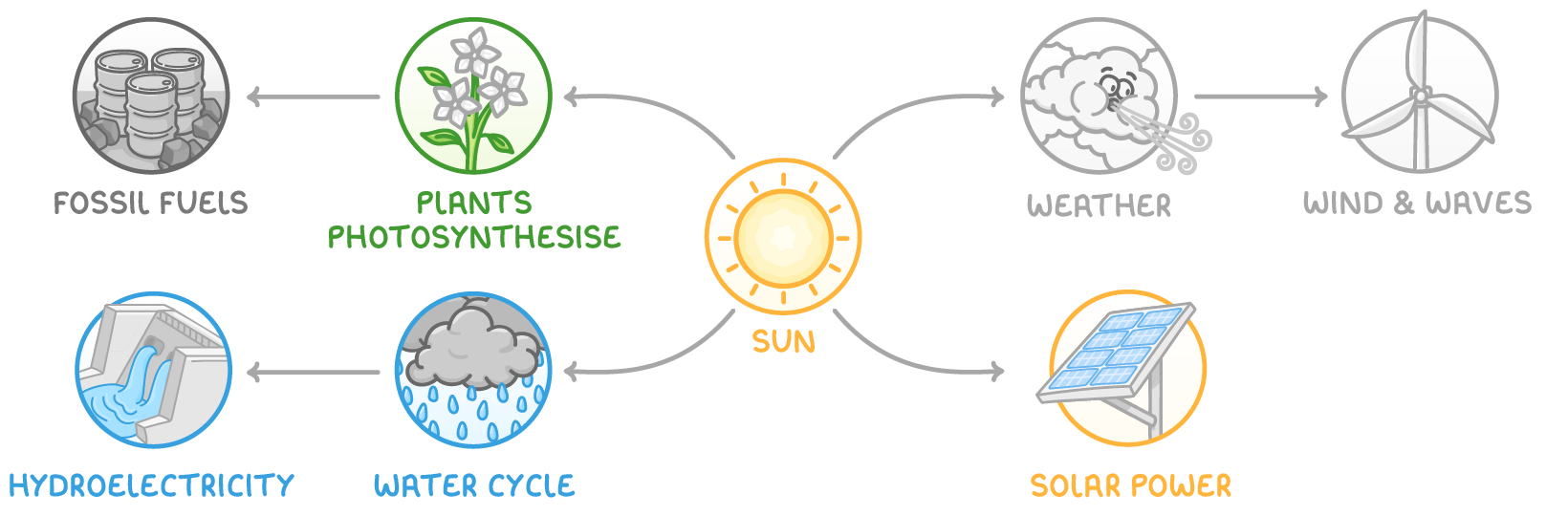
Almost all energy resources rely on the Sun
Almost every energy resource can be traced back to the energy of the Sun:
- Fossil fuels - Formed from the dead remains of plants and animals from millions of years ago. Plants captured the Sun's energy by photosynthesis; animals got energy from eating plants or other animals.
- Hydroelectricity - Depends on the water cycle, driven by the Sun evaporating water that falls as rain to refill reservoirs.
- Wind and waves - Depend on weather systems driven by the Sun heating the Earth unevenly.
- Solar power - Uses the Sun's energy directly.
The exceptions
- Geothermal - Comes from heat inside the Earth.
- Nuclear - Comes from radioactive elements in the Earth's crust.
- Tidal - Comes mainly from the gravitational pull of the Moon.
TermDefinition
Non-renewable energy resourceAn energy resource that is used up faster than it can be replaced, so it will eventually run out.
Renewable energy resourceAn energy resource that is replenished as fast as or faster than it is used.