12.2 - Diffraction
Diffraction is waves spreading at gaps and edges
- Diffraction is the spreading out of waves as they pass through a gap or round the edge of an obstacle.
- All waves diffract, though the effect isn't always easy to see.
- As a wave spreads out, its energy is shared over a larger area, so its amplitude decreases.
Diffraction around objects
- Waves diffract around the edges of objects, leaving a shadow behind the object where the wave is blocked.
- The wider the object is compared with the wavelength, the less the wave diffracts around it.
Observing diffraction in a ripple tank
- Set up the ripple tank so a dipper produces straight wavefronts travelling across the water.
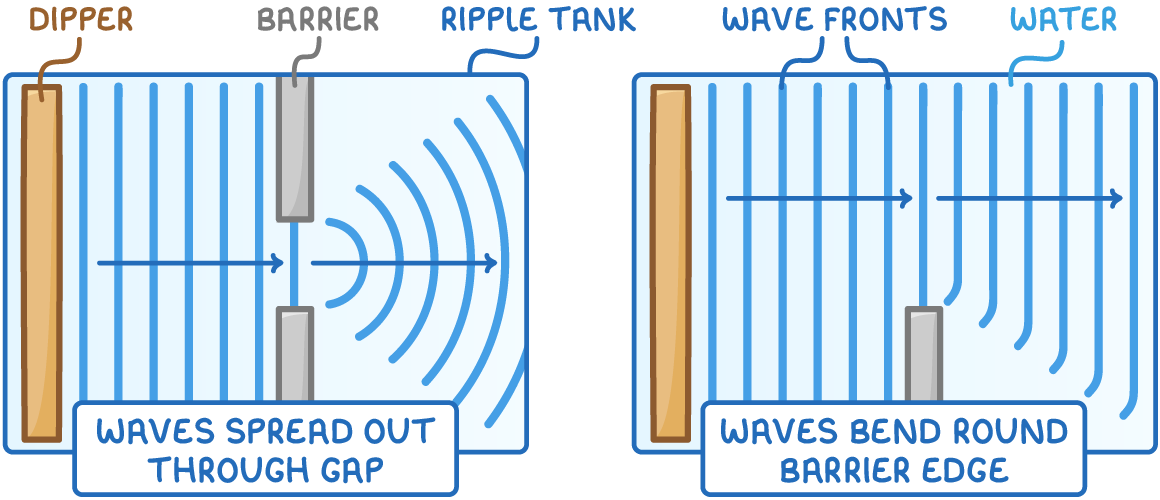
- Place a barrier in the water. As the waves pass the end of the barrier, they bend round its edge into the region behind it.
- Place two barriers with a small gap between them. As the waves pass through the gap, they spread out on the far side.
Wavefront diagrams
- A wavefront is an imaginary line joining points on a wave that are at the same stage of their cycle, such as along a crest.
- Wavefronts are drawn at right angles to the direction the wave is travelling.
- The distance between one wavefront and the next is one wavelength.
- Straight wavefronts arriving at a gap or obstacle curve as they spread out.
TermDefinition
DiffractionThe spreading out of waves as they pass through a gap or round the edge of an obstacle.
WavefrontAn imaginary line joining points on a wave that are at the same stage of their cycle, such as along one crest. It is drawn at right angles to the direction the wave travels.