9.10 - National Grid
The National Grid
- The National Grid is a nationwide system of cables and transformers that connects power stations to consumers.
- It transfers electrical power from power stations to wherever it's needed, such as homes and industry.
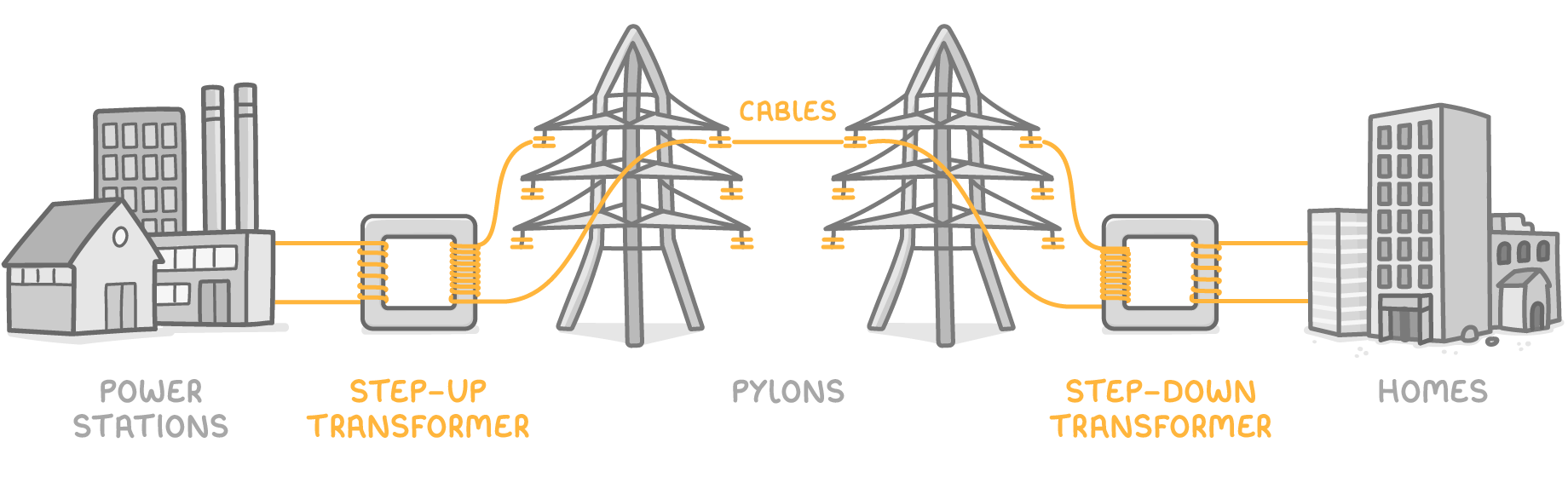
Step-up and step-down transformers raise the potential difference for transmission, then lower it.
Transmitting at high potential difference
- Transmitting electricity at a high current causes the cables to heat up, wasting energy as heat to the surroundings (P = I2R).
- Electrical power is given by P = IV, so for a given power, increasing the potential difference lowers the current.
- Transmitting at a very high potential difference (around 400,000 V) keeps the current low, minimising thermal energy loss and making the grid much more efficient.
Step-up and step-down transformers
- Transformers change the potential difference of the alternating current on the National Grid.
- Step-up transformers increase the potential difference to around 400,000 V as electricity leaves the power station. This decreases the current, reducing energy wasted as heat in the transmission cables.
- Step-down transformers decrease the potential difference to safe, usable levels (230 V in UK homes) before electricity reaches consumers.
TermDefinition
National Grid
Transformer
Step-up transformer
Step-down transformer