10.3 - Life Cycle of Stars
How a star is born
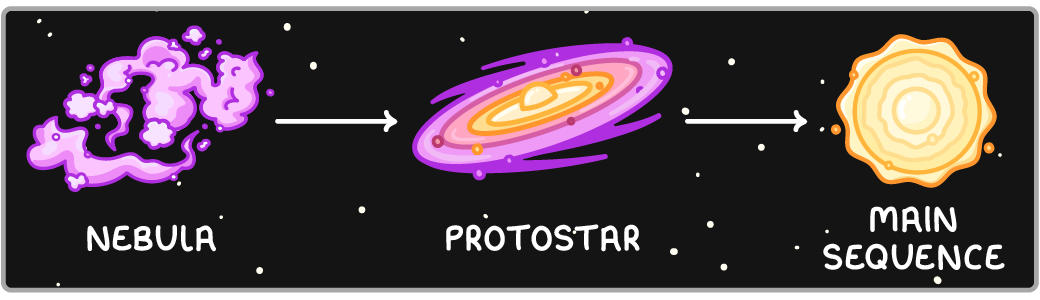
- Stars begin as a vast cloud of dust and gas called a nebula, made mostly of hydrogen.
- Gravity pulls the particles together, so the cloud collapses inwards and becomes denser.
- As particles are squeezed closer and collide more often, the core temperature rises to millions of degrees.
- This hot, dense core is called a protostar.
Nuclear fusion
- When the core gets hot enough, hydrogen nuclei join together in nuclear fusion, forming helium nuclei.
- Fusion releases enormous amounts of energy, which keeps the core hot and makes the star shine. A star in this stable, hydrogen-fusing stage is called a main sequence star.
Using spectra to find a star's composition
- A star emits a continuous spectrum of radiation from its hot interior.
- As this light passes through the cooler gases in the star's atmosphere, those gases absorb their characteristic frequencies.
- The light reaching Earth shows an absorption spectrum, with dark lines matching the elements present in the star's atmosphere.
- By comparing these absorption lines with the known spectra of elements tested in a laboratory, astronomers can identify what elements the star contains.
TermDefinition
Nebula
Protostar
Main sequence