1.2 - Scalar & Vector Quantities
Representing vectors with arrows
- A vector is drawn as an arrow.
- The length of the arrow shows the magnitude of the quantity.
- The direction of the arrow shows the quantity's direction.
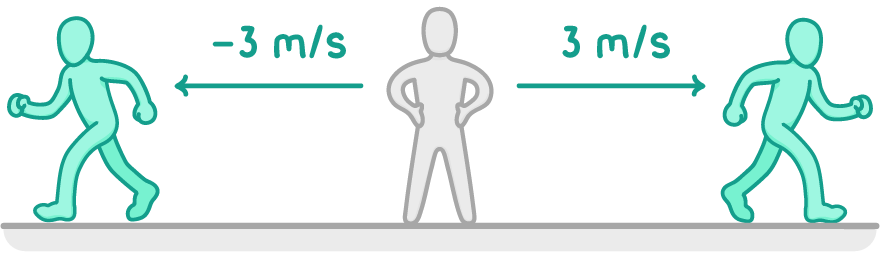
- Two objects travelling at the same speed in opposite directions have arrows of the same length pointing opposite ways: the same speed, but different velocities.
Positive and negative directions
- When a vector acts along a line, one direction is chosen as positive and the opposite direction as negative.
- A velocity of 3 m/s in one direction is -3 m/s in the opposite direction (the speed is 3 m/s in both cases).
- A 10 N force in one direction is -10 N in the opposite direction.
Interaction pairs
Whenever two objects interact, they exert an interaction pair of forces on each other.
The two forces in an interaction pair:
- Are the same type of force
- Are equal in size
- Act in opposite directions
- Act on different objects
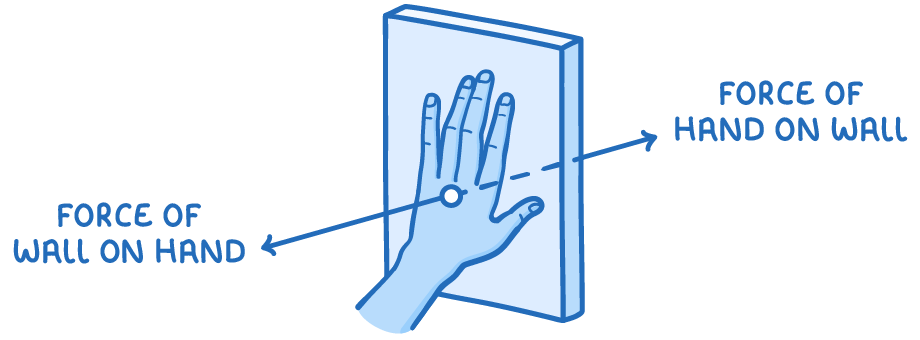
A hand pushing a wall and the wall pushing back are an interaction pair.
Examples of interaction pairs
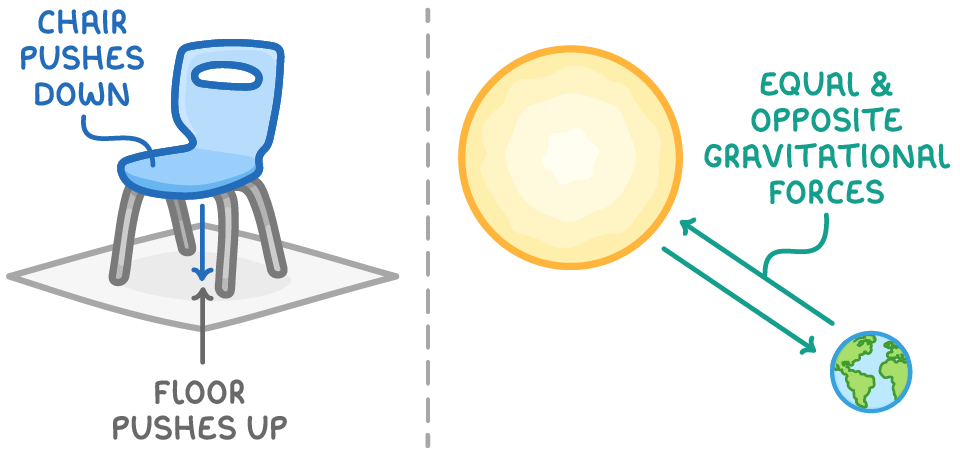
- Contact force - A chair pushes down on the ground, and the ground pushes back up on the chair with an equal and opposite normal contact force.
- Non-contact force - The Sun pulls on the Earth, and the Earth pulls on the Sun with an equal and opposite gravitational force.
Why the forces don't cancel
- Because the two forces act on different objects, they do not cancel each other out.
- Cancelling only happens when forces act on the same object.
TermDefinition
Interaction pair