2.12 - Static Electricity - Charging
Charging an insulator by friction
- Atoms are built from positive protons and negative electrons. Most objects have equal numbers of each, so they have zero net charge - they're neutral.
- When two insulating materials are rubbed together, negatively charged electrons are transferred from one to the other.
- Insulators don't let charge flow, so transferred electrons stay trapped where they land. This trapped charge is static electricity.
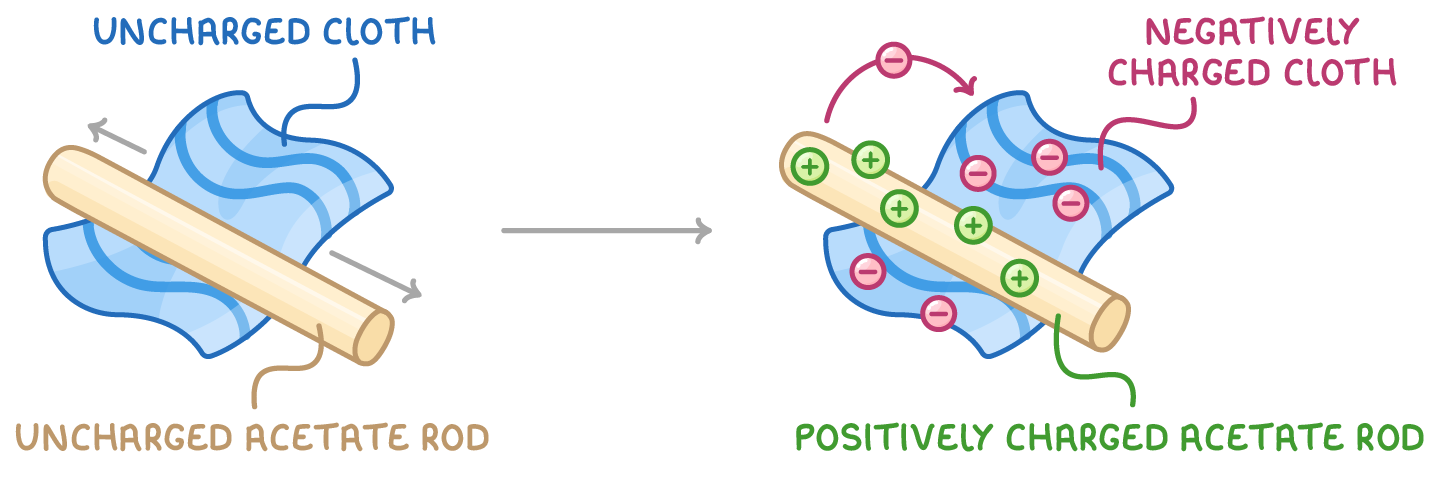
Which material gains which charge
- The material that gains electrons is left with a negative static charge.
- The material that loses electrons is left with an equal positive static charge.
- Only negative electrons move - positive charges don't. An object becomes positively charged only because electrons have moved away from it.
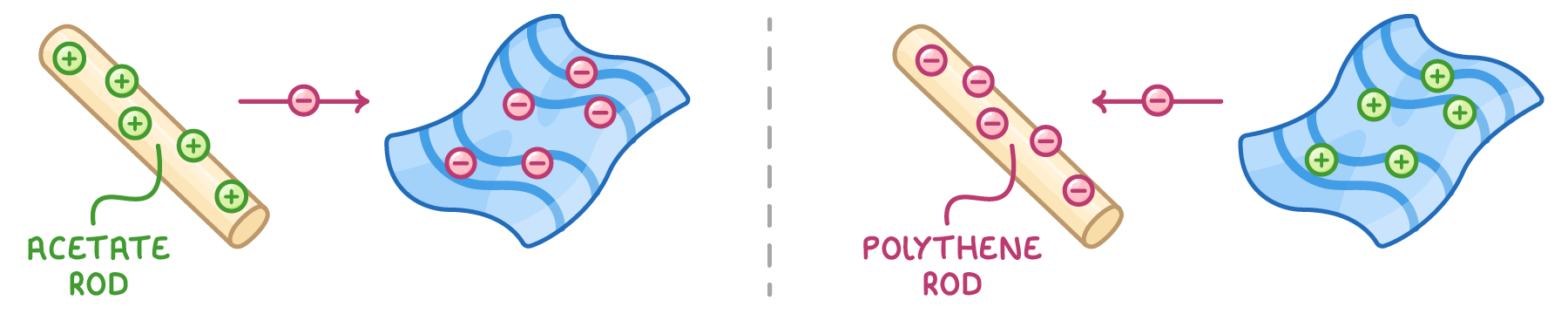
Polythene and acetate rods
- Polythene rod - Rubbing transfers electrons from the cloth onto the rod, leaving the rod negatively charged.
- Acetate rod - Rubbing transfers electrons from the rod onto the cloth, leaving the rod positively charged.
Like charges repel, opposite charges attract
- When two charged objects are brought close, they exert a non-contact electrostatic force on each other.
- Opposite charges (one positive, one negative) attract each other.
- Like charges (both positive or both negative) repel each other.
- The force gets weaker the further apart the objects are.

Testing charge with a suspended rod
- Suspend a rod of known charge from a thread so it can swing freely.
- Bringing up an object with the same charge repels the rod (pushes it away).
- Bringing up an object with the opposite charge attracts the rod (pulls it towards it).
Too much static causes a spark
- As charge builds up on an isolated object, the potential difference between the object and the earth (at 0 V) gets larger.
- If the potential difference becomes large enough, electrons can jump across the gap to the earth or a nearby earthed conductor as a spark.
- Lightning is a very large spark between a charged cloud and the ground.
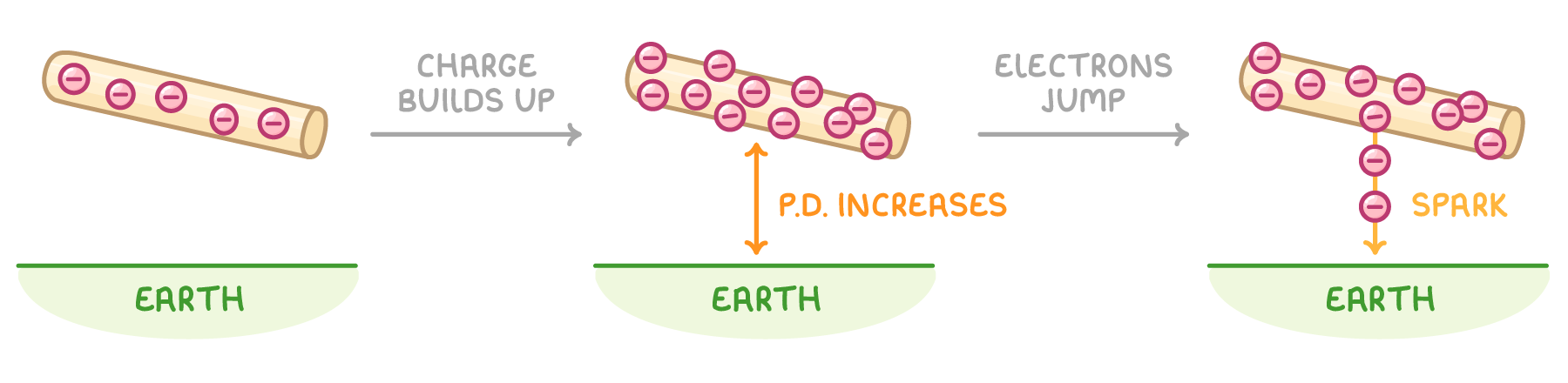
Discharging safely to earth
- A charged conductor can be discharged safely (earthed) by connecting it to earth with a metal strap or wire.
- If negatively charged, electrons flow down the strap to the ground.
- If positively charged, electrons flow up the strap from the ground to neutralise it.
TermDefinition
Static electricity
Electrical insulator