5.2 - Contact & Non-Contact Forces
Forces can be contact or non-contact
- A force is a push or a pull on an object, caused by an interaction with another object.
- Every force has a size and a direction.
Contact forces
A contact force only acts when two objects are touching.
- Friction - Acts between two surfaces that are sliding, or trying to slide, past each other.
- Drag - Acts on an object moving through a fluid. Drag in air is called air resistance.
- Tension - The pull in a stretched rope, cable or string.
- Normal contact force - The push that two touching surfaces exert on each other, at right angles to the surfaces.
- Upthrust - The upward push a fluid exerts on an object placed in it.
Non-contact forces
A non-contact force can act even when the objects are not touching. These forces are caused by fields interacting.
- Gravitational force - The attraction between any two masses (such as the Earth and the Sun).
- Electrostatic force - The attraction or repulsion between charged objects (like charges repel, opposite charges attract).
- Magnetic force - The attraction or repulsion between magnetic objects.
Newton's third law
- Newton's third law states that when two objects interact, the forces they exert on each other are equal in size and opposite in direction.
- These two forces are called an interaction pair.
The two forces in an interaction pair:
- Are the same type of force
- Are equal in size
- Act in opposite directions
- Act on different objects (one force on each, so they don't cancel out)
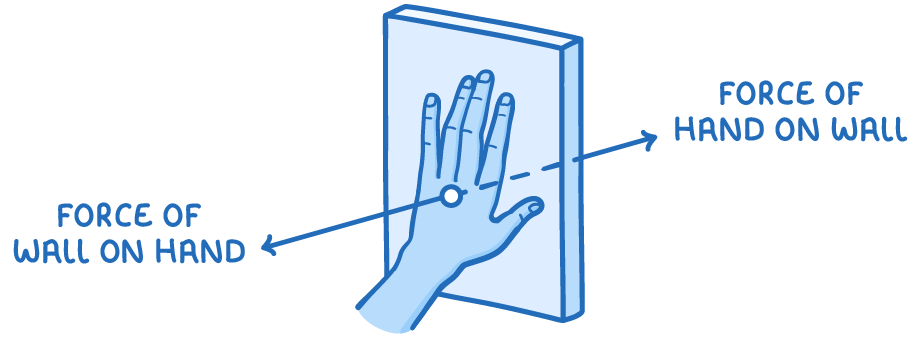
A hand pushing a wall and the wall pushing back are an interaction pair.
Examples
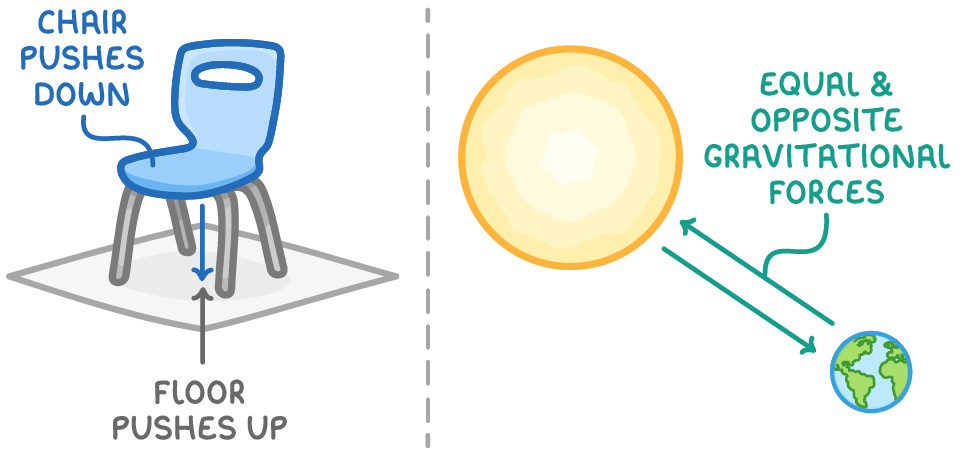
- Chair on the ground - The chair pushes down on the ground, and the ground pushes up on the chair with an equal and opposite force.
- Sun and Earth - The gravitational pull of the Sun on the Earth is equal and opposite to the pull of the Earth on the Sun.
TermDefinition
Force
Contact force
Non-contact force
Newton's third law
Interaction pair