Life Cycle of Stars - exam practice
Life Cycle of Stars
Question 1 of 6
This question is about the evolution of stars.
Stars begin their life cycle as a stellar nebula.
Describe what a nebula is.
State the name of the stage of stellar evolution that our Sun is in.
During this stage, the star is stable.
Explain why the star is stable during this stage of its evolution.
Describe what will happen to our Sun between this stage and the end of its stellar life cycle.
This question is about a star that is much larger than the Sun.
Describe the evolution of star through its stellar life cycle.
State the name of the gas fused during the early stages of the stellar life cycle.
This question is about the life cycle of our Sun.
Fill in the blanks to name the stages in the evolution of our Sun.
Explain why the Sun is described as stable during the main sequence phase.
Stars undergo nuclear fusion during the main sequence phase of their life cycle.
Describe the process of nuclear fusion in stars.
This question is about the life cycle of a star much more massive than our Sun.
How will the star release energy during the main sequence stage of its life cycle?
What will this star become after it leaves the main sequence?
What could this star end its stellar life cycle as?
What is the name of the fuel in stars that undergoes nucleus fusion to release huge amounts of energy?
This question is about the life cycle of a star with a similar mass to our Sun.
Describe the evolution of a star with a mass similar to our Sun.
This question is about the life cycle of a star with a similar mass to our Sun.
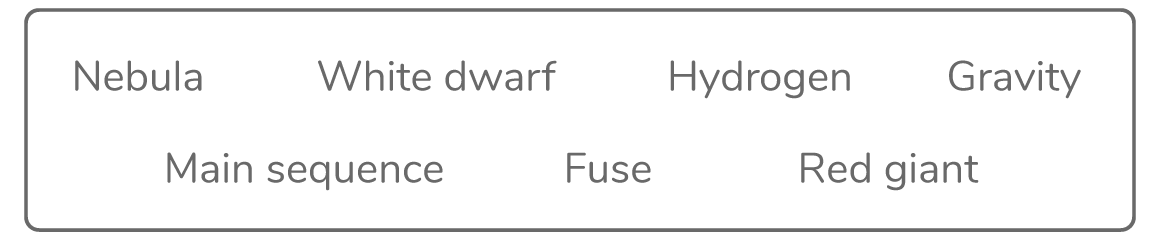
Use the words from the box above to complete the sentences below.
A star starts its stellar life cycle as a cloud of dust and gas known as a .
The force of pulls the cloud of gas together.
The temperature of the cloud begins to increase until begins to to form helium.
At this point the star is known as a star.
When the star runs out of hydrogen, it will expand and cool. The star is now known as a .
The outer layers will then dissipate, leaving a hot dense core known as a .