Visible Light - exam practice
Visible Light
Question 1 of 3
A student is investigating the properties of light.
They shine white light through a red filter.
Explain what the student would observe on the screen.
A green filter is then placed behind the red filter.
Describe what the student would observe on the screen, and explain why.
The diagram below shows white light hitting three different coloured opaque objects.
- Yellow is comprised of both red and green wavelengths of light.
- Cyan is comprised of both green and blue wavelengths of light.
Complete the diagram below to show which wavelengths of light are absorbed and reflected by the red, yellow and cyan objects.
A group of students are learning about the properties of coloured light.
Students observe a coloured object through different coloured filters.
The table below shows the filter that each student is holding.
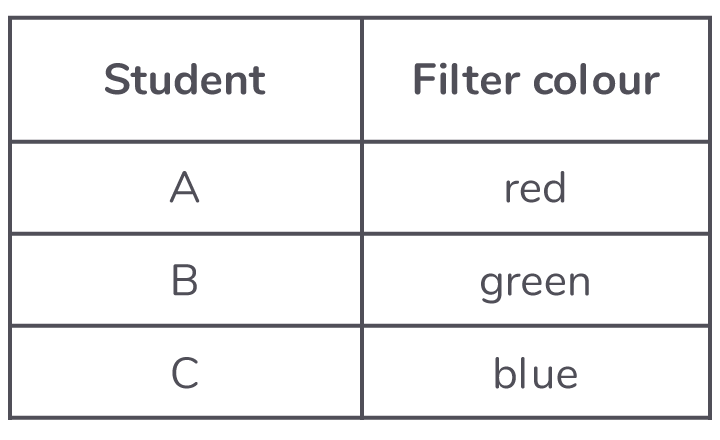
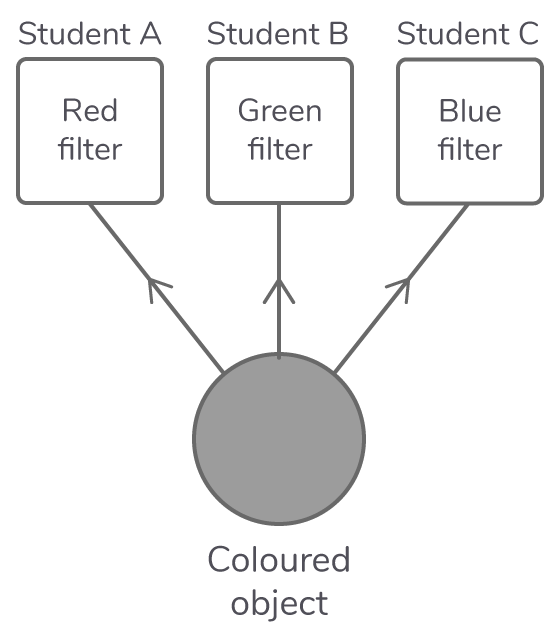
Each student observes the object and recalls what they saw.:
- Student A states the object at the centre looked red.
- Student B states the object at the centre looked black.
- Student C states the object at the centre looked blue.
The coloured object has a magenta colour.
Explain which colours of light make up the colour magenta. Use the student's observations in your answer.
Each student places another filter behind their first filter. This new filter is a different colour.
Describe and explain what each student would observe.
This question is about the use of light to provide special effects in a school play.
The special effects team use translucent, transparent and opaque objects to provide different lighting conditions on stage.
Match the description to the correct term.
In a school play an actor is wearing green trousers.
They are illuminated with red light.
Explain why the green trousers no longer appear green.
Another actor is wearing yellow clothing. Yellow is comprised of both red and green wavelengths of light.
Explain how the yellow clothing will appear to the audience when illuminated with green light.