Static Electricity - exam practice
Static Electricity
Question 1 of 9
This question is about static electricity.
A student rubs a plastic rod with a cloth and it becomes negatively charged.
Explain why the friction between the rod and cloth causes the rod to become negatively charged.
When the charged rod is placed near a thin stream of water, it causes the stream of water to deflect.
Explain why.
The student accidentally puts the rod in the stream of water.
Explain why the stream of water does not deflect as far as before.
This question is about static electricity.
A student rubs the balloon on their jumper for 1 minute. The balloon gains a negative charge.
Explain why rubbing the balloon on the student's jumper gives it a negative charge.
The student charges a second balloon in the same way.
Both balloons are suspended from threads and brought close together.
Explain what the student would observe.
One of the charged balloons is now placed carefully on a vertical wall.
Explain why the balloon does not fall to the ground.
This question is about the hazards of static electricity in the aviation industry.
As aircraft fly through the air, they become statically charged.
Explain how an aircraft could become charged during flight.
Describe why it is dangerous to refuel a statically charged aircraft.
Before aircraft are refuelled, they are connected to Earth by an electrical cable.
Explain why this makes refuelling safe.
As an aircraft flies, it gains roughly 72 mC of charge.
The charge of 1 electron is 1.6x10⁻¹⁹ C.
Calculate how many electrons were transferred during this flight.
A plastic comb becomes negatively charged when rubbed with a cloth.
The charged comb is brought close to small pieces of paper.
Explain why the pieces of paper jump up and stick to the comb.
The student rubs a metal rod with a cloth and brings it close to the pieces of paper.
Explain what happens to the pieces of paper.
A teacher is demonstrating the idea of static electricity using a Van de Graaff generator.
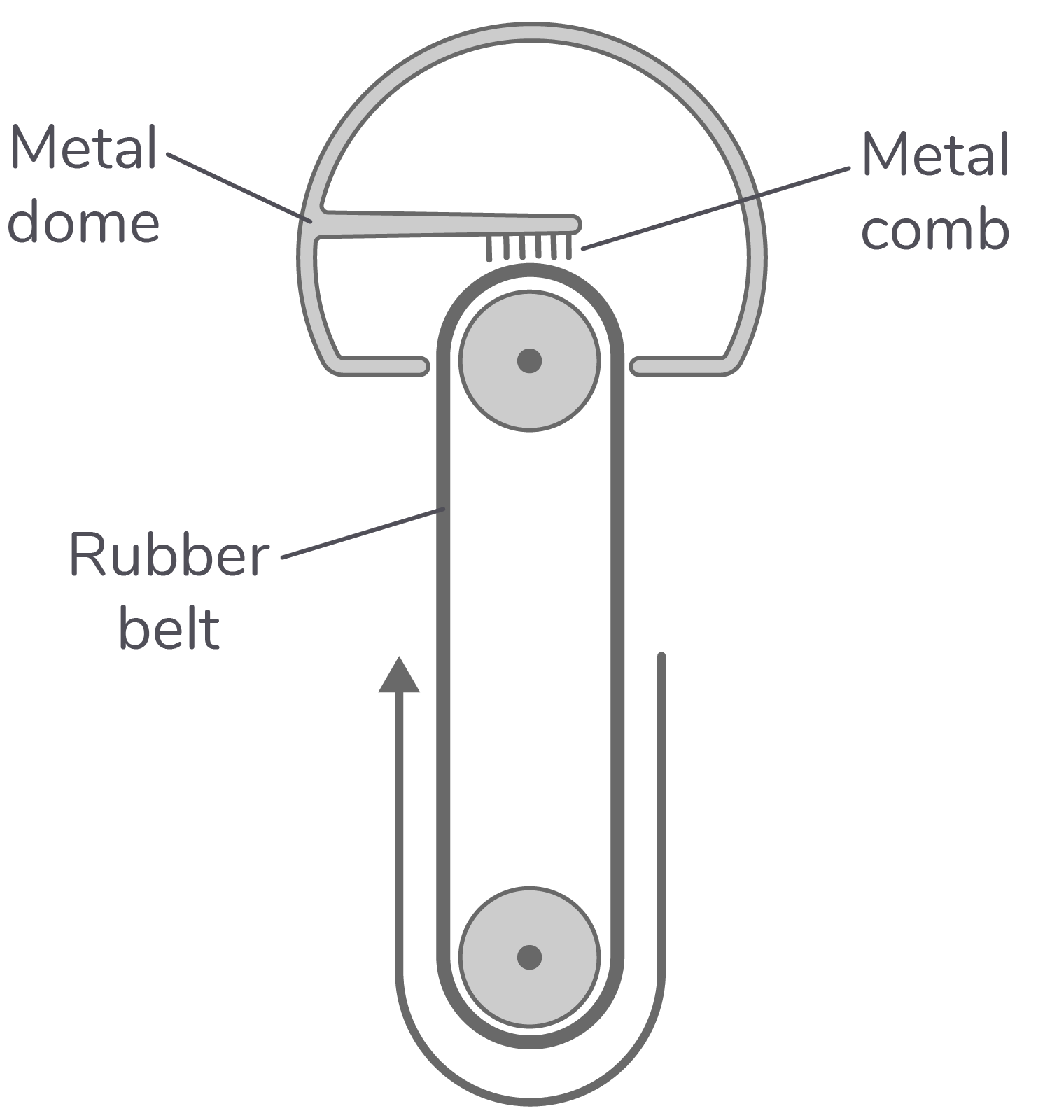
Explain how the metal dome of the Van de Graaff becomes positively charged.
Before the teacher turned on the Van de Graaff generator, he placed a pile of metal cake cases on top. The cake cases also became positively charged.
Explain the cake cases need to be made from metal.
The teacher turns on the Van de Graaff generator.
Explain why the metal cake cases begin to fly off after a short period.
A student places two metal plates a short distance apart.
A large potential difference is applied across the plates.
An insulated ball covered in metallic paint is suspended from a light thread and suspended between the plates.
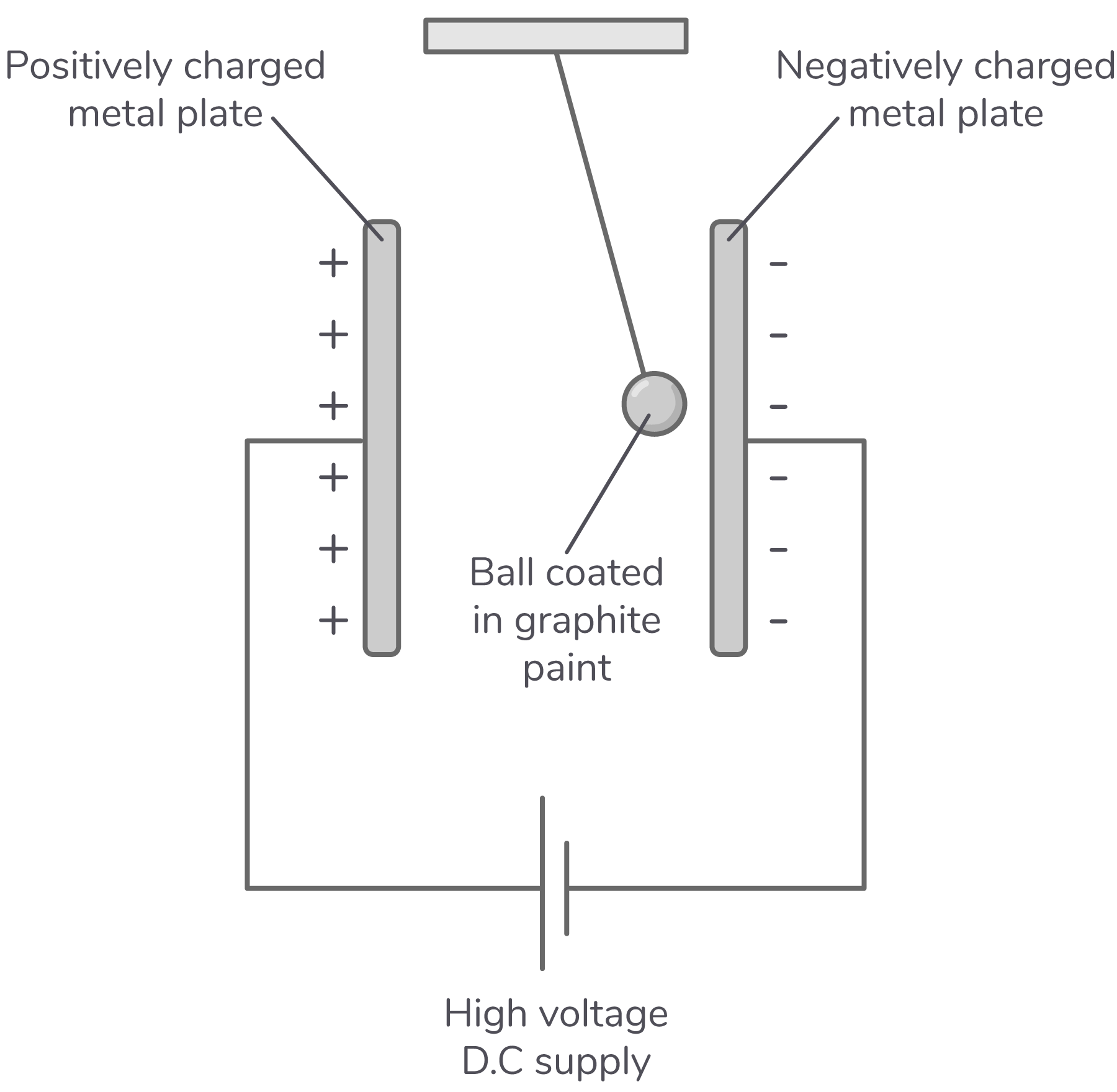
When the ball touches the negatively charged metal plate it becomes charged.
Explain why.
The ball now swings rapidly across towards the positively charged plate.
Explain why.
The frequency of the shuttling ball between the plates is 4.0 Hz.
Explain what is meant by a frequency of 4.0 Hz.
The charge transferred between the plates per second is 5 x 10⁻⁹ C.
The charge on an individual electron is 1.6 x 10⁻¹⁹ C.
Calculate the number of electrons transferred between the plates.
This question is about electrostatic paint spraying.
The nozzle of the paint gun is negatively charged and the car being painted is positively charged.
Explain why the paint forms a fine mist as it leaves the spray gun.
Explain why the car needs to be positively charged.
As the paint leaves the spray gun it gains a negative charge because
This question is about static electricity.
Complete the sentence.
When a rod is rubbed with a cloth it gains a negative charge because
What is the unit for charge?
Which of these is a property of a metal?
A child is playing on a slide at the park.
After going down the slide, the child's hair is standing on end.

As the child goes down the slide they become negatively charged.
Explain why the child becomes charged.
Explain why the child's hair is standing on end.
The child gets off the slide and touches the metal frame of the slide.
Explain what happens to the child's hair.