Mains Electricity - exam practice
Mains Electricity
Question 1 of 9
This question is about mains electricity in the UK.
The UK mains supply is an A.C. supply.
Describe what an A.C. supply is.
In UK plugs, the live wire is
The neutral wire is
The Earth wire is
Which wire should the fuse be connected to?
A kettle is rated a 2 kW, 230 V.
Calculate the operating current. Give your answer to 1 decimal place.
A student has 3 A, 10 A and 13 A fuses.
The student fits a 3 A fuse to the kettle and turns it on.
Explain why the kettle won't work with a 3 A fuse fitted.
State which fuse the student should have fitted to the kettle and explain why.
The metal case of the kettle is connected to the earth wire.
Explain why metal appliances need to be earthed.
An electric oven has a heating element and a fan.
The table below shows the operating conditions for the heating element and the fan.
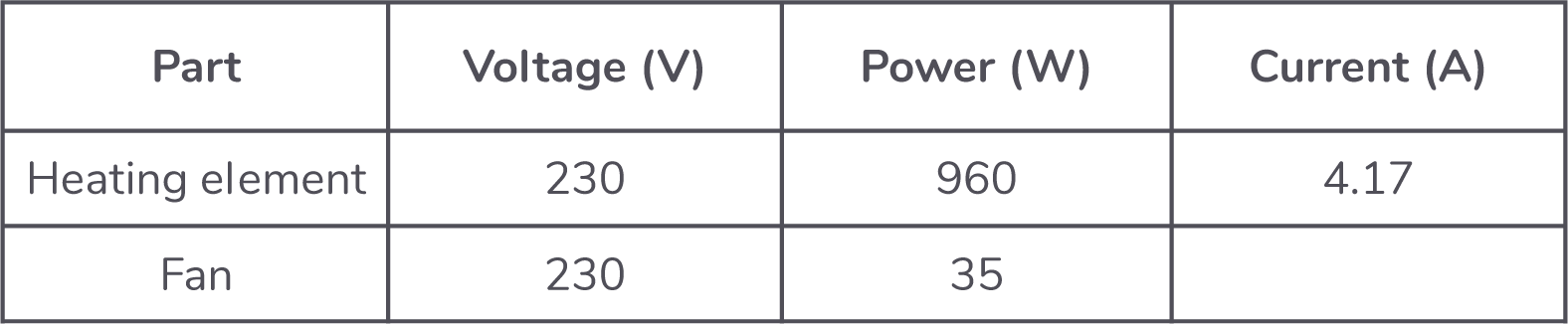
Calculate the current flowing through the fan.
The student needs to replace the fuse in the oven. She has 3A, 5A and 13A fuses.
Calculate the total current requirement and suggest which fuse the student should use.
A fault occurs in the oven and the live wire touches the metal case of the oven.
Explain how the safety features of the plug work to prevent the user getting a dangerous electric shock.
A fridge has a power rating of 800 W.
Calculate the energy required to run the fridge for 1 day.
The fridge operates of the UK mains supply.
State the operating voltage and frequency of the UK mains supply.
Calculate the operating current of the fridge.
Which fuse should be fitted to the fridge?
A homeowner needs to replace the heating element in their electric oven.
The table below summarises the details of 3 different heating elements.
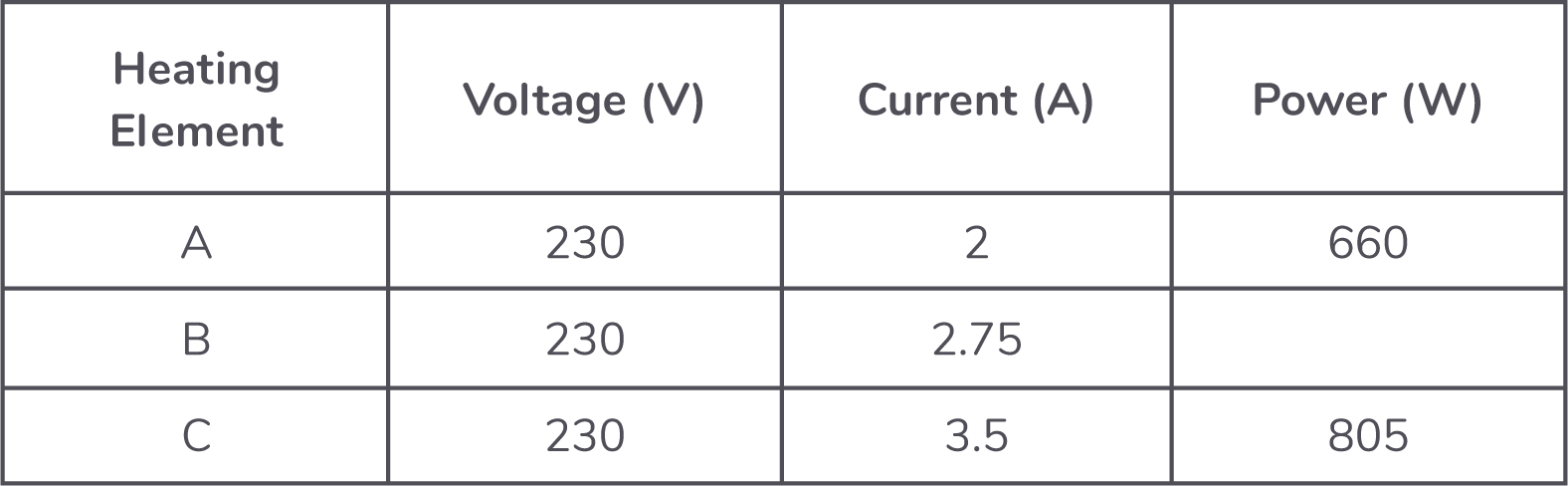
Calculate the power of heating element B.
Give your answer to 3 significant figures.
The oven is fitted with a 3 A fuse. Which heating element should the homeowner avoid using?
The oven is turned on for 40 minutes.
Calculate how much extra energy heating element B uses compared to heating element A.
Both heating elements A and B are capable of heating the oven.
Explain which heating element the homeowner should install.
This question is about the wiring of UK mains electricity plugs.
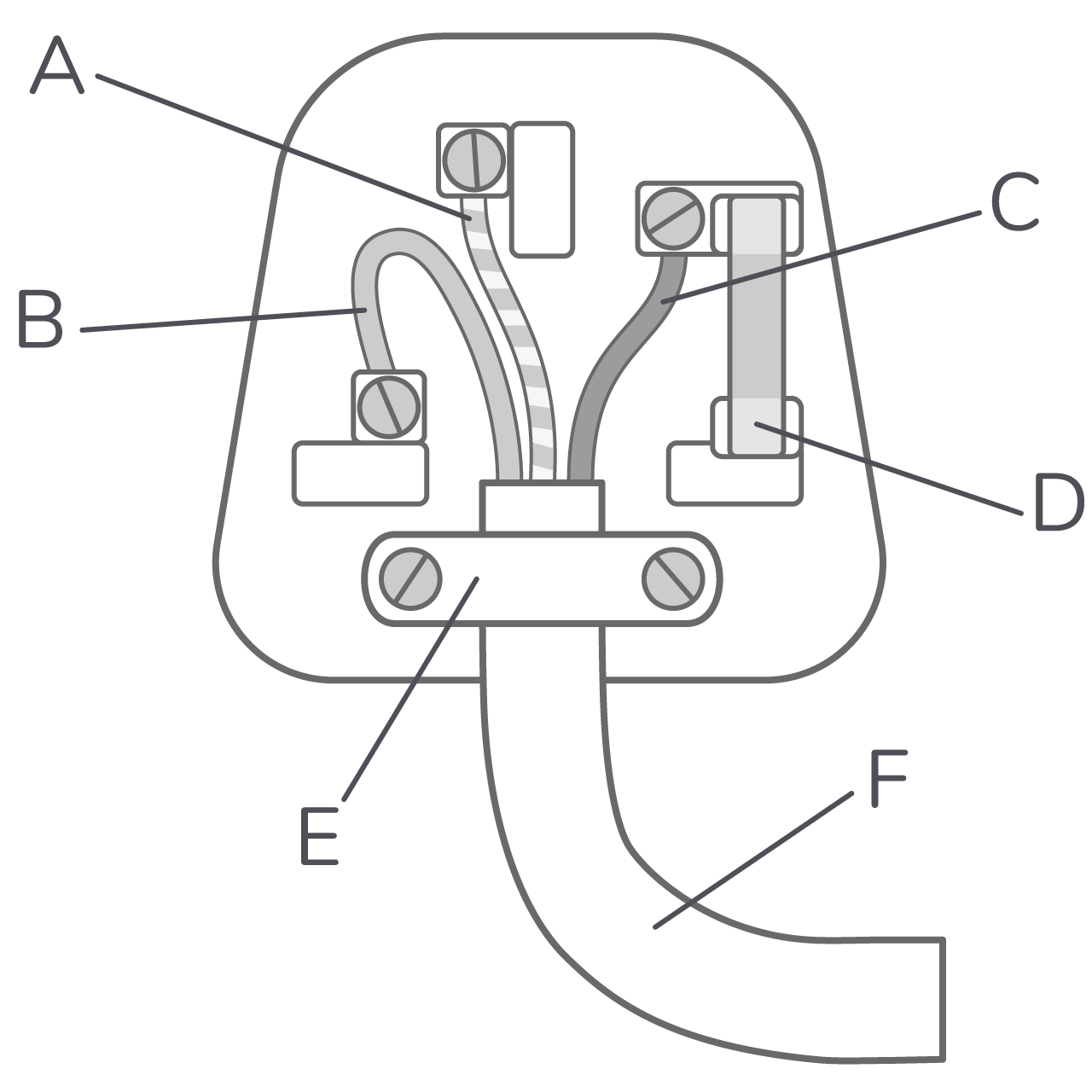
State the name and purpose of part E.
State the name of the three wires A, B and C.
Describe the purpose of the three wires A, B and C.
A fuse is a safety device used to prevent dangerously high currents flowing.
Explain how a fuse works to keep electrical circuits safe.
Circuit breakers are another common safety device used to cut off circuits in the event of an electrical fault.
Describe the advantages and disadvantages of using circuit breakers and fuses.
This question is about an electric hairdryer.
The hairdryer contains a heating element, an electric fan and a plastic case.
The hairdryer runs off the UK mains supply.
State the voltage and frequency of the UK mains supply.
The hairdryer is not earthed.
Explain why the hairdryer is still safe to use despite not being earthed.
The power of the hairdryer is 1.2 kW.
Explain what is meant by 1.2 kW.
Calculate the energy transferred in 10 minutes of operation.
This question is about a coffee machine.

The heating element of the coffee machine is rated at 1,500 W, 230 V.
Calculate the resistance of the heating element.
Give your answer to 1 decimal place.
Calculate the current flowing through the heating element.
Give your answer to 2 decimal places.
A fault develops in the coffee machine and the live wire touches the metal casing.
Explain how earthing and a fuse prevent the user from getting an electric shock.
The coffee machine has a total current requirement of 9 A. The manufacturer has 3 A, 10 A and 13 A fuses.
Explain why the manufacturer fits a 10 A fuse to the coffee machine.
10 W is equivalent to
A device is rated at 450 W, 230 V.
Which fuse should be fitted to the device?
Double insulation is needed on devices which
The UK Mains supply is