Stopping Distance - exam practice
Stopping Distance
Question 1 of 9
This question is about the motion of vehicles.
Which of the following statements describes thinking distance?
Which of the following actions increases the stopping distance of a vehicle?
Which of the following factors affects thinking distance?
Which of these factors affects both thinking distance and braking distance?
A woman is driving along the road at 13 m/s.
She notices a hazard on the road and uses the brakes to stop the car.
Define thinking distance.
Define braking distance.
The equation for stopping distance is:
It takes the woman 0.24 s to react and apply the brakes.
Calculate the thinking distance travelled.
The woman comes to rest 3.5 s after she applies the brakes.
Calculate the deceleration of the car during the braking period.
Sketch the woman's journey from when she sees the obstacle to when the car comes to rest.
The graph below shows the journey of a motorcycle along a country road.
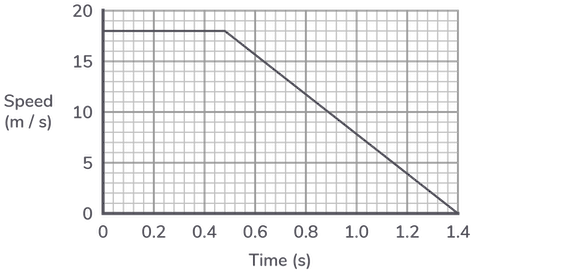
The rider sees an obstacle in the road and applies the brakes.
State the reaction time of the rider.
Calculate the thinking distance of the rider.
Calculate the deceleration of the motorcycle during the braking section.
Describe what would happen to the thinking distance and braking distance of the motorcycle if the roads were icy.
This question is about stopping distance.
State the equation linking stopping distance, braking distance, and thinking distance.
Complete the table below.
Tick one correct box per row.
A car is driving along the road at 15 m/s.
The driver sees a red light ahead and applies the brakes, coming to a rest.
The driver has a reaction time of 0.5 s.
Calculate the thinking distance.
The braking distance of the car was 19.5 m.
Calculate the time taken for the car to come to rest.
A lorry driver sees a hazard on the motorway.
The driver uses the brakes to stop the lorry.
Explain the factors that affect the thinking distance and braking distance of the lorry.
A cyclist is travelling along a road at 8 m/s and needs to stop.
State the equation linking stopping distance, thinking distance, and braking distance.
State two factors that would increase the brakingdistance of the bike.
The braking force on the cyclist and bike was 2,500 N.
The combined mass of the cyclist and bike is 85 kg.
Calculate the deceleration of the cyclist.
Calculate the braking distance of the cyclist.
The graph below shows how thinking distance and braking distance vary with speed.
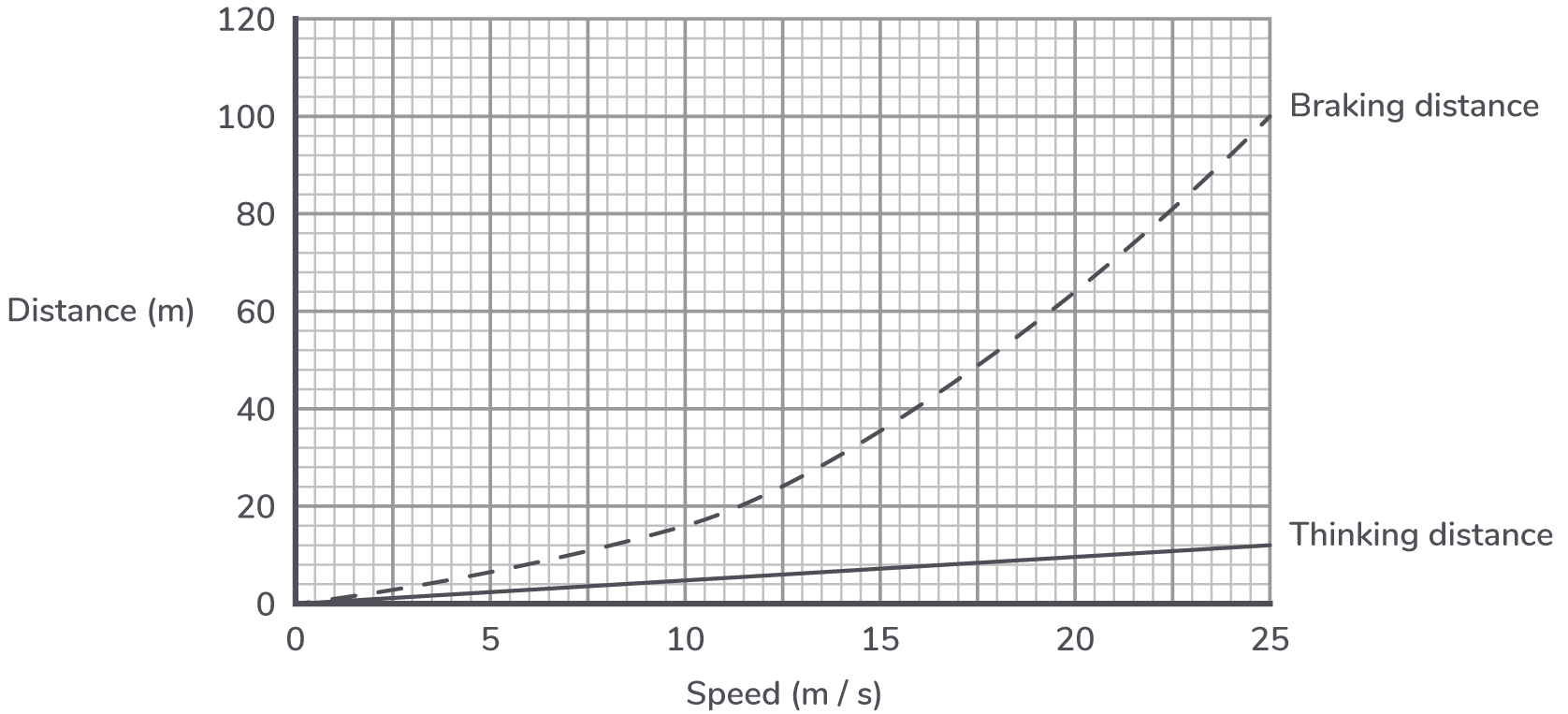
Describe the patterns shown by the graph.
State the thinking distance and braking distance at 20 m/s.
Calculate the reaction time of the driver.
Calculate the kinetic energy of the car and passengers at 20 m/s.
The combined mass of the car and passengers is 900 kg.
State the work done on the car bringing it to rest.
Calculate the mean braking force on the car as it is braking from 20 m/s.
Give your answer to 2 significant figures.
A car is travelling along a road at 18 m/s.
The driver sees a hazard and uses the brakes to stop the car.
The driver travels a distance of 50 m while the brakes are applied.
Calculate the deceleration of the car while the brakes are applied.
The mass of the car and passengers is 1,100 kg.
Calculate the mean braking force acting on the car.
Calculate the work done on the car and passengers while the brakes are applied.
The driver of the car is tired.
Describe the effect of being tired on the braking distance of the car.
A car is accelerating along a straight road.
Draw and label two arrows on the car below to show the forces acting on the car.
The thrust force is 1,500 N and the drag force is 350 N.
Calculate the resultant force acting on the car.
The combined mass of the car and passengers is 1,250 kg.
Calculate the acceleration of the car.
The car started at rest.
Calculate the speed of the car after 14 s.
The driver now maintains this speed for 10 s.
After 10 s, the driver sees a red light ahead and uses the brakes to stop the car.
The car comes to rest in 3 s.
Calculate the braking distance of the car.
State two factors that would increase the braking distance of the car.