Energy Stores & Systems - exam practice
Energy Stores & Systems
Question 1 of 8
This question is about a bouncy ball, held at rest, 1.3m above the ground.
State the equation linking gravitational potential energy, mass, gravitational field strength, and height.
The mass of the ball is 40 g and is held 1.3 m above the ground.
Calculate the gravitational potential energy of the ball.
The gravitational field strength on Earth is 9.8 N/kg.
The ball is released and falls to the ground. State the kinetic energy of the ball just before it hits the ground.
J
Calculate the speed of the ball just before it hits the ground.
Give your answer to 2 decimal places in m/s.
Describe how the student could measure the final speed of the ball, just before it hits the ground.
Using ideas about forces, explain why the measured value of speed is different to the calculated value.
This question is about the energy transfers that take place when a skydiver jumps out of a plane.
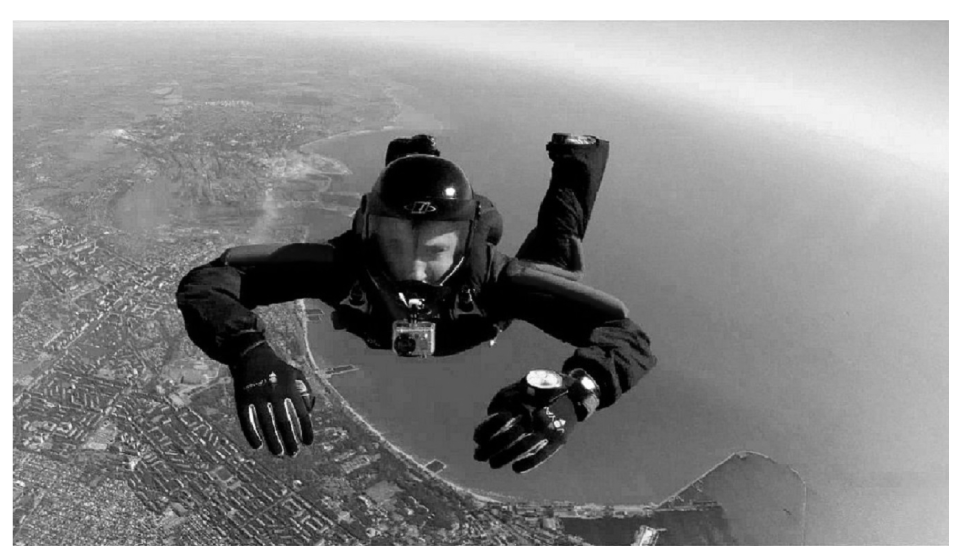
The parachutist jumps out of a plane which is flying horizontally at a height of 1.8 km above the ground.
The parachutist and all the equipment has a total mass of 70 kg.
Calculate the gravitational potential energy of the parachutist at this height above the ground.
The gravitational field strength on Earth is 9.8 N/kg.
Calculate the speed of the parachutist after they have fallen 60 m.
When the parachutist is closer to the ground, they open their parachute.
Explain how the speed of the parachutist changes between opening the parachute and moments before hitting the ground.
Use ideas about forces in your answer.
State the law of conservation of energy.
As the parachutist falls, both the gravitational potential energy store and the kinetic store of the parachutist decrease. Energy is still conserved.
Explain how energy is still conserved.
This question is about the energy conversions that take place on a roller coaster.
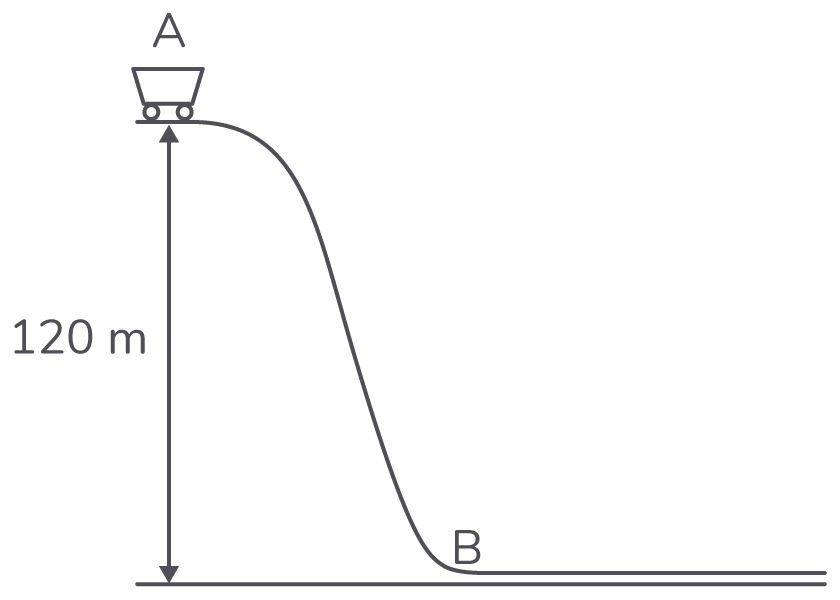
A rollercoaster cart is stationary at a height of 120 m before descending towards the ground.
The mass of the rollercoaster cart and passengers is 800 kg.
Calculate the gravitational potential energy of the passengers at the highest point.
The gravitational field strength on Earth is 9.8 N/kg.
State the kinetic energy of the roller coaster at point B.
The rollercoaster comes to rest 80 m after passing point B.
Calculate the average frictional force acting on the rollercoaster to bring it to rest.
The gravitational potential energy and the kinetic energy of the roller coaster are both now zero.
Explain with reference to the conservation of energy how this is possible.
This question is about an archer.
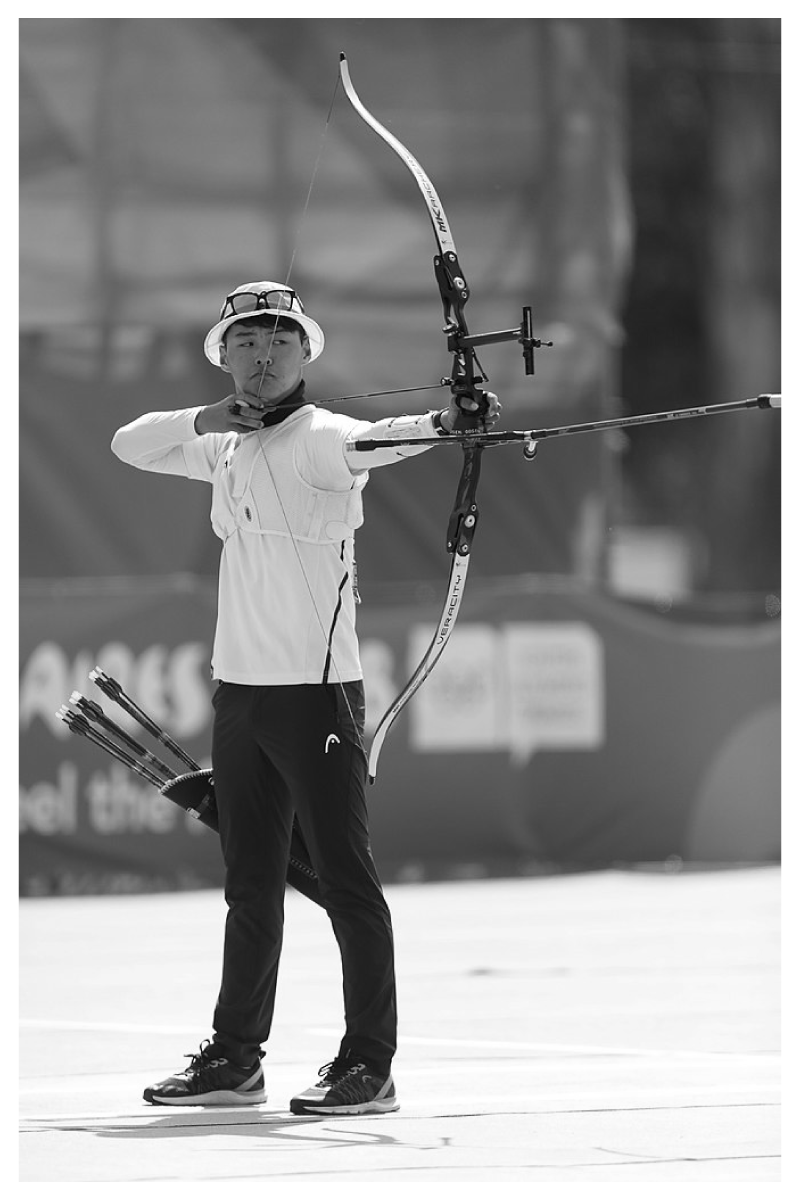
The archer pulls the string of the bow back.
State the name of the energy store that increases as the string is pulled back.
The bow stores 170 J of energy.
When released, 80 % of the energy is transferred to the kinetic store of the 300 g arrow.
Calculate the speed of the arrow as it leaves the bow.
This question is about energy stores and transfers.
A cyclist is cycling along a horizontal road at constant speed.
State the name of the energy store of the cyclist that is decreasing as they cycle.
The mass of the bicycle and the cyclist is 95 kg.
The cyclist is travelling at 11 m/s.
Calculate the kinetic energy of the cyclist and bicycle.
The cyclist sees an obstacle in the road and needs to stop quickly.
Describe the energy transfer that takes place between the brakes being applied and the bicycle coming to rest.
This question is about energy stores and transfers.
Match the description to the energy store that is changing.
A student stretches an elastic band before releasing it to fire across the room.
Which method of energy transfer takes place as the elastic band is being stretched?
The energy stored in the elastic band is transferred to the kinetic store of the elastic band when the student releases it.
State the law of conservation of energy.
The elastic band has a spring constant of 6 N/m and is stretched by 15 cm.
Calculate the energy stored in the elastic band.
The mass of the elastic band is 2 g.
Calculate the speed of the elastic band when it is released.
This question is about the energy transfers for a rollercoaster.
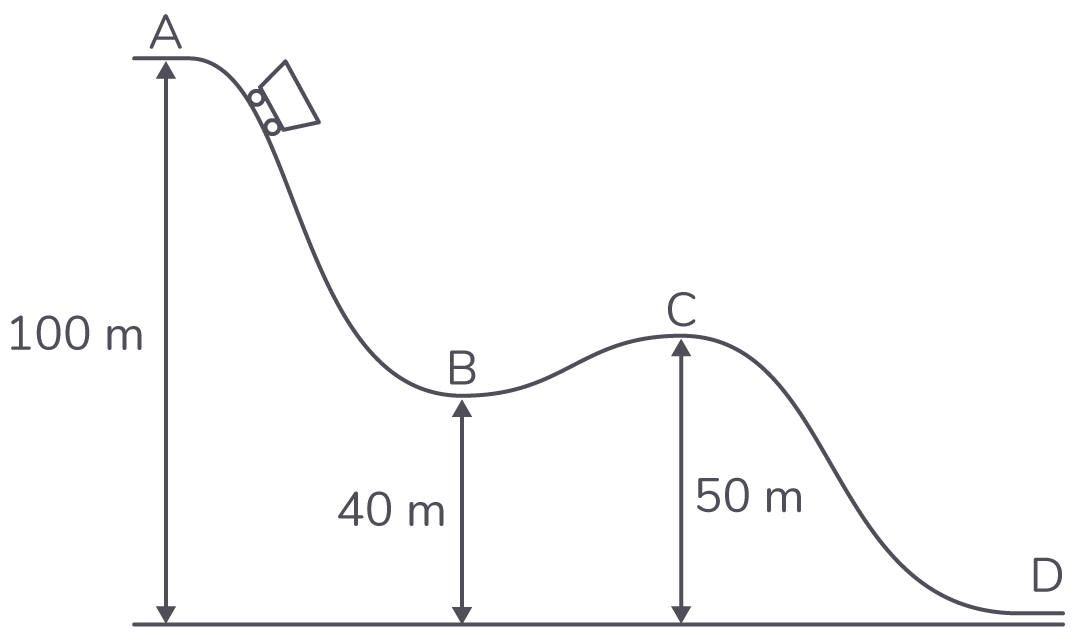
The rollercoaster is stationary at A.
The roller coaster cart has a mass of 800 kg.
Calculate the gravitational potential energy of the cart at A. Give your answer in J.
The gravitational field strength on Earth is 10 m/s2.
Describe the energy transfer that takes place between A and B.
You may assume no energy is lost to the surroundings.
Calculate the kinetic energy of the roller coaster at B.
Calculate the speed of the roller coaster at B. Give your answer in m/s to 1 decimal place.
Explain why the roller coaster is travelling at a lower speed than that calculated in part d).
This question is about energy transfers and transfer mechanisms.
Which of the following is the useful energy store for a car?
Cars are not 100% efficient.
Which of the following is the wasted energy store for a car?
A car has 50 MJ of kinetic energy.
Which of the following is not the amount of work that needs to be done to bring the car to rest?
Burning some fuel releases 15 kJ of thermal energy. The car gains 9 kJ of useful energy from the fuel burned.
Calculate the efficiency of the car.