Power, Work Done & Efficiency - exam practice
Power, Work Done & Efficiency
Question 1 of 7
A shop worker is stacking the shelves in a supermarket.
They lift tins of soup from pallets on the ground and place them on a shelf 1.2 m off the ground.
Each tin has a mass of 350 g.
Calculate the weight of each tin of soup.
Gravitational field strength = 9.8 N/kg
State the equation linking work done, force, and distance moved.
Calculate the work done when a pack of 12 tins are lifted onto the shelf.
It takes 20 s to put all 12 tins on the shelf.
Calculate the power of the shop worker lifting the tins.
Give your answer to 2 decimal places.
A student is using resistance bands to exercise.
The student stretches the band with spring constant 150 N/m.
At full extension the band stored 50 J.
Calculate the extension of the band at full extension.
Give your answer in m, to 2 decimal places.
The student stretches the band to full extension 15 times in 40 s.
Calculate the student's power output while stretching the resistance band.
Give your answer to 2 decimal places.
A student is investigating the force needed to push a box up a ramp.
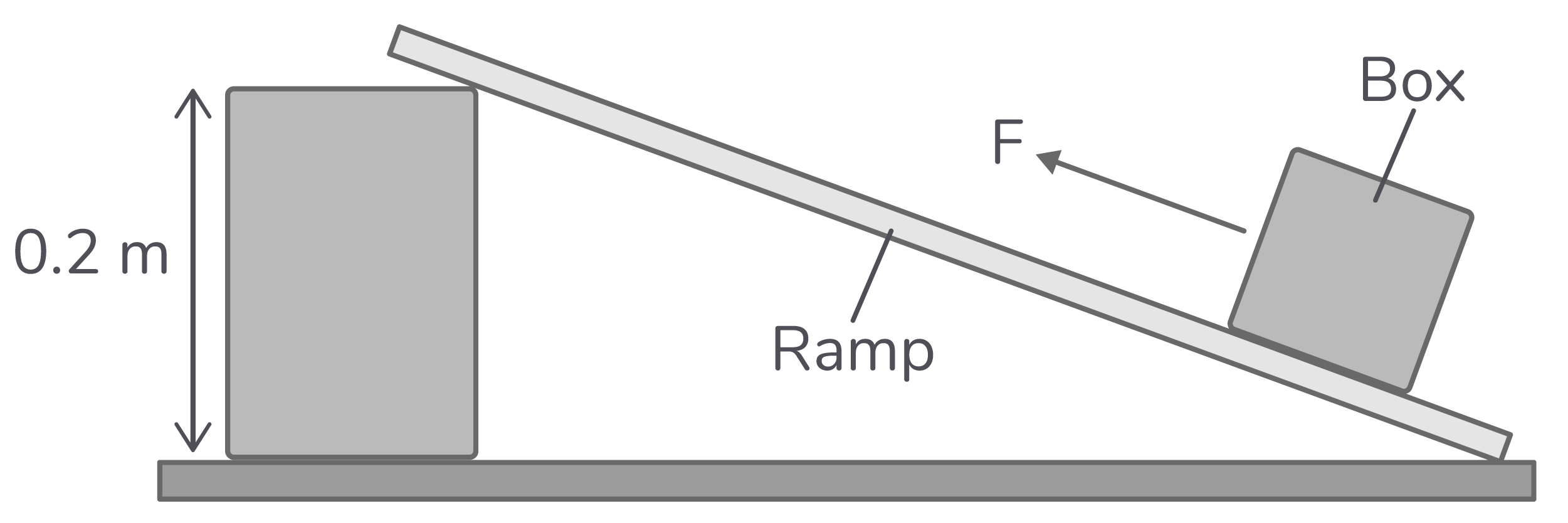
State the equation linking work done, force, and distance moved.
The student pushes the block 40 cm along the ramp.
The work required to do this is 6 J.
Calculate the force exerted on the block by the student.
The box gains 1.8 J of gravitational potential energy when it is pushed to the top of the ramp.
Calculate the mass of the box in kg. You may assume that g = 9.8 N/kg.
Explain why the work done on the box is greater than the increase in GPE store of the block.
A cyclist is cycling along a horizontal road at 15 m/s.
The cyclist and bicycle have a combined mass of 100 kg.
Calculate the kinetic energy of the cyclist and bicycle.
The cyclist applies the brakes and slows down to 6 m/s.
Calculate the work done in slowing the bicycle to 6 m/s.
Describe the energy transfers that take place as the brakes slow the bicycle from 15 m/s to 6m/s.
The brakes slowed the bike from 15 m/s to 6 m/s over a distance of 30 m.
Calculate the average braking force on the bike.
This question is about work done, power, and efficiency.
Which of these is not a unit for power?
A box is pushed with a force of 120 N.
The box moves a total distance of 26 cm.
Which of the following represents the work done on the box?
A cyclist applies the brakes to slow their speed from 8m/s to rest.
The mass of the cyclist and bicycle is 89 kg.
Which of the following represents the work done by the brakes on the bike?
An electric motor has an input of 250 W.
The efficiency of the motor is 49%.
Calculate the useful output power of the motor.
A student is using an electric motor to lift a mass off the ground.
The motor operates at 12 V with a current of 20 mA.
Calculate the power of the motor.
The motor is 60% efficient.
Calculate the useful energy output per second.
Give your answer to 2 decimal places.
The mass being lifted is 200 g.
Calculate the gravitational potential energy of the mass when it has been lifted through a distance of 80 cm.
The gravitational field strength on Earth is 9.8 N/kg.
Calculate how long it takes for the motor to lift the 200 g mass to a height of 80 cm.
Give your answer to 1 decimal place.
This question is about the forces and work done when an archer loads a bow.
State the name of the energy store that increases as the archer pulls the string of the arrow back.
When the 150 g arrow is released, it has a speed of 80 m/s.
Calculate the kinetic energy of the arrow.
The elastic potential energy stored in the bow before the archer released was 560 J.
Calculate the efficiency of conversion from elastic potential energy to kinetic energy.
Give your answer to 2 significant figures.
The arrow is brought to rest when it hits the target.
State the work done on the arrow when it hits the target.