7.7 - Alpha, Beta & Gamma Radiation
Radioactive decay and the types of nuclear radiation
- Some isotopes have unstable nuclei. An unstable nucleus tends to break down, or decay, releasing radiation as it changes into a more stable arrangement.
- This process is called radioactive decay, and a substance whose nuclei decay this way is radioactive.
- A nucleus is unstable when there's an imbalance between the numbers of protons and neutrons it contains (for example, too many neutrons), or when it is too heavy.
- The radiation comes from the nucleus itself.
The three types of radiation
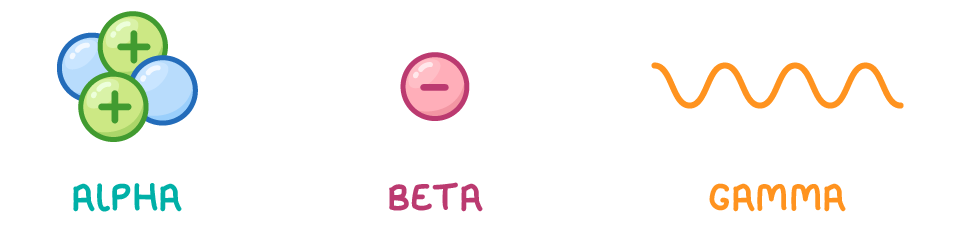
- Alpha particle (α) - Two protons and two neutrons, the same as a helium nucleus. Relative mass 4, relative charge +2. Comparatively large, heavy and slow-moving.
- Beta particle (β) - A fast-moving electron created in, and thrown out of, the nucleus when a neutron turns into a proton. Virtually no mass and a relative charge of -1. Small and travels quickly.
- Gamma ray (γ) - A high-frequency electromagnetic wave released by the nucleus. Carries away energy but has no mass and no charge.
Effect on the element
- Emitting an alpha or beta particle usually changes the nucleus into a different element.
- Gamma radiation carries only energy, so it leaves the element unchanged.
Ionising radiation and ionising power
- Ionising radiation knocks electrons off atoms it passes, turning those atoms into positively charged ions.
- Ionising power measures how readily a source does this.
What affects ionising power
How strongly a type of radiation ionises depends on its charge and its energy:
- Charge - A more highly charged particle attracts or repels an atom's electrons more strongly, so it's more likely to remove electrons.
- Energy - A particle carrying more energy can transfer more energy to an atom it collides with, making ionisation more likely.
Ionising power of each type
- Alpha - Strongly ionising. It carries much more mass and energy than beta and has the largest charge (+2), so it collides with and ionises many atoms over a short distance.
- Beta - Moderately ionising.
- Gamma - Weakly ionising. With no mass and no charge, it tends to pass straight through atoms rather than collide with them.
Penetration and range of radiation
The more strongly a type of radiation ionises, the more it collides with atoms, so the shorter its range and the more easily it's absorbed.
Range and what stops each type
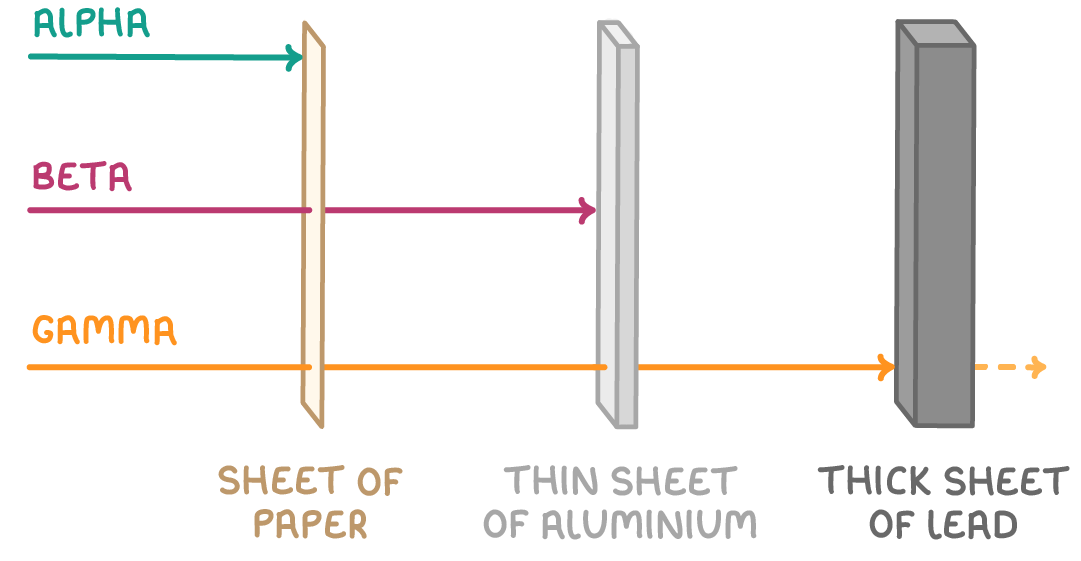
- Alpha - Travels only a few centimetres in air and is stopped by a sheet of paper.
- Beta - Travels up to a few metres in air and is stopped by a thin sheet of aluminium (around 5 mm thick).
- Gamma - Travels a long distance through air and is only absorbed by thick lead or metres of concrete. Gamma is never completely stopped; thick lead and concrete reduce its intensity rather than blocking it entirely.
TermDefinition
Radioactive decay
Ionising radiation