3.10 - Magnets & Magnetic Fields
Magnets, poles and the magnetic field
- Every magnet has two poles: a north pole (north-seeking) and a south pole (south-seeking).
- The poles are at the ends of the magnet, where its magnetic effect is strongest.
- A magnet produces a magnetic field in the space around it - the region where another magnet, or a magnetic material, experiences a force.
- Because magnetic materials feel a force without being touched, magnetism is a non-contact force.
Magnetic and non-magnetic materials
- Magnetic materials feel a force in a magnetic field - e.g. iron, steel, nickel and cobalt.
- Most everyday materials are non-magnetic - e.g. plastic, wood, copper and aluminium.
Magnetic flux density
- The strength of a magnetic field at a point is called the magnetic flux density.
- It's measured in teslas (T).
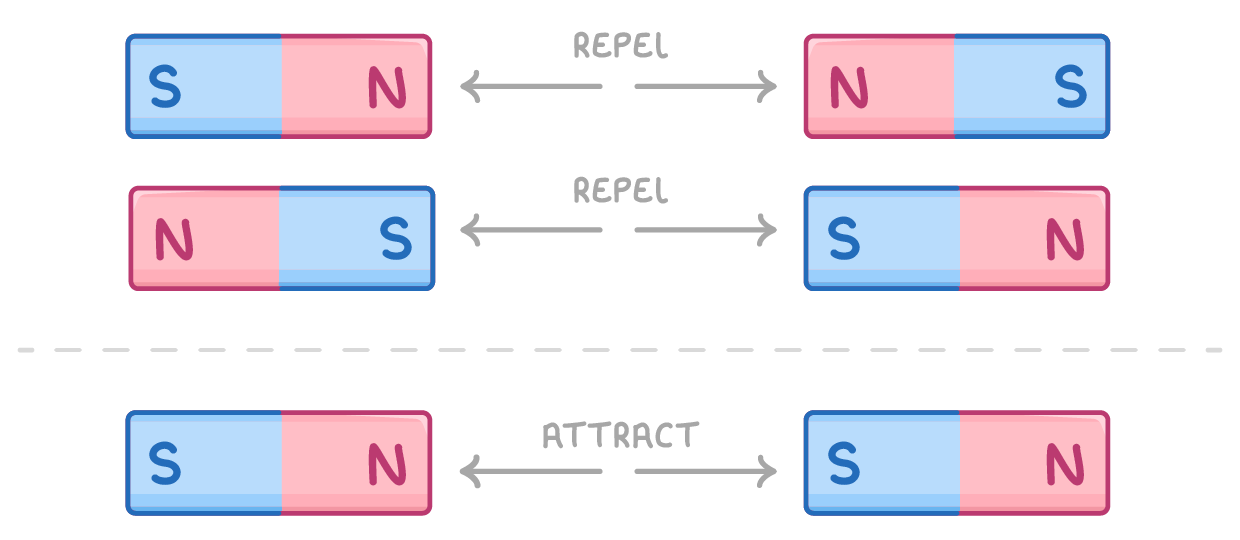
Forces between poles - Like repel, unlike attract
- Like poles repel - Two north poles, or two south poles, push apart.
- Unlike poles attract - A north pole and a south pole pull together.
Magnet and a magnetic material
The force between a magnet and a magnetic material (such as unmagnetised iron) is always attractive, whichever pole is brought near it.
Uniform field between two magnets
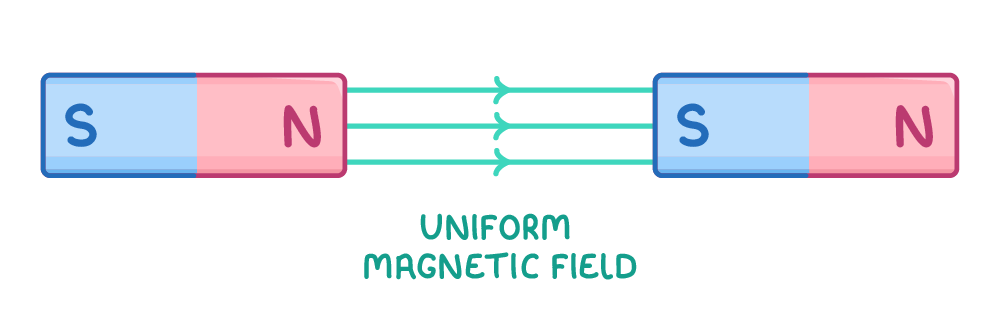
- Placing the north and south poles of two bar magnets near each other forms a uniform magnetic field in the gap.
- A uniform field has the same strength and direction everywhere.
- It's drawn as parallel, equally spaced field lines running from the north pole across to the south pole.
Drawing magnetic field lines
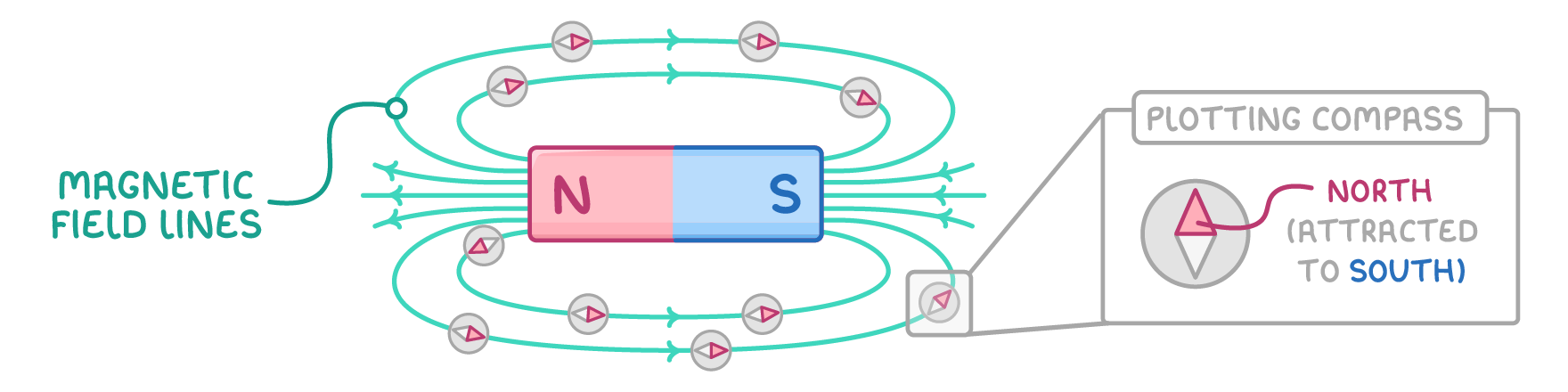
- A magnetic field can be represented using magnetic field lines (lines of force).
- Field lines show both the direction and the strength of the field:
- Direction - Field lines always point from the north pole to the south pole outside the magnet. This is the direction of the force on a north pole placed in the field.
- Strength - The closer together the lines, the stronger the field. The field is strongest at the poles, where the lines are most crowded.
Rules for field lines
- Field lines never touch or cross - at any point the field can only act in one direction.
- A point where the opposing fields cancel out to zero is called a neutral point.

Plotting magnetic fields
- A plotting compass contains a small magnetic needle that's free to turn.
- The needle lines up along the field line at that point, pointing towards the south pole of the magnet.
Using a plotting compass
- Put the magnet on paper and draw around it.
- Place the compass near the magnet and mark a dot at each end of the needle.
- Move the compass so the tail of the needle sits on the second dot, and mark the new tip with another dot.
- Repeat, then join the dots to trace a field line. Add an arrow pointing from north to south.
- Repeat from different starting points around the magnet to map the full field.
Using iron filings
- Place a sheet of card over the magnet, scatter iron filings on top, and tap the card gently.
- The filings temporarily magnetise and line up with the field, showing the shape of the field lines.
- Iron filings show the shape quickly but do not show the field's direction.
Compasses and the Earth's magnetic field
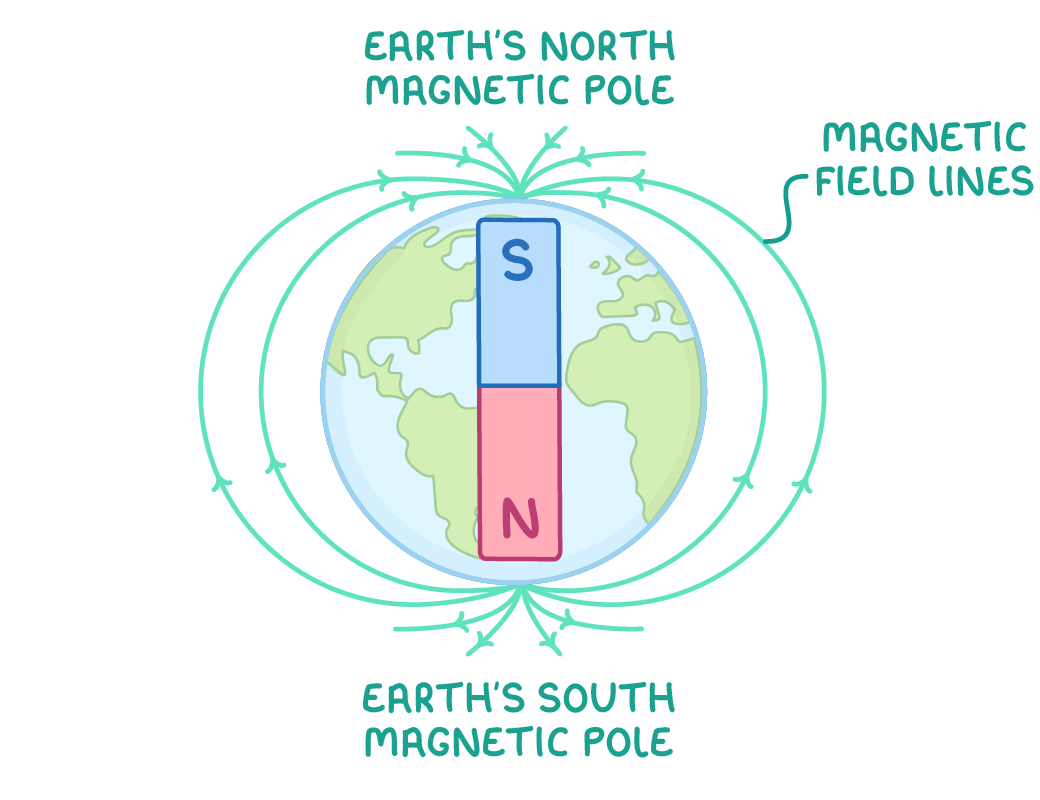
- A compass that isn't near any magnet settles pointing towards the Earth's geographic North Pole.
- This is because the Earth produces a magnetic field, shaped like the field of a giant bar magnet.
- This behaviour is evidence that the Earth has a magnetic core (composed mainly of molten iron and nickel).
Geographic vs magnetic poles
- A compass needle's north pole is attracted towards the Earth's geographic North Pole.
- Because unlike poles attract, the magnetic pole located in the geographic north is actually a magnetic south pole.
TermDefinition
Magnetic fieldThe region around a magnet where another magnet or magnetic material experiences a force.
Magnetic flux densityThe strength of a magnetic field at a point, measured in teslas (T).
Uniform fieldA field that has the same strength and direction everywhere, shown by parallel field lines that are equally spaced.
Neutral pointA point where two or more fields cancel each other out, so the resultant field there is zero.
Key points to remember
How were these notes?