1.9 - Absorbing & Emitting Radiation
How temperature changes the radiation curve
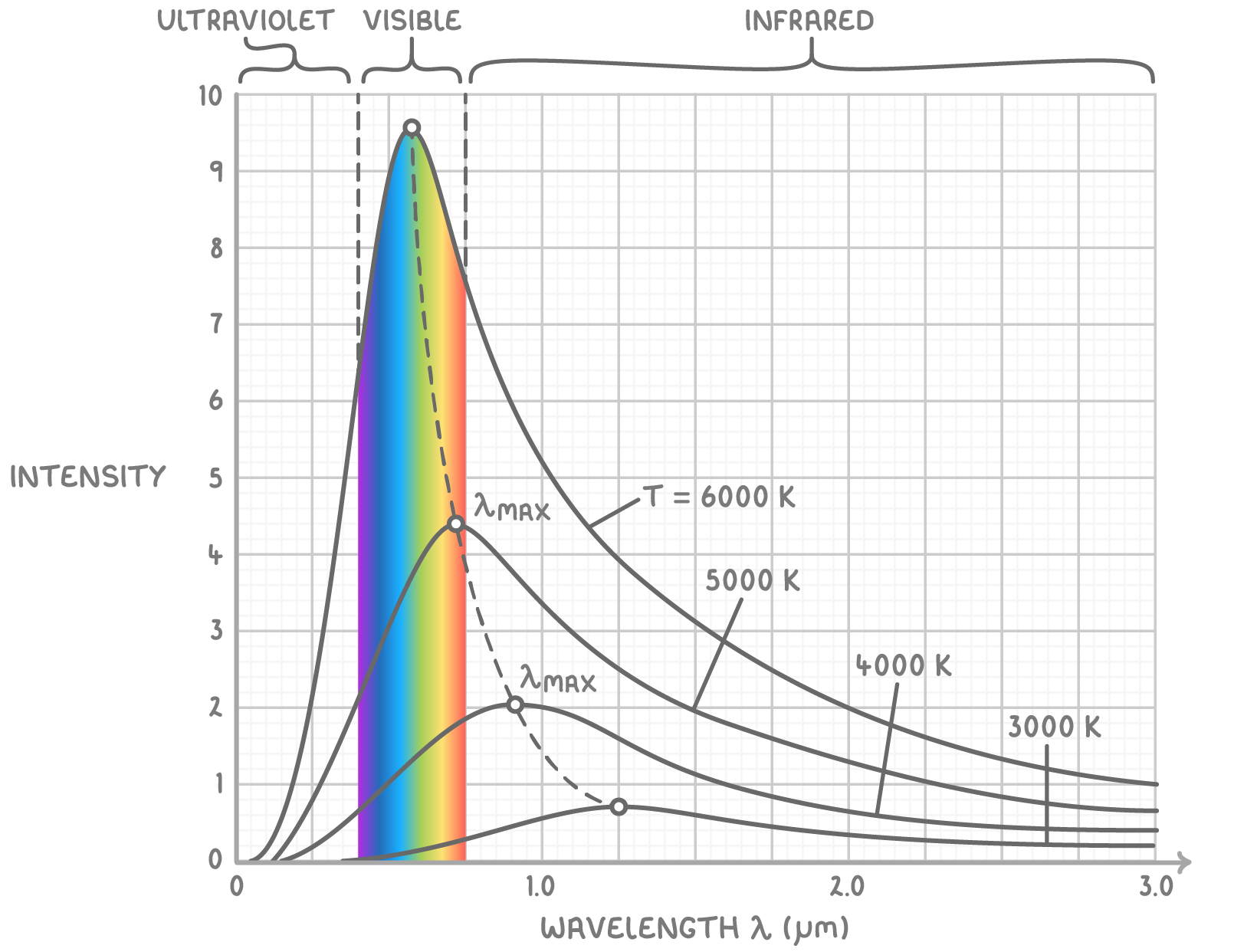
- An object emits radiation across a continuous range of wavelengths.
- How that radiation is spread across wavelengths depends on the object's temperature.
As the temperature increases
- The intensity of every wavelength increases.
- The intensity increases more rapidly for shorter wavelengths than for longer ones.
- The peak wavelength (the wavelength emitted with the highest intensity) decreases, shifting the peak towards shorter wavelengths.
Visible changes with heating
- At everyday temperatures, the peak wavelength lies in the infrared.
- As an object gets hotter, it begins to glow red and then white as more of its radiation moves into the visible light spectrum.
Radiation balance and the Earth's temperature
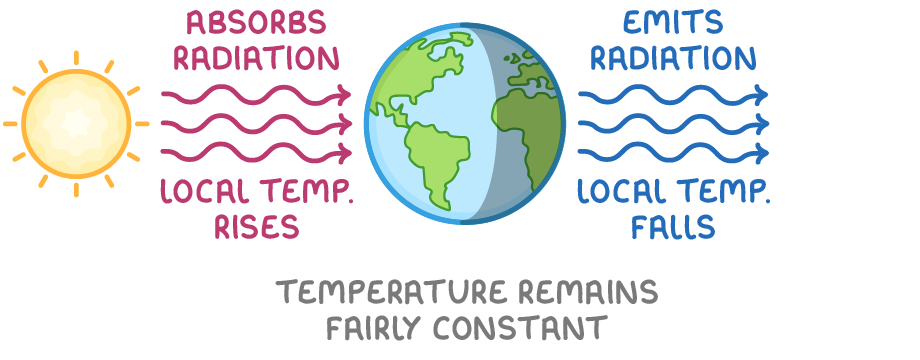
The Earth's temperature depends on the balance between the radiation it absorbs and the radiation it emits.
- Absorbs faster than it emits - Temperature rises.
- Emits faster than it absorbs - Temperature falls.
- Absorbs and emits at the same rate - Temperature stays constant.
Day and night
- During the day - Radiation from the Sun is absorbed by the atmosphere and surface, so local temperatures rise.
- At night - Less radiation is absorbed than is emitted, so local temperatures fall.
The greenhouse effect
- Greenhouse gases in the atmosphere (such as carbon dioxide and methane) absorb infrared radiation emitted by the Earth's surface.
- They re-emit this radiation in all directions, including back towards the surface.
- This reduces the rate at which energy is lost to space, causing the Earth's temperature to rise until absorption and emission balance again at a higher temperature.
TermDefinition
Peak wavelengthThe wavelength emitted with the highest intensity.
Key points to remember
How were these notes?