5.1 - Developing the Model of the Atom
Early atomic ideas
- In the 5th century BC, the Greek philosopher Democritus suggested that matter is made of tiny, indivisible particles called "atomos".
- In 1804, John Dalton agreed that matter is made of tiny solid spheres that can't be broken up, but proposed that each element has its own distinct type of atom.
The plum pudding model
- In 1897, J. J. Thomson discovered the electron - a tiny, negatively charged particle.
- This showed atoms are not indivisible spheres, but contain smaller charged parts.
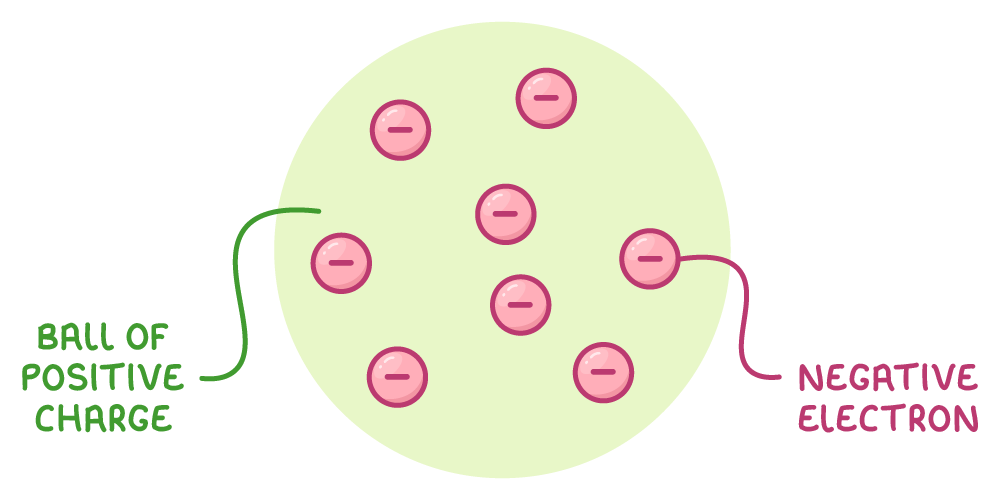
- Thomson proposed the plum pudding model:
- The atom is a ball of positive charge.
- Tiny negative electrons are embedded inside it.
Rutherford's alpha scattering and the nuclear model
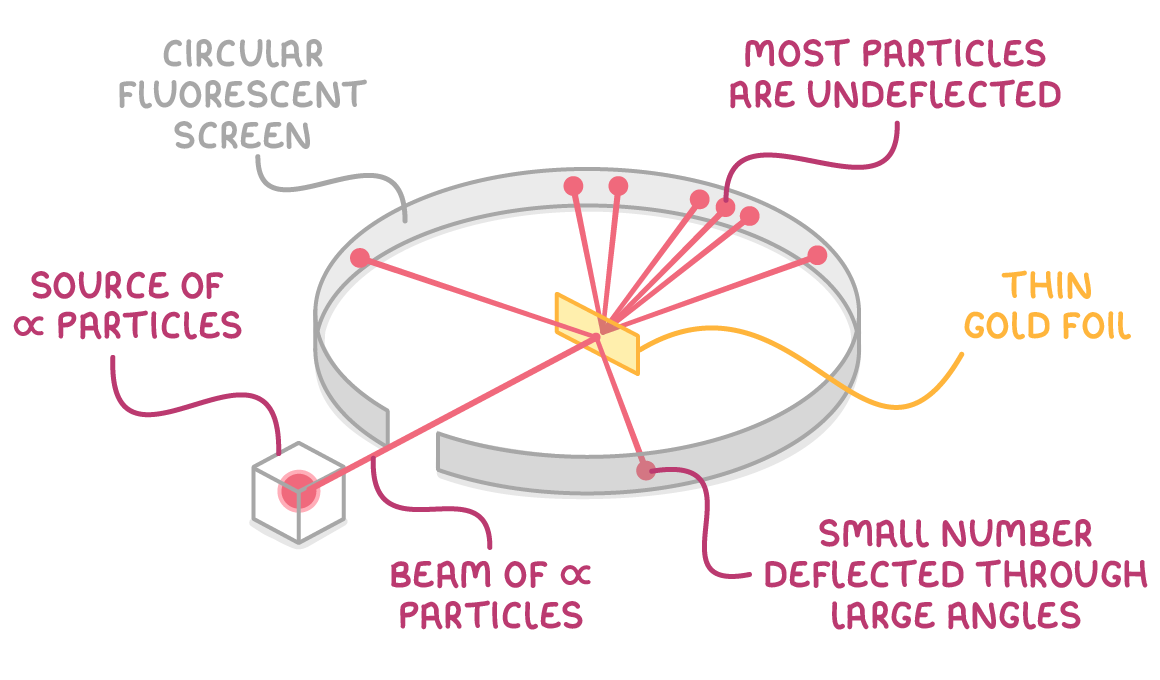
- In 1909, Ernest Rutherford (with Hans Geiger and Ernest Marsden) fired positively charged alpha particles at a thin sheet of gold foil.
- If the plum pudding model had been correct, the alpha particles should have passed straight through or been deflected only slightly.
Observations and conclusions
- Most particles passed straight through - The atom is mostly empty space.
- A small number were deflected through large angles - The atom's mass and positive charge are concentrated in a tiny central nucleus.
- A few bounced almost straight back - The nucleus is very dense and positively charged, repelling the positive alpha particles.
This led to the nuclear model: a tiny, dense, positively charged nucleus at the centre, surrounded by electrons.
Bohr's energy levels
- Rutherford's model had electrons in a "cloud" around the nucleus, but electrons in this arrangement would spiral inwards, causing the atom to collapse.
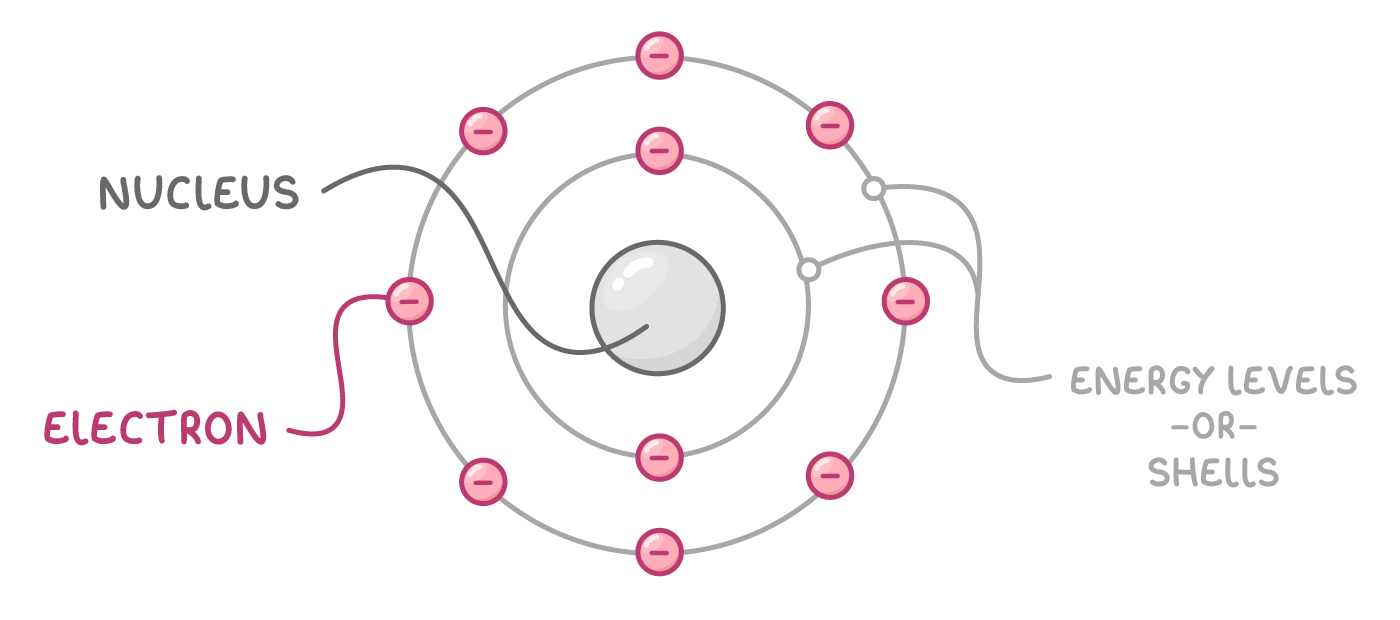
- Niels Bohr adapted the model:
- Electrons orbit the nucleus only at fixed distances, called energy levels or shells.
- Electrons can exist in these allowed shells, but not in between them.
- Bohr's theoretical calculations matched experimental observations.
TermDefinition
ElectronA tiny, negatively charged particle found in atoms.
Plum pudding modelAn early model of the atom as a ball of positive charge with negative electrons embedded in it.
Nuclear modelA model of the atom with a tiny, dense, positively charged nucleus at the centre, surrounded by electrons.
Energy levelA fixed distance from the nucleus where electrons can orbit. It is also called a shell.
Key points to remember
How were these notes?