3.9 - National Grid
The National Grid
- The National Grid is a nationwide system of cables and transformers that connects power stations to consumers.
- It transfers electrical power from power stations to wherever it's needed, such as homes and industry.
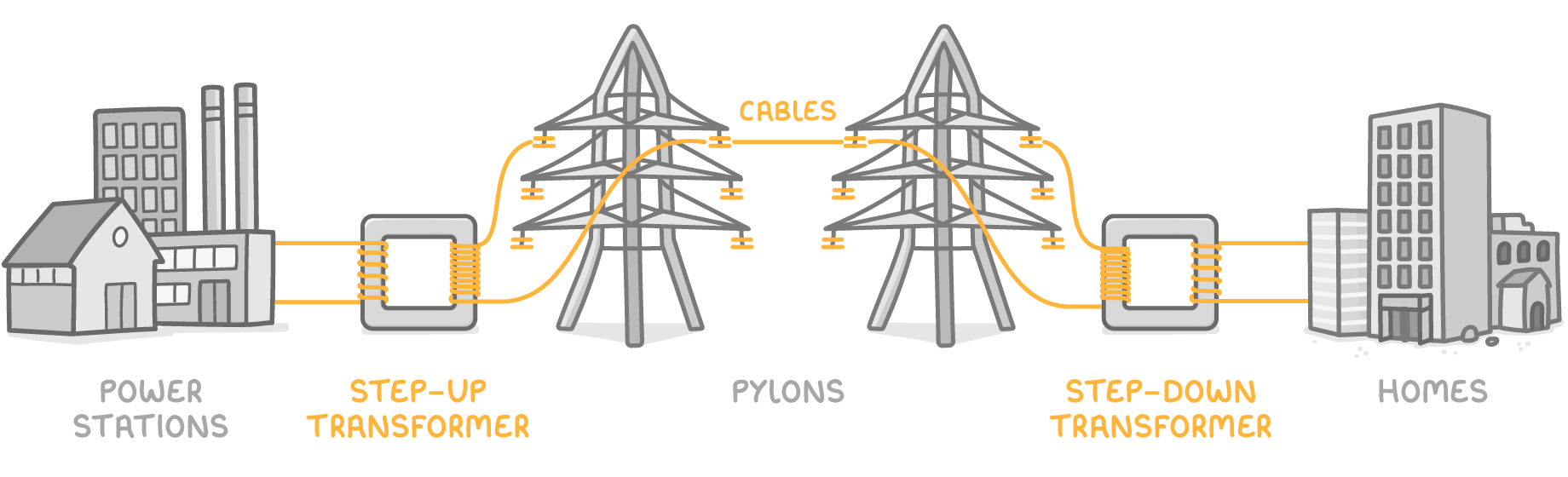
Step-up and step-down transformers raise the potential difference for transmission, then lower it.
Matching supply to demand
- Electricity demand changes throughout the day: it rises in the morning, when people get home from work or school, and during cold or dark weather.
- The minimum demand over a period is called the base load.
How the grid copes with changes in demand
- Power stations often run below their maximum output, leaving spare capacity for sudden surges in demand.
- Stations with short start-up times are kept on standby to respond quickly.
- Electricity can also be imported or exported through links with other countries.
Transmitting at high potential difference
- Transmitting electricity at a high current causes the cables to heat up, wasting energy as heat to the surroundings (P = I2R).
- Electrical power is given by P = IV, so for a given power, increasing the potential difference lowers the current.
- Transmitting at a very high potential difference (around 400,000 V) keeps the current low, minimising thermal energy loss and making the grid much more efficient.
Step-up and step-down transformers
- Transformers change the potential difference of the alternating current on the National Grid.
- Step-up transformers increase the potential difference to around 400,000 V as electricity leaves the power station. This decreases the current, reducing energy wasted as heat in the transmission cables.
- Step-down transformers decrease the potential difference to safe, usable levels (230 V in UK homes) before electricity reaches consumers.
TermDefinition
National GridA nationwide system of cables and transformers that connects power stations to consumers.
Base loadThe minimum demand for electricity over a given period.
TransformerA device that changes the size of an alternating potential difference (voltage).
Step-up transformerA transformer that increases the potential difference (voltage) and decreases the current. It has more turns on its secondary coil than on its primary coil.
Step-down transformerA transformer that decreases the potential difference (voltage) and increases the current. It has fewer turns on its secondary coil than on its primary coil.
Key points to remember
How were these notes?