4.11 - Resultant Forces
Free body diagrams
A free body diagram shows a single object and every force acting on it, not the forces the object exerts on other things.
Drawing the force arrows
- Direction - The arrow points in the direction the force acts.
- Length - The length shows the relative size of the force (a longer arrow means a larger force).
Example - Falling skydiver
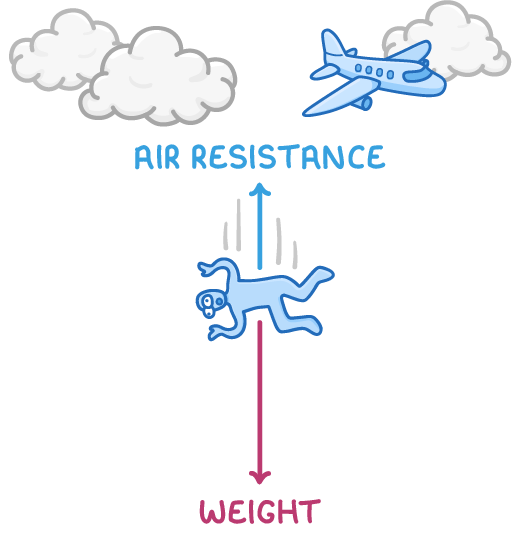
- A skydiver falling through the air has two forces acting on her: weight acting downwards and drag (air resistance) acting upwards.
- While she's speeding up, her weight is larger than the drag, so the weight arrow is drawn longer than the drag arrow.
Resultant force, balanced and unbalanced forces
When several forces act on an object, they can be replaced by a single force that has the same effect. This is the resultant force (or net force).
Finding the resultant force
For forces acting along the same straight line:
- Add forces that act in the same direction.
- Subtract forces that act in opposite directions.
Balanced vs unbalanced forces
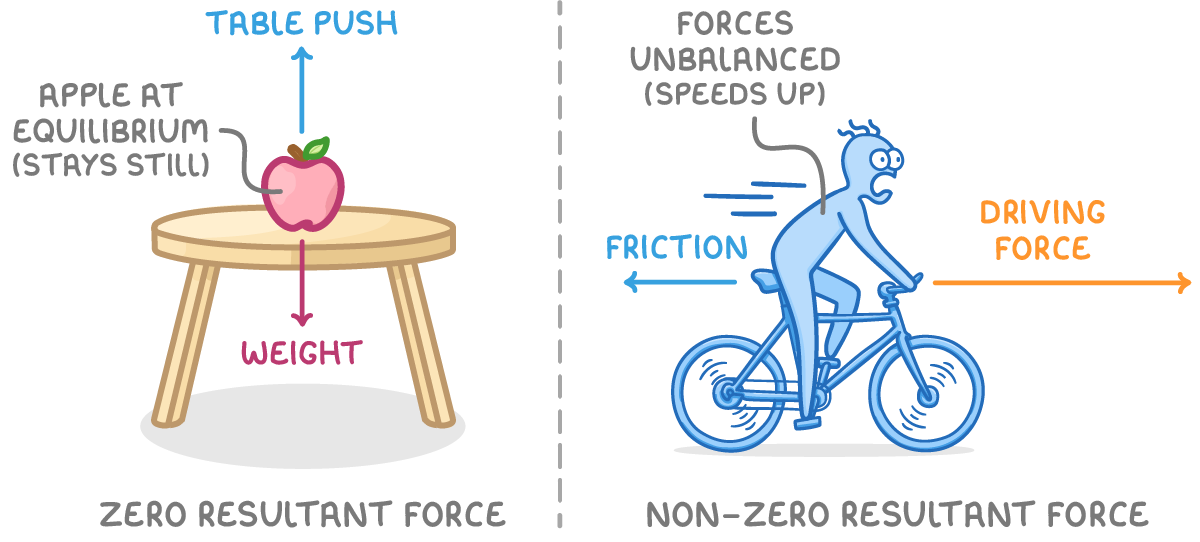
- Zero resultant force - The forces are balanced. The object stays stationary or keeps moving at a steady speed in a straight line (it's in equilibrium).
- Non-zero resultant force - The forces are unbalanced. The object speeds up, slows down, or changes direction in the direction of the resultant force.
Example - Apple on a table
- An apple resting on a table has its weight acting downwards and an equal upward push from the table.
- These forces are equal and opposite, so the resultant force is zero and the apple stays still.
Worked example - Resultant force on a van
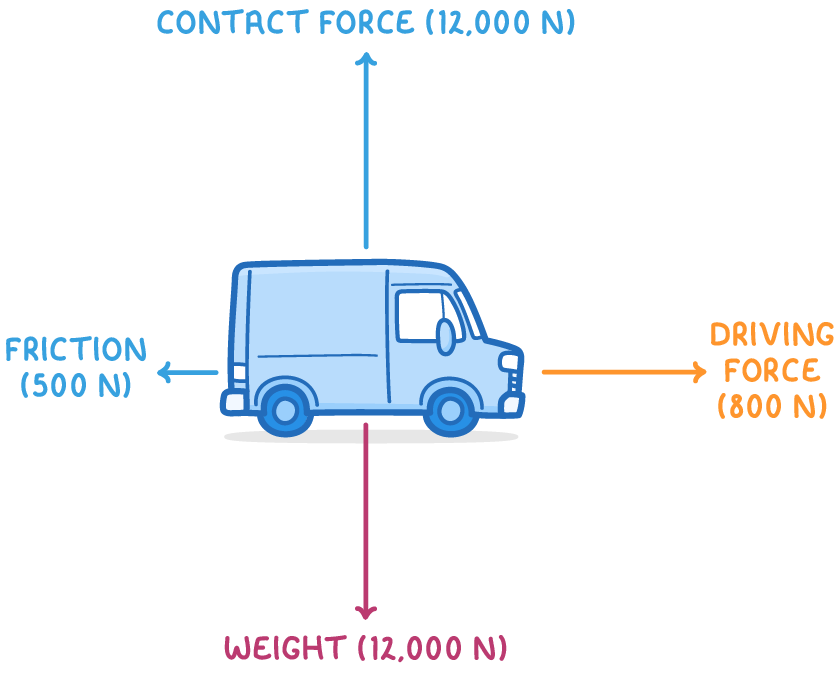
A van is being driven along a flat road. The forces acting on it are: a driving force of 800 N forwards, friction of 500 N backwards, weight of 12,000 N downwards, and a normal contact force of 12,000 N upwards from the road. Find the resultant force on the van.
Step 1 - Take the vertical direction
The weight (12,000 N down) and the normal contact force (12,000 N up) act along the same line in opposite directions:
12,000 - 12,000 = 0 N
There's no resultant force in the vertical direction.
Step 2 - Take the horizontal direction
The driving force (800 N forwards) and friction (500 N backwards) act along the same line in opposite directions:
800 - 500 = 300 N
Step 3 - State the size and direction of the resultant force
The resultant force is 300 N forwards (in the direction of the driving force).