3.14 - How the Electric Motor Works
Forces on a coil produce a turning effect
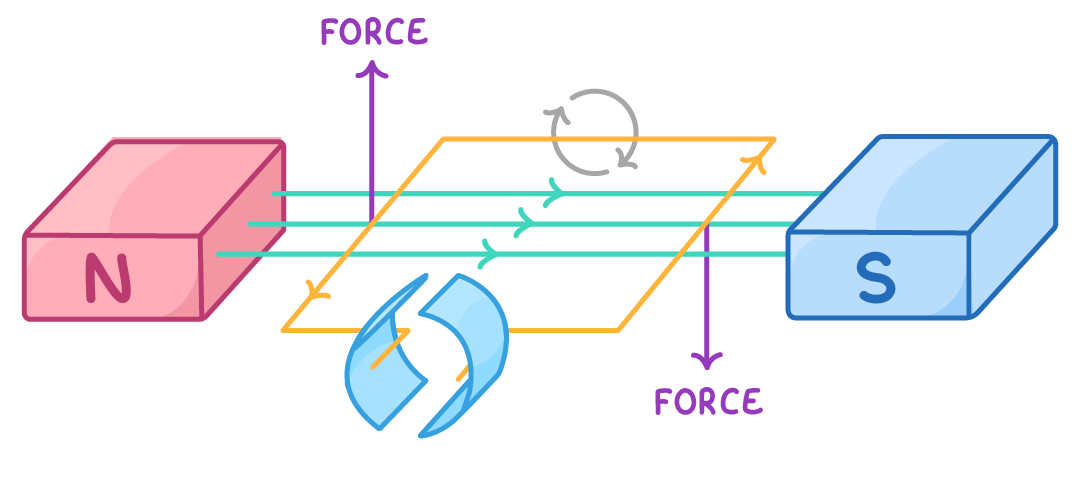
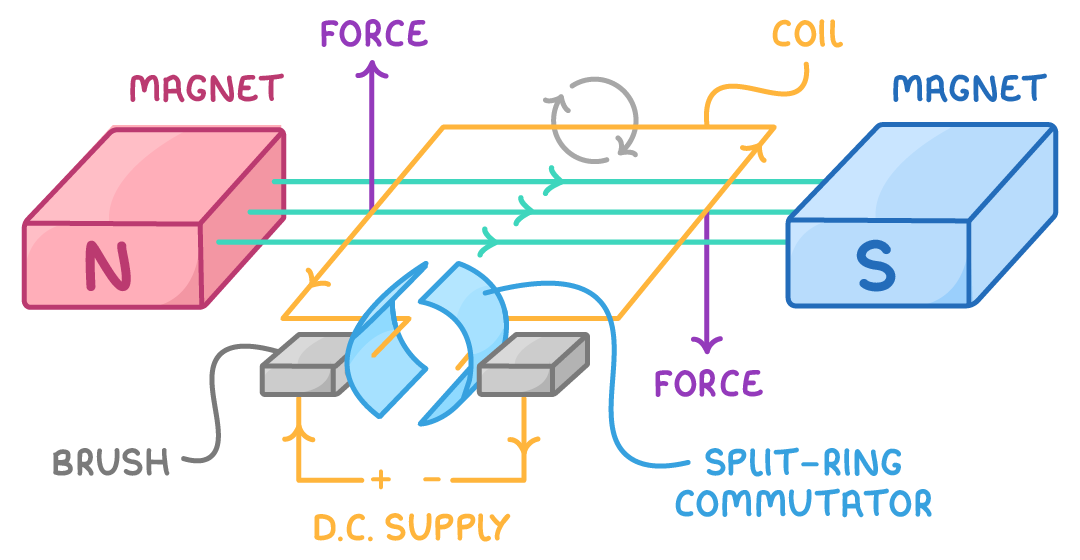
- A simple direct current (d.c.) motor is a coil of wire sitting between the poles of a magnet, free to turn on a spindle.
- When current flows, each side arm of the coil carries current in the opposite direction to the other.
- The motor effect pushes one side arm up and the other side arm down.
- These two forces act in opposite directions on opposite sides of the spindle, producing a turning effect so the coil rotates.
Making a motor turn faster
The turning effect on the coil is increased, making the motor turn faster, by:
- Increasing the current in the coil
- Increasing the number of turns on the coil
- Increasing the strength of the magnetic field
The motor effect:
- The side arms feel a force because they're current-carrying conductors at right angles to a magnetic field (the motor effect).
- The direction of each force is found with Fleming's left-hand rule.
The split-ring commutator keeps the motor turning
- If the current stayed the same, the coil would only swing as far as the vertical position and then stop.
- This is because the turning effect is greatest when the coil is horizontal and falls to zero when the coil is vertical, at right angles to the field.
How it works
- The split-ring commutator is fixed to the coil and rotates with it, staying connected to the d.c. supply through a pair of brushes.
- Every half turn the brushes swap which half of the split ring they touch, so the current direction reverses every half turn.
- This means the side of the coil nearest a given pole always carries current in the same direction, so the force always pushes the same way and the motor keeps rotating in one direction.
The motor's direction of rotation can be reversed by:
- Reversing the current (swapping the connections to the d.c. supply)
- Swapping the magnetic poles over (reversing the magnetic field)
Uses of electric motors
- Electric motors turn electrical energy into rotation.
- Common uses include:
- In industry - Driving factory machinery and conveyor belts
- Electric vehicles - Providing the driving force to move the vehicle
- Household appliances - Appliances with moving parts, e.g. hair dryers, vacuum cleaners, fans, and blenders
TermDefinition
Direct current (d.c.) motorA motor with a coil of wire between the poles of a magnet. The coil rotates when a direct current passes through it.
Split-ring commutatorA split ring that reverses the connections between a rotating coil and the circuit every half turn, which keeps a motor turning one way or makes a dynamo give direct current.
Key points to remember
How were these notes?