5.3 - Alpha, Beta & Gamma Radiation
Radioactive decay and the types of nuclear radiation
- Some isotopes have unstable nuclei. An unstable nucleus tends to break down, or decay, releasing radiation as it changes into a more stable arrangement.
- This process is called radioactive decay, and a substance whose nuclei decay this way is radioactive.
- A nucleus is unstable when there's an imbalance between the numbers of protons and neutrons it contains (for example, too many neutrons), or when it is too heavy.
- The radiation comes from the nucleus itself.
The three types of radiation
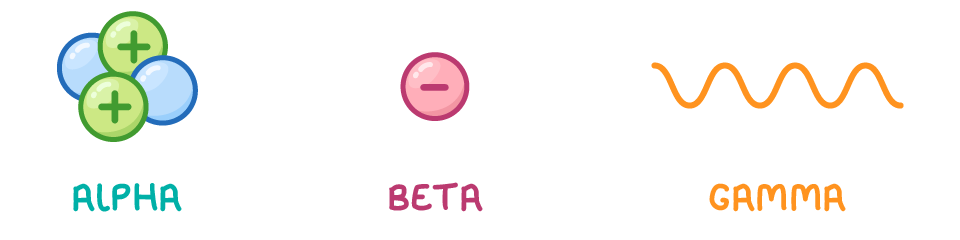
- Alpha particle (α) - Two protons and two neutrons, the same as a helium nucleus. Relative mass 4, relative charge +2. Comparatively large, heavy and slow-moving.
- Beta particle (β) - A fast-moving electron created in, and thrown out of, the nucleus when a neutron turns into a proton. Virtually no mass and a relative charge of -1. Small and travels quickly.
- Gamma ray (γ) - A high-frequency electromagnetic wave released by the nucleus. Carries away energy but has no mass and no charge.
Effect on the element
- Emitting an alpha or beta particle usually changes the nucleus into a different element.
- Gamma radiation carries only energy, so it leaves the element unchanged.
Neutron emission
- An unstable nucleus with too many neutrons can get rid of the excess by emitting a neutron (n).
- A neutron carries no charge.
- The number of protons doesn't change, so the nucleus stays the same element, but with a different mass number - making it a different isotope.
- Neutron radiation is ionising.
Ionising radiation and ionising power
- Ionising radiation knocks electrons off atoms it passes, turning those atoms into positively charged ions.
- Ionising power measures how readily a source does this.
What affects ionising power
How strongly a type of radiation ionises depends on its charge and its energy:
- Charge - A more highly charged particle attracts or repels an atom's electrons more strongly, so it's more likely to remove electrons.
- Energy - A particle carrying more energy can transfer more energy to an atom it collides with, making ionisation more likely.
Ionising power of each type
- Alpha - Strongly ionising. It carries much more mass and energy than beta and has the largest charge (+2), so it collides with and ionises many atoms over a short distance.
- Beta - Moderately ionising.
- Gamma - Weakly ionising. With no mass and no charge, it tends to pass straight through atoms rather than collide with them.
Penetration and range of radiation
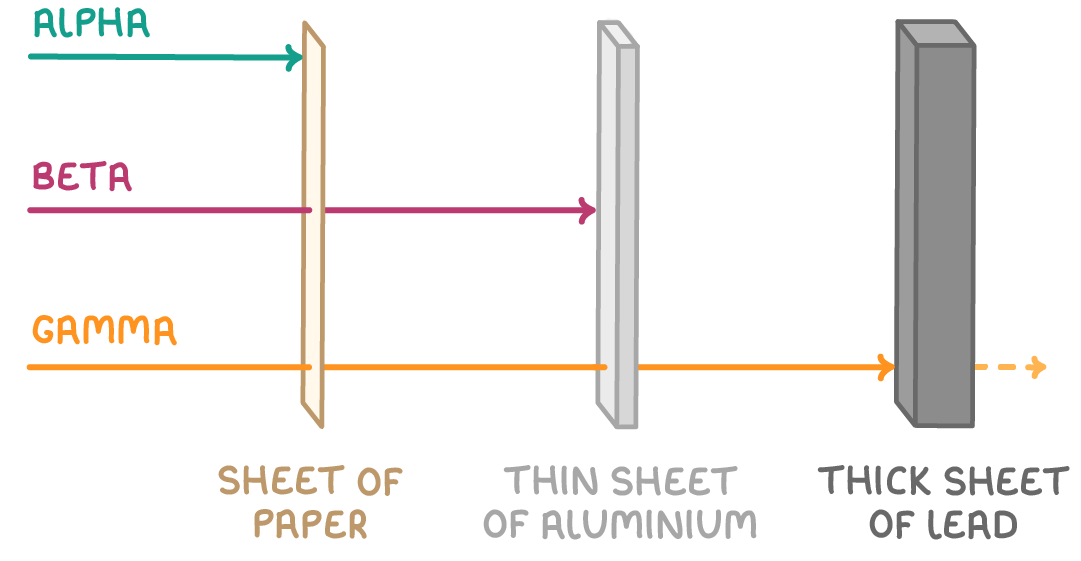
The more strongly a type of radiation ionises, the more it collides with atoms, so the shorter its range and the more easily it's absorbed.
Range and what stops each type
- Alpha - Travels only a few centimetres in air and is stopped by a sheet of paper.
- Beta - Travels up to a few metres in air and is stopped by a thin sheet of aluminium (around 5 mm thick).
- Gamma - Travels a long distance through air and is only absorbed by thick lead or metres of concrete. Gamma is never completely stopped; thick lead and concrete reduce its intensity rather than blocking it entirely.
Count rate and distance from a source
- Count rate is the number of radiation particles reaching a detector in a given time.
- Radiation spreads out as it travels and some is absorbed by the air, so the count rate falls as the detector moves further away from the source.
Dealing with random decay
- Radioactive decay is random, so the count rate fluctuates from one reading to the next even when nothing has moved.
- Take several readings at each distance and calculate an average to prevent fluctuations from hiding the overall trend.
TermDefinition
Radioactive decayThe random process where an unstable nucleus breaks down and releases radiation to become more stable.
Ionising radiationRadiation that has enough energy to knock electrons out of atoms, turning them into ions.
Count rateThe number of decays recorded by a detector in a given time, usually each second.
Key points to remember
How were these notes?