4.20 - Work Done
Work is done when a force moves an object
- When a force moves an object through a distance, energy is transferred and work is done on the object.
- "Work done" and "energy transferred" describe the same thing.
- Work is done whether the energy is transferred usefully (like lifting a load) or dissipated (like energy transferred to thermal stores by friction).
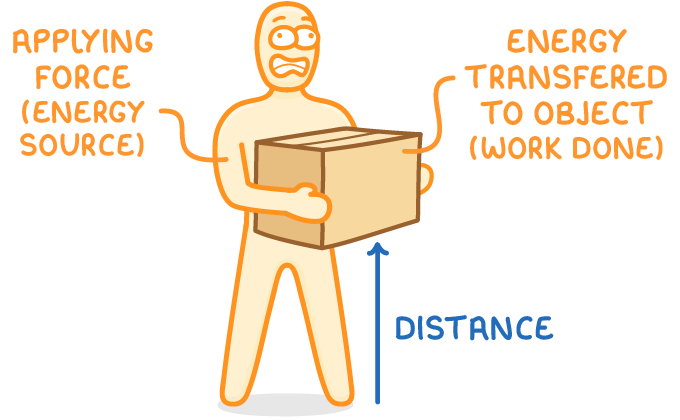
Work done against friction
- When an object is moved against a resistive force like friction, work is done against friction.
- Energy is transferred to thermal energy stores, raising the temperature of the object and its surroundings.
- The work done by the applied force equals the kinetic energy gained plus the energy transferred to thermal stores.
Formula for work done
Where:
- = Work done, in joules (J) or newton metres (Nm)
- = Force, in newtons (N)
- = Distance moved along the line of action of the force, in metres (m)
Work done is calculated by multiplying the force by the distance moved along the line of action of the force.
One joule of work is done when a force of one newton moves an object a distance of one metre (1 J = 1 Nm).
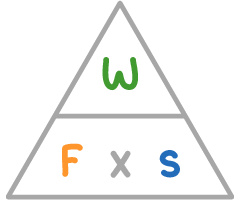
Cover the quantity you want to find to see how to calculate it.
Worked example - Work done pushing a crate
A crate is pushed 6.0 m across a level warehouse floor by a constant horizontal force of 250 N. Find the work done.
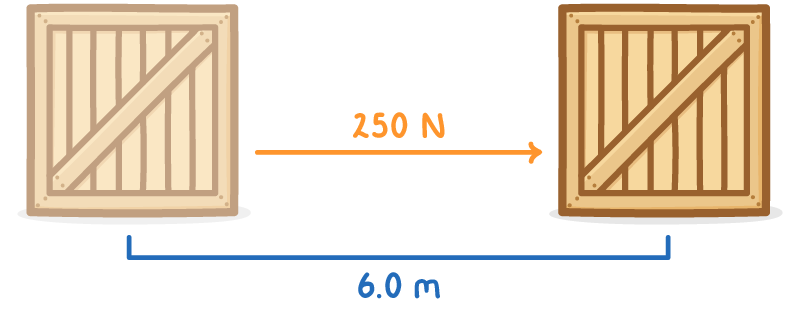
Step 1 - Formula
Step 2 - Substitution and calculation
The force and the movement are in the same direction, so all of the force does work. 1,500 J of energy is transferred from the person pushing the crate.
TermDefinition
Work doneThe energy transferred when a force moves an object through a distance, or when charge flows through a circuit.
JouleThe work done when a force of one newton moves an object a distance of one metre.
Key points to remember
How were these notes?