1.11 - Reflection
Waves at a boundary - Absorbed, transmitted or reflected
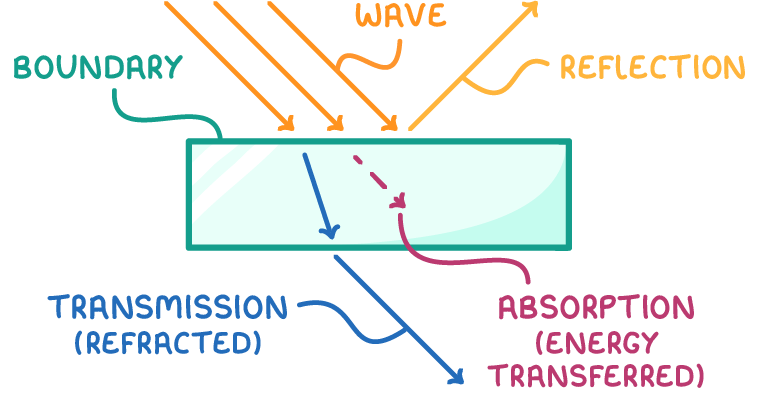
When a wave reaches a boundary between two different materials, one of three things can happen:
- Absorption - The wave's energy is transferred to the second material (for example, microwaves heating food).
- Transmission - The wave carries on travelling through the new material, which often leads to refraction (a change in direction).
- Reflection - The wave bounces back off the boundary instead of passing through or being absorbed.
Factors affecting the outcome:
- Which of these happens depends on the wavelength of the wave and the properties of the two materials.
- This applies to all types of wave, including electromagnetic waves, sound waves and water waves.
What reflection is
Reflection happens when a wave hits a boundary between two materials and bounces back, instead of being absorbed or passing into the new material.
Reflection happens with every kind of wave
- Light reflects off surfaces - it's how we see objects and how mirrors form images.
- Sound reflects off hard surfaces such as walls and cliffs, producing echoes.
- Water waves bounce back off a harbour wall or the side of a tank.
Hard surfaces reflect sound strongly, while softer surfaces absorb more of it and reflect less.
TermDefinition
AbsorptionThe transfer of a wave's energy to the material it enters or travels through.
TransmissionA wave carrying on through a new material after hitting a boundary.
ReflectionA wave bouncing back off a boundary between two materials instead of passing through or being absorbed.
Key points to remember
How were these notes?