1.4 - Radio Waves
Radio waves and the electromagnetic spectrum
- Radio waves are part of the electromagnetic (EM) spectrum.
- They have the longest wavelengths and the lowest frequencies of all EM waves.
- Like all EM waves, they are transverse and travel at the speed of light through a vacuum.
- Their long wavelengths make them useful for carrying signals over long distances, such as radio and television broadcasts.
Radio waves are produced and received by oscillating charges
- EM waves are made of oscillating electric and magnetic fields.
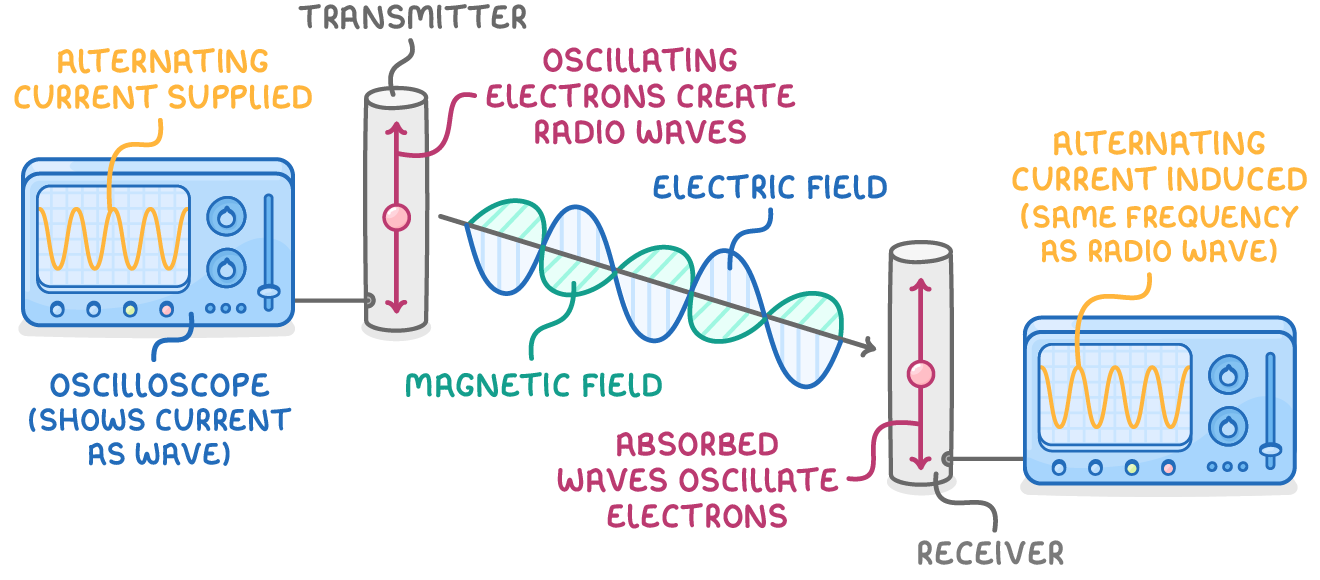
- An alternating current (a.c.) is made of oscillating charges. When it flows in a circuit, the moving charges produce oscillating electric and magnetic fields - an EM wave.
- The frequency of the radio wave equals the frequency of the a.c.
- The object in which the charges oscillate to create the radio waves is called a transmitter.
Receiving radio waves
- When a radio wave reaches a receiver, it is absorbed and transfers its energy to the electrons in the receiver, making them oscillate.
- If the receiver is part of a complete circuit, this induces an alternating current.
- That induced current has the same frequency as the radio wave, allowing the signal to be recovered.
Radio waves carry communication signals
- Radio waves are used mainly for communication - they carry television and radio broadcasts from one place to another.
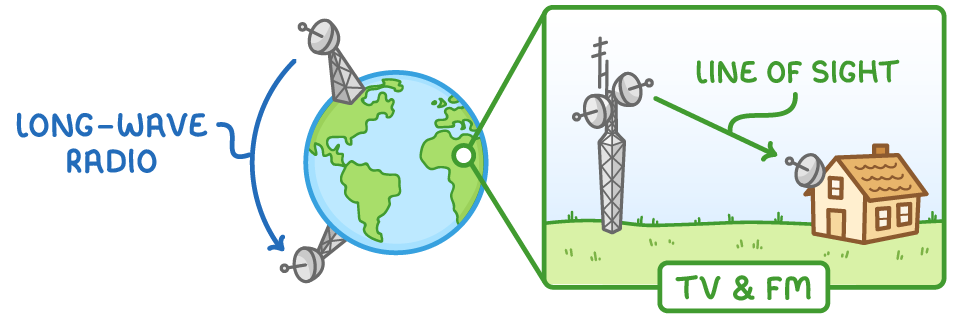
- Radio waves have wavelengths longer than about 10 cm, and how a radio wave travels from transmitter to receiver depends on its wavelength.
- Longer-wavelength radio waves can be received over very large distances.
- The very short wavelengths used for TV and FM radio only reach a receiver in line of sight of the transmitter, because they don't bend or travel far through obstacles.
TermDefinition
TransmitterAn object in which electrical charges oscillate to produce radio waves.
Key points to remember
How were these notes?