1.7 - X-Rays & Gamma Rays
X-rays let us see inside the body
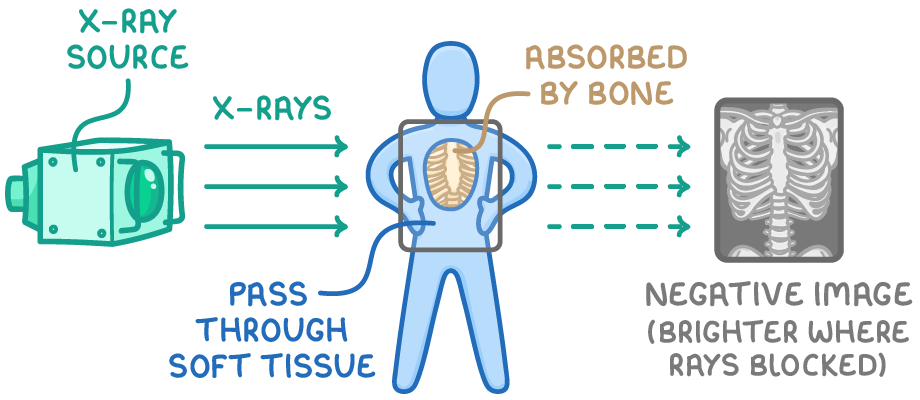
X-rays pass easily through soft tissue but are absorbed by denser material such as bone or metal.
Forming an X-ray image
- Radiation is directed through the body onto a detector plate.
- The result is a negative image: lighter areas show where X-rays were absorbed by dense material (such as bone), while darker areas show where they passed through soft tissue.
Uses of X-ray imaging
- Diagnosing broken bones and dental problems - Dense bone shows up clearly against surrounding tissue.
- CT scans - Use multiple X-rays taken from different angles to build a 3D image of the body.
- Airport security scanners - Detect hidden objects inside baggage.
Treating cancer and tracing the body
Radiotherapy
- High doses of X-rays and gamma rays kill living cells.
- In radiotherapy, beams of radiation are aimed precisely at a tumour to destroy cancer cells while minimising damage to surrounding healthy tissue.
Medical tracers
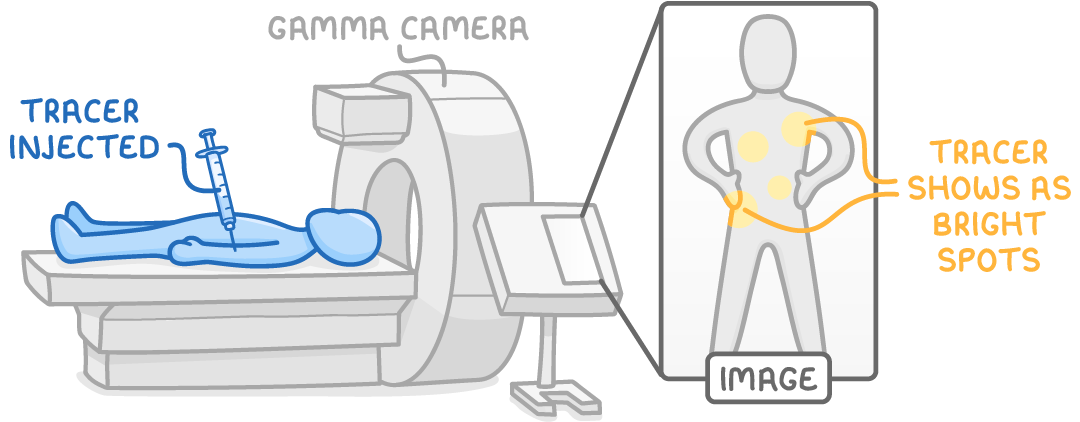
- A tracer containing a gamma-emitting source is injected or swallowed, and a gamma camera outside the body detects the emitted gamma rays to build an image.
- Gamma rays are used because they pass out through skin, soft tissue and bone without being fully absorbed.
- Tracers can be attached to molecules like glucose; cancerous tumours use more energy and take up more glucose, showing up as bright spots on the scan.
Sterilising with gamma rays
Medical instruments
- Gamma rays sterilise medical instruments by killing microbes (such as bacteria).
- They pass through packaging and reach into deep crevices.
- They can sterilise items that would melt or be damaged by heat, such as plastic instruments.
Food
- Gamma radiation kills microbes on food, keeping it fresh for longer without cooking or freezing.
- The treatment does not make the food radioactive, so it's safe to eat.
Staying safe around X-rays
- X-rays are ionising, so exposure can damage living cells.
- Exposure is kept as low as possible by:
- Using lead aprons and shields to absorb stray radiation.
- Keeping the exposure time to a minimum.
Weighing risks against benefits
- Using electromagnetic radiation brings benefits that must be weighed against the risks.
- Decisions about using radiation technologies should be justified using scientific evidence and data, rather than opinion.
Example - Airport body scanners
- Some airport body scanners used X-rays to improve security.
- Although the radiation dose was very low, concerns that repeated exposure increased cancer risk led to this type of scanner being banned in many countries.
TermDefinition
CT scanA scan that uses multiple X-rays taken from different angles to build a 3D image of the body.
RadiotherapyThe treatment of cancer using high doses of ionising radiation to kill cancer cells.
TracerA radioactive substance put into something, such as a patient's body or a pipe, to show where it goes. The radiation it gives out is detected from outside.
Key points to remember
How were these notes?