1.14 - Sound Waves & Hearing
Sound is a longitudinal wave that needs a medium
- A sound wave is produced by a vibrating object, which passes vibrations into the particles of the surrounding material.
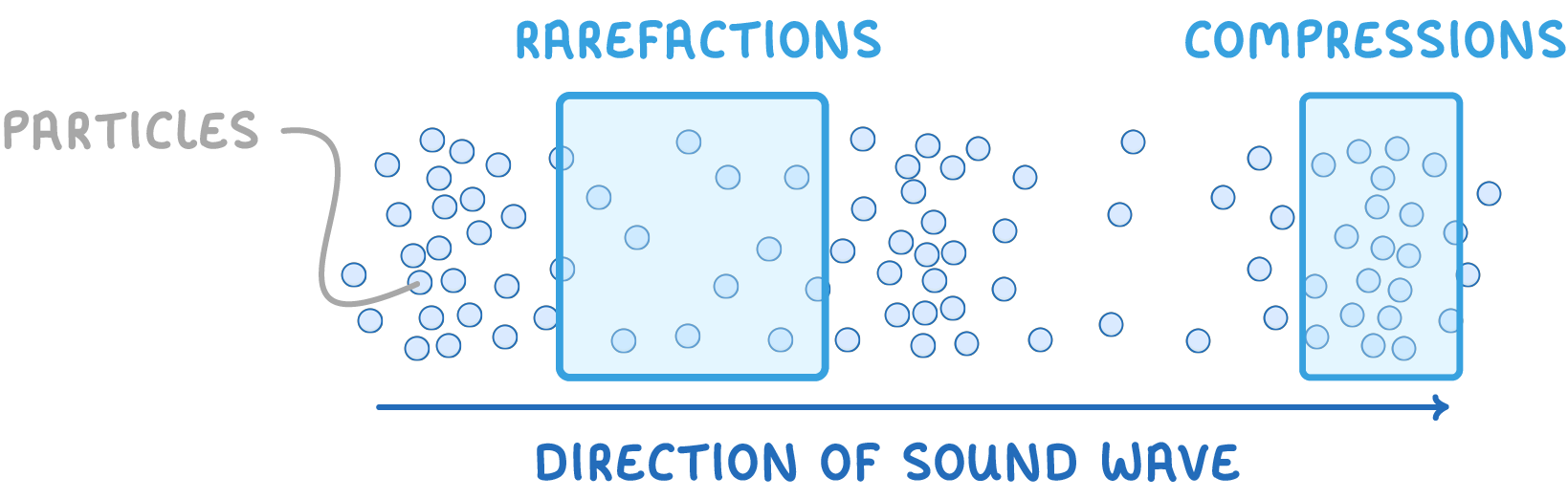
- Sound is a longitudinal wave: the particles vibrate back and forth along the same direction the wave travels.
- As they vibrate, particles bunch into regions of high pressure called compressions, and spread apart into regions of low pressure called rarefactions.
- The wave is this travelling pattern of compressions and rarefactions. The particles vibrate about fixed positions - it's the wave, not the material, that travels.
Sound needs a medium
- Because it is carried by vibrating particles, sound needs a medium - a solid, a liquid, or a gas.
- Sound cannot travel through a vacuum (such as space) because there are no particles to pass the vibrations on.
Speed of sound in different materials
- Sound travels at different speeds in different materials: in general, it travels fastest in solids, slower in liquids, and slowest in gases.
- The denser the medium, the more closely packed its particles are, so vibrations pass from particle to particle more quickly.
- In air, sound travels at roughly 330 to 350 m/s, depending mainly on air temperature.
TermDefinition
CompressionA region in a longitudinal wave where the particles are squashed close together.
RarefactionA region in a longitudinal wave where the particles are spread further apart.
MediumA material that a wave travels through, which can be a solid, liquid or gas.
VacuumA completely empty space containing no particles.
Key points to remember
How were these notes?