1.13 - Investigating Refraction
Investigating refraction and dispersion with a prism
- Apparatus - A light source (a ray box, or a laser), coloured filters, and a triangular glass prism on paper.
- Keep the room dim.
Method
- Draw around the prism. Place a coloured filter (start with red) in front of the ray box and shine a thin beam into the prism at an angle to its surface.
- Trace the incident ray and the ray that emerges, then remove the prism. Join the entry and exit points with a straight line to show the refracted ray inside the prism.
- Draw normals (lines at 90° to the faces) at the entry and exit points. Measure the angles of incidence and refraction with a protractor at each surface.
- Repeat with a blue filter at the same angle of incidence, then with other colours.
Findings
- Entering the denser glass, light slows down and bends towards the normal, so the angle of refraction is smaller than the angle of incidence.
- Leaving the prism back into air, it speeds up and bends away from the normal.
- Shorter wavelengths refract more - Blue light bends more than red at each boundary.
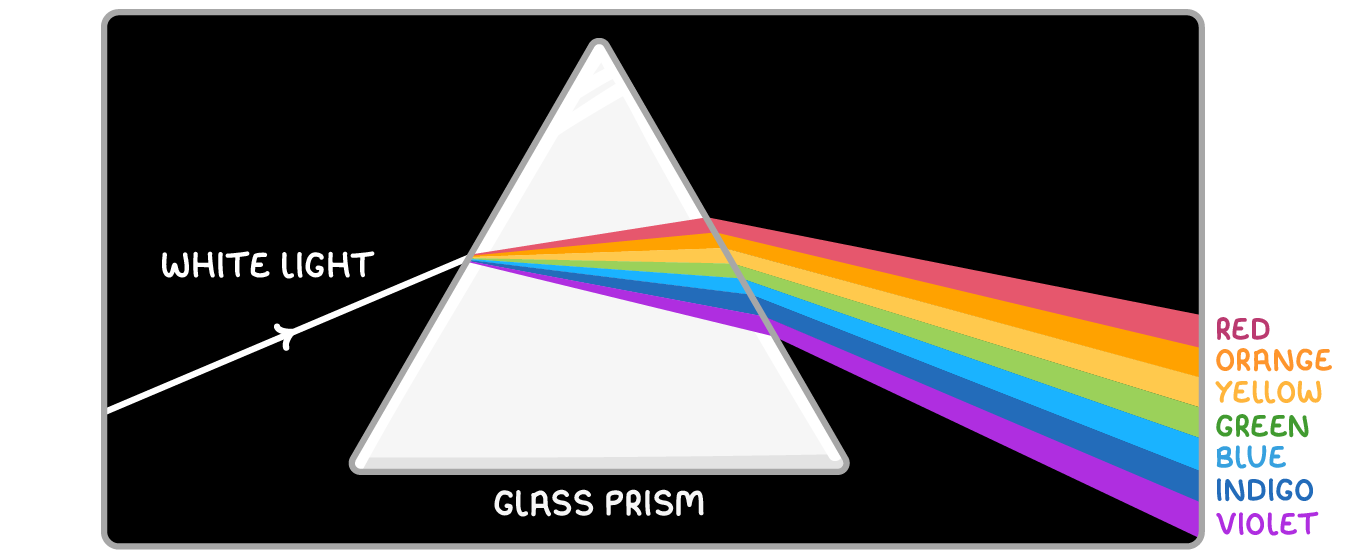
- The prism's faces are not parallel, so shining white light (no filter) separates it into a spectrum, with red bending least and violet most.
TermDefinition
NormalA line drawn at right angles to a surface or boundary at the point where a ray or wave meets it. A force or pressure that acts at right angles to a surface is also said to act normal to it.
Angle of incidenceThe angle between the incident ray and the normal.
Angle of refractionThe angle between the refracted ray and the normal.
SpectrumThe range of wavelengths (or colours) that radiation is spread into, such as the band of colours a prism makes from white light, or the whole electromagnetic spectrum.
Key points to remember
How were these notes?