1.3 - Electromagnetic Waves
EM waves transfer energy from a source to an absorber
- Electromagnetic (EM) waves are transverse waves that transfer energy from a source to an absorber.
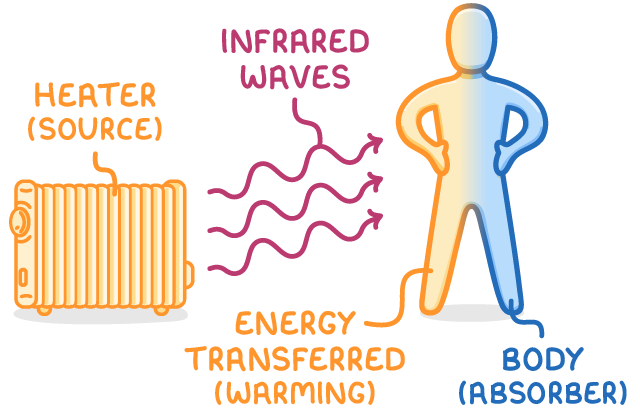
- For example, an electric heater (source) emits infrared waves that are absorbed by your body (absorber), warming you.
- EM waves are vibrations of electric and magnetic fields, not particles, so they can travel through a vacuum (such as empty space).
The speed of EM waves
- All EM waves travel at the same speed through a vacuum (and through air): 3.0 × 10⁸ m/s (the speed of light).
- EM waves travel at different speeds in different materials.
EM waves form a continuous spectrum of seven groups
- EM waves cover a wide range of wavelengths and frequencies.
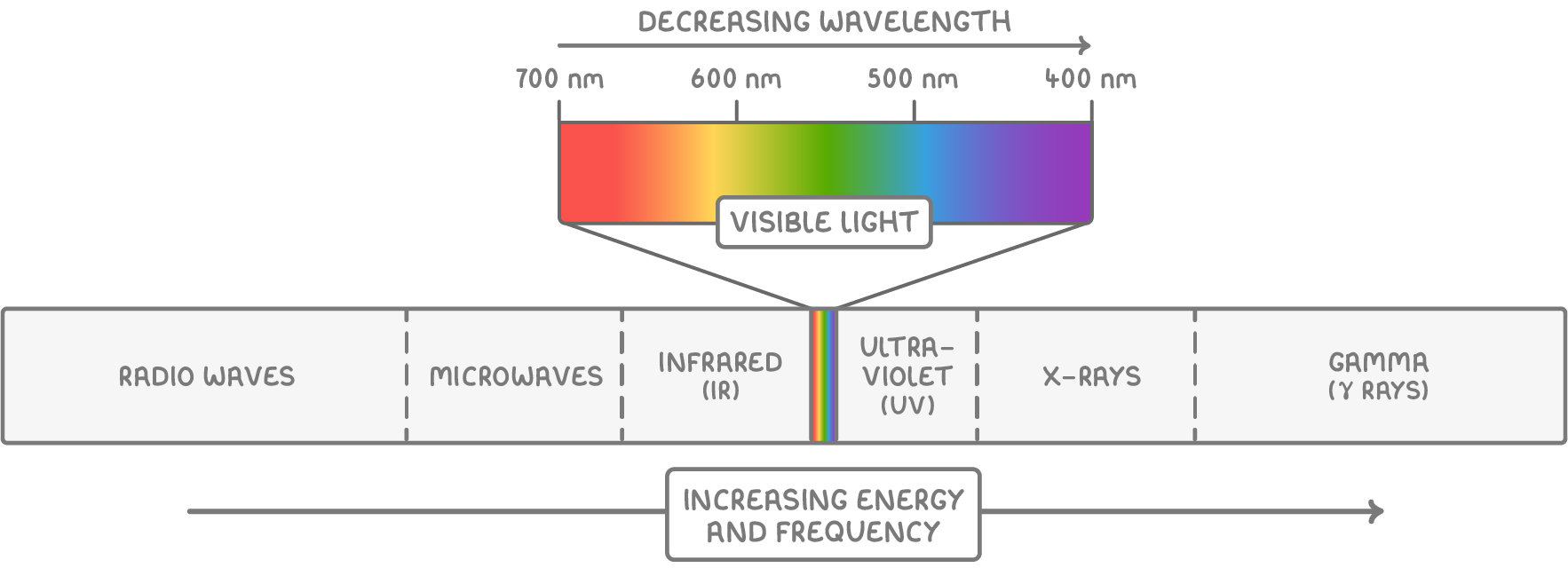
- They're grouped into seven bands, with no sharp boundaries between them, forming a single continuous spectrum.
In order from longest wavelength (lowest frequency) to shortest wavelength (highest frequency):
radio waves → microwaves → infrared → visible light → ultraviolet → X-rays → gamma rays
As wavelength decreases, frequency increases across the spectrum (since ).
Visible light
- Our eyes detect only visible light, which is a narrow band of the spectrum.
- Within visible light, the colour depends on the wavelength. From longest wavelength to shortest:
red, orange, yellow, green, blue, indigo, violet
Interactions at a boundary
- Different wavelengths interact differently at a boundary between materials.
- A wave may be absorbed, transmitted, reflected or refracted, depending on both the material and the wavelength.
How EM waves are generated by changes in atoms
EM waves can be generated by changes inside atoms and their nuclei:
- Electrons losing energy - When electrons drop to a lower energy level, the atom emits an EM wave (infrared, visible light, ultraviolet, or X-rays, depending on the energy change).
- Changes in the nucleus - Unstable nuclei emit gamma rays.
- Molecules vibrating - Oscillating bonds between atoms generate infrared radiation.
Absorption is the reverse process
- When EM waves are absorbed, the process works in reverse: an atom or molecule absorbs a wave whose energy matches one of these changes.
- A given substance therefore absorbs a specific range of frequencies.
What happens when EM waves are absorbed
- When an EM wave is absorbed, its energy is transferred to the absorbing material.
- For most EM waves, the main effect of absorption is heating.
Ionising radiation
- High-energy ultraviolet, X-rays and gamma rays carry enough energy to knock electrons off atoms when absorbed.
- This process is called ionisation, and these waves are described as ionising radiation.
Ozone in the upper atmosphere
- Ultraviolet radiation from the Sun is absorbed by oxygen molecules high in the atmosphere, converting them into ozone.
- This ozone layer then absorbs large amounts of harmful ultraviolet radiation, shielding living organisms on Earth.
TermDefinition
Electromagnetic waveA transverse wave that transfers energy from a source to an absorber and travels at the same speed as all other electromagnetic waves in a vacuum.
Continuous spectrumA spread of wavelengths and frequencies with no gaps or sharp boundaries between the different bands.
IonisationThe process in which an atom gains or loses an electron and becomes a charged ion.
Ionising radiationRadiation that has enough energy to knock electrons out of atoms, turning them into ions.
Key points to remember
How were these notes?