8.5 - Wind & Solar
Wind turbines generate electricity
- Wind turbines are built in exposed places where the wind is strong - moors, coasts, or out at sea.
- They can stand singly or be grouped into a wind farm.
How a wind turbine works
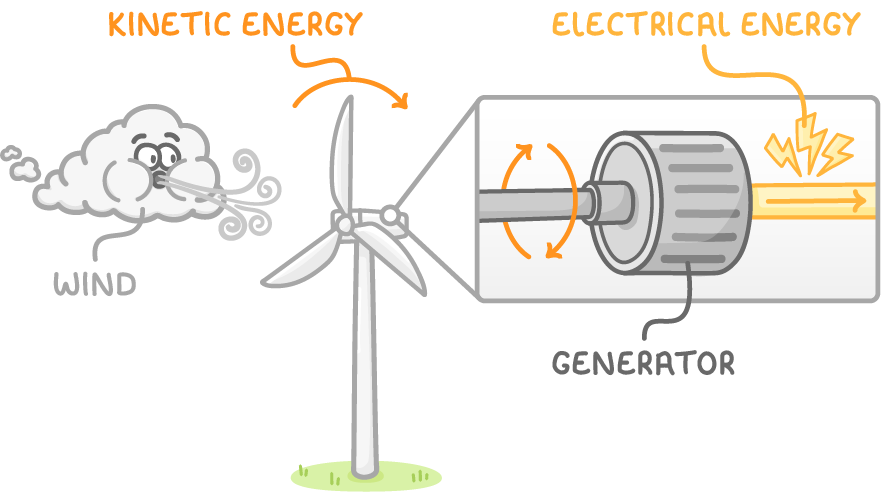
- Each turbine has a generator inside it.
- Moving air turns the blades, which turn the generator to produce electricity.
- The energy comes from the kinetic energy of the wind, so no fuel is burned.
Advantages
- No pollution while running (some is produced during manufacture).
- The wind is free, so there are no fuel costs and low running costs.
- Renewable - The wind won't run out.
- No permanent damage to the landscape.
Disadvantages
- High initial cost to build, especially out at sea.
- A very large number of turbines is needed to replace one conventional power station, taking up a lot of space and affecting views.
- Turbines can be noisy, annoying people living nearby.
- The supply is unreliable - they only work when it's windy, and output can't be increased to meet extra demand.
Solar cells generate electricity directly from sunlight
- Solar cells generate electricity directly from sunlight, with no moving parts and no burning of fuel.
- Individual cells join together to form solar panels, and multiple panels form a solar farm.
What they are used for
- Powering small, low-power devices such as calculators and watches.
- Providing electricity in remote places - satellites, road signs, and homes far from the mains grid.
- Small-scale generation on home rooftops.
Advantages
- No pollution while working.
- The Sun's energy is free and running costs are almost zero once installed.
- Renewable and very reliable in sunny countries.
Disadvantages
- High initial cost to manufacture and install.
- They only generate in the daytime, and the supply can't be increased to meet extra demand.
- They produce relatively little power for the area they take up.
TermDefinition
Solar cellA device that generates electricity directly from sunlight.
Key points to remember
How were these notes?