6.1 - Atomic Structure & Isotopes
The nuclear model of the atom
- An atom has a tiny central nucleus surrounded by electrons.
- The nucleus contains protons (positively charged) and neutrons (neutral), giving the nucleus an overall positive charge.
- Electrons are negatively charged and orbit the nucleus at different distances.
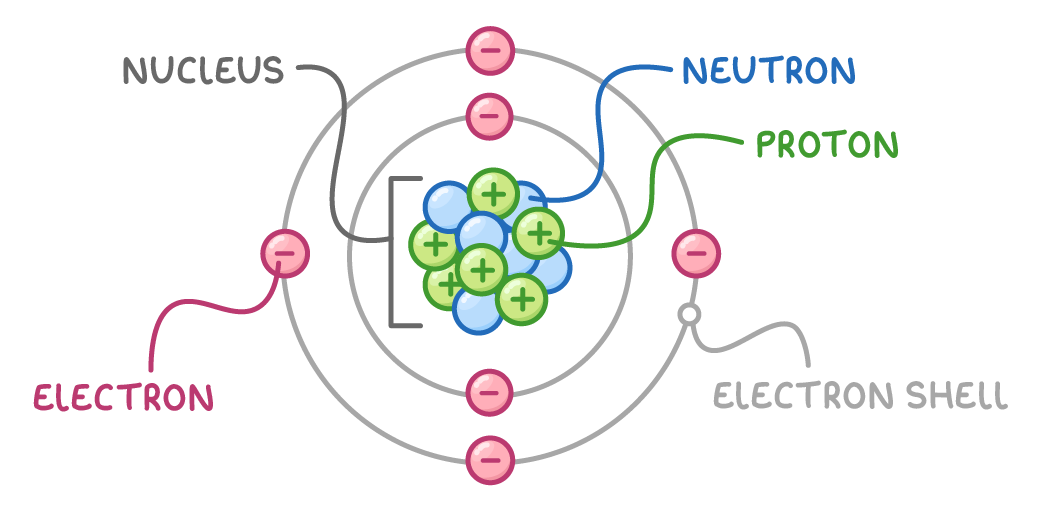
Not to scale: the nucleus is drawn far larger so it can be seen.
The three subatomic particles
| Particle | Relative mass | Relative charge |
|---|---|---|
| Proton | 1 | +1 |
| Neutron | 1 | 0 |
| Electron | very small (about 0.0005) | -1 |
Almost all of an atom's mass is concentrated in the nucleus. The rest of the atom is mostly empty space.
Atoms are neutral
An atom has no overall charge because it has equal numbers of protons and electrons, whose equal and opposite charges cancel out.
The size of atoms
- The radius of a typical atom is about 1 × 10⁻¹⁰ m.
- The nucleus is much smaller - its radius is more than 10,000 times smaller than the radius of the whole atom.
- Small molecules (e.g. O2) are roughly the size of a single atom, about 1 × 10⁻¹⁰ m.
Atomic number, mass number and isotopes
The number of protons determines which element an atom is (e.g. every carbon atom has 6 protons).
Atomic number and mass number
- Atomic number (proton number) - The number of protons in the nucleus, symbol .
- Mass number (nucleon number) - The total number of protons and neutrons in the nucleus, symbol .
- In a neutral atom, the atomic number also equals the number of electrons.
- Number of neutrons = .
Nuclide notation
A nucleus is written with the mass number above the atomic number, in front of the chemical symbol:
Where:
- = Chemical symbol
- = Mass number
- = Atomic number
For example, has 6 protons and 14 - 6 = 8 neutrons.
Isotopes
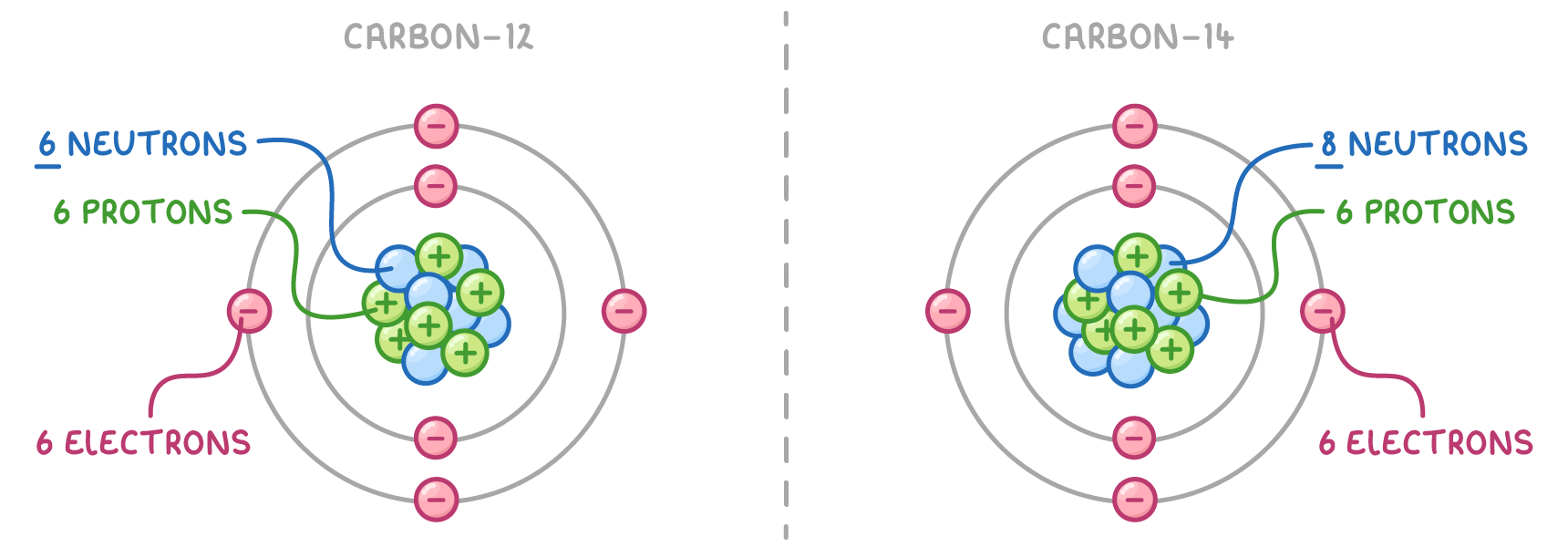
- Isotopes are atoms of the same element with the same number of protons but different numbers of neutrons (same atomic number, different mass numbers).
- Example: carbon-12 has 6 protons and 6 neutrons, while carbon-14 has 6 protons and 8 neutrons.
- Most elements have multiple isotopes, but usually only one or two are stable.
Electron energy levels
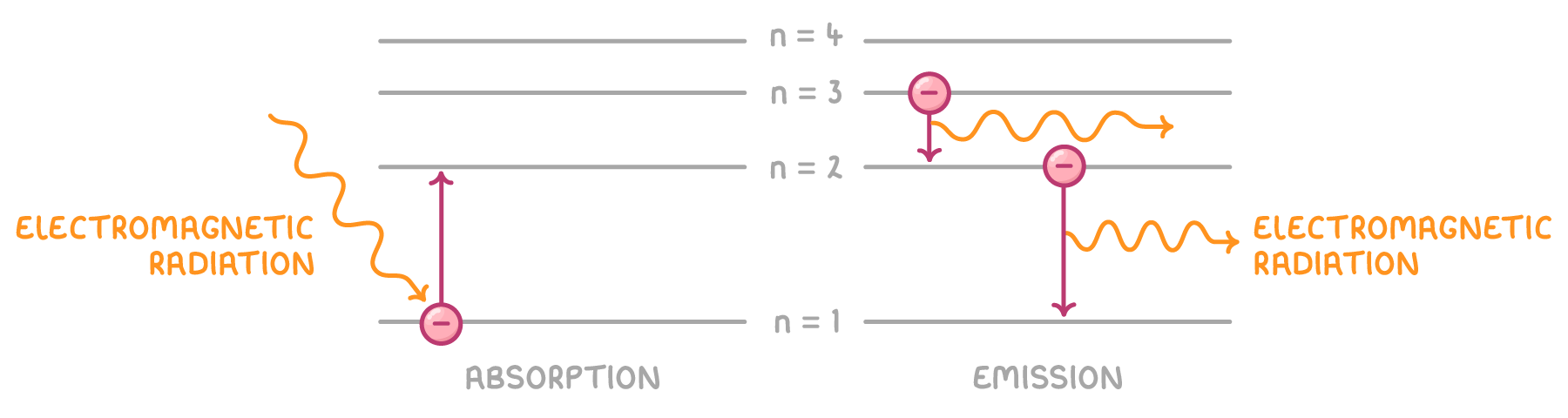
- Electrons occupy energy levels (shells) at different distances from the nucleus.
- The further an energy level is from the nucleus, the higher its energy. The levels are numbered outwards from the nucleus, starting at n = 1 for the level closest to it.
Moving between energy levels
- Absorbing electromagnetic radiation - An electron absorbs radiation with the right energy to move up to a higher energy level (it becomes excited).
- Emitting electromagnetic radiation - An excited electron falls back to a lower level, emitting electromagnetic radiation equal in energy to the gap between the levels.
Frequency and energy gaps
- The energy of the radiation emitted depends on the size of the energy gap between the levels.
- A larger energy gap produces radiation of higher frequency.
Ionisation
- If an electron absorbs enough energy, it can leave the atom entirely.
- Losing an electron leaves the atom with an overall positive charge, turning it into a positive ion. This process is called ionisation.
- If an atom gains an electron, it becomes a negative ion.
How fluorescent tubes produce light
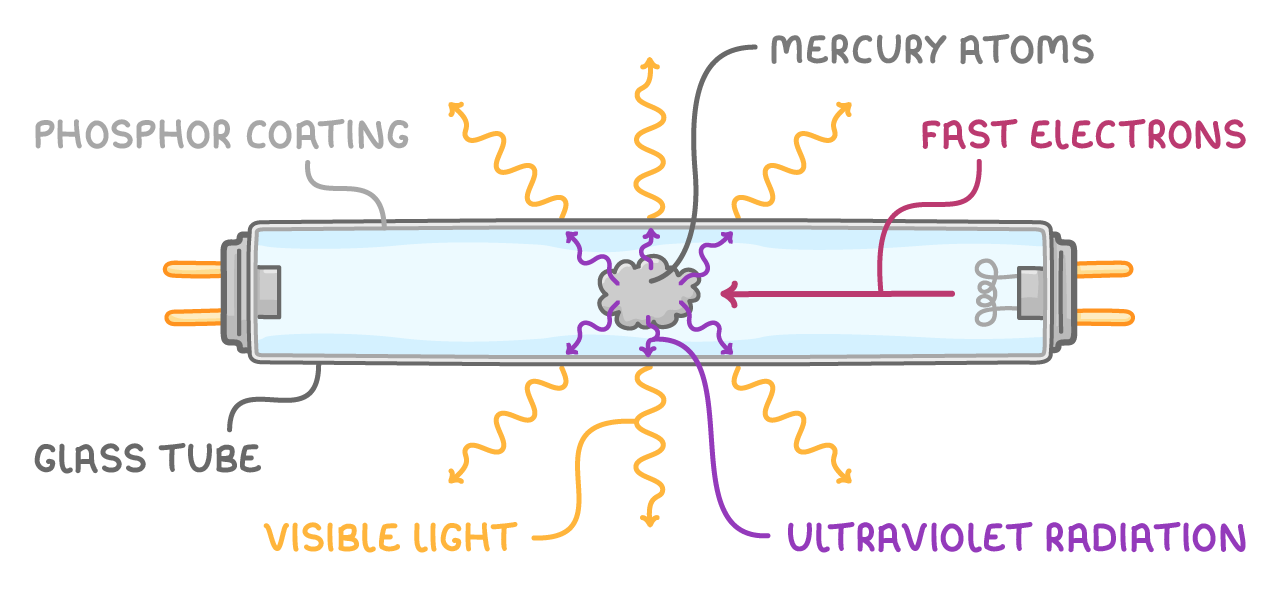
A fluorescent tube uses electron energy-level transitions to produce visible light in two stages.
Stage 1 - Mercury vapour emits ultraviolet radiation
- Fast-moving electrons pass through the tube and collide with mercury atoms.
- These collisions excite electrons in the mercury atoms to higher energy levels.
- When the excited electrons fall back down, they emit ultraviolet radiation.
Stage 2 - Phosphor coating emits visible light
- The inside of the tube is coated with a phosphor.
- The phosphor absorbs the ultraviolet radiation, exciting its electrons.
- These electrons cascade down through lower energy levels in smaller steps, emitting visible light.
TermDefinition
Atomic numberThe number of protons in the nucleus of an atom.
Mass numberThe total number of protons and neutrons in the nucleus of an atom.
IsotopeOne of two or more forms of the same element whose atoms have the same number of protons but different numbers of neutrons.
IonisationThe process in which an atom gains or loses an electron and becomes a charged ion.
Key points to remember
How were these notes?