5.3 - Refraction
Why waves refract - The change in speed
- A wave refracts because it changes speed when crossing into a different material.
- If the wave meets the boundary at an angle, this change in speed makes it change direction.
- The bigger the change in speed, the more the wave bends.
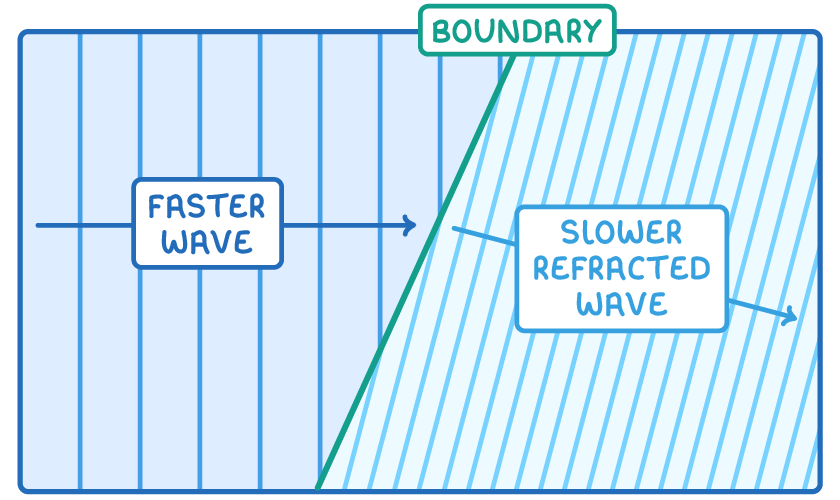
Wavefront explanation
- When a line of wavefronts hits a boundary at an angle and slows down, the end that crosses first slows down before the other end.
- That end travels a shorter distance in the same time, so the wavefront swings round and changes direction.
- The wavefronts also get closer together, showing that wavelength has decreased.
Frequency stays the same, so wavelength changes
When a wave crosses a boundary, its frequency does not change. From the wave equation (), if speed changes while frequency is constant, the wavelength must change:
- If the wave slows down, its wavelength decreases.
- If the wave speeds up, its wavelength increases.
Optical density
- Optical density is a measure of how quickly light travels through a material - the higher the optical density, the slower light travels.
- Light slows down and bends towards the normal when entering a more optically dense material.
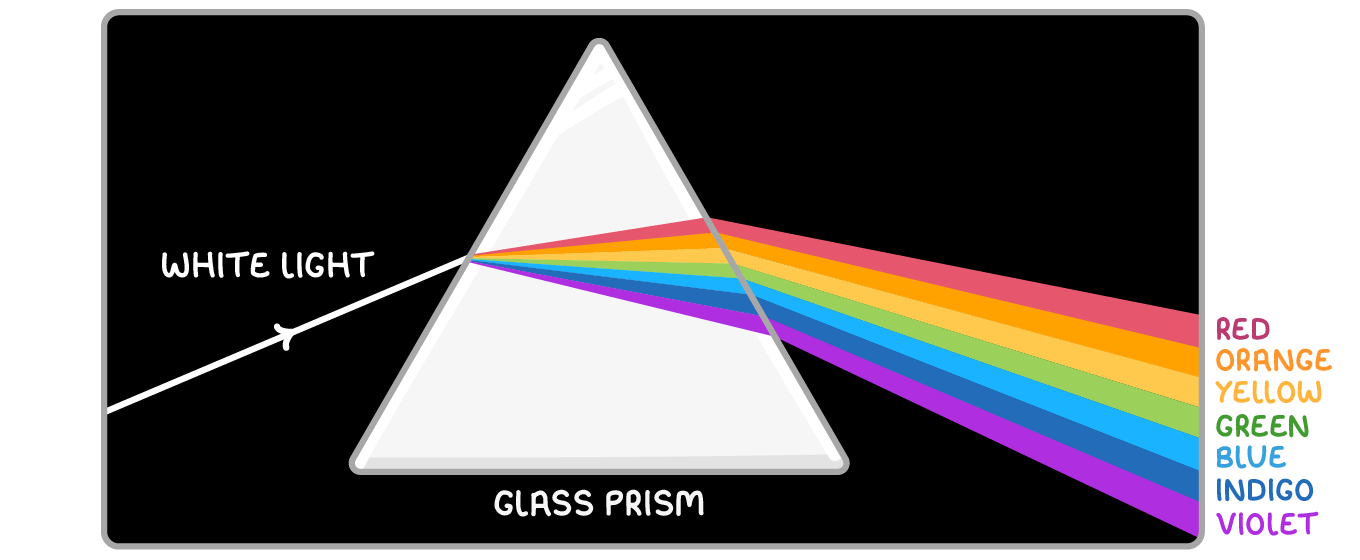
A prism splits white light into a spectrum
- White light is a mixture of all the colours in the visible spectrum, each with a different wavelength.
- Different wavelengths refract by different amounts, so a triangular prism separates white light into a spectrum. This is called dispersion.
Why the colours disperse
- All colours travel at the same speed in air, but travel at different speeds in glass.
- Violet slows down the most and refracts the most.
- Red slows down the least and refracts the least.
- Because the sides of a triangular prism are not parallel, the colours spread out further as they leave rather than recombining.
Light of a single frequency (one colour) is called monochromatic.
TermDefinition
Optical densityA measure of how much a material slows down light passing through it.
DispersionThe separation of white light into a spectrum of colours because different wavelengths refract by different amounts.
MonochromaticLight of a single frequency or colour.
Key points to remember
How were these notes?