7.7 - Conservation of Energy
The principle of conservation of energy
The principle of conservation of energy states:
Energy can be stored, transferred between stores, or dissipated, but it can never be created or destroyed.
The total amount of energy never changes: the total energy before a process always equals the total energy after it.
Dissipation and wasted energy
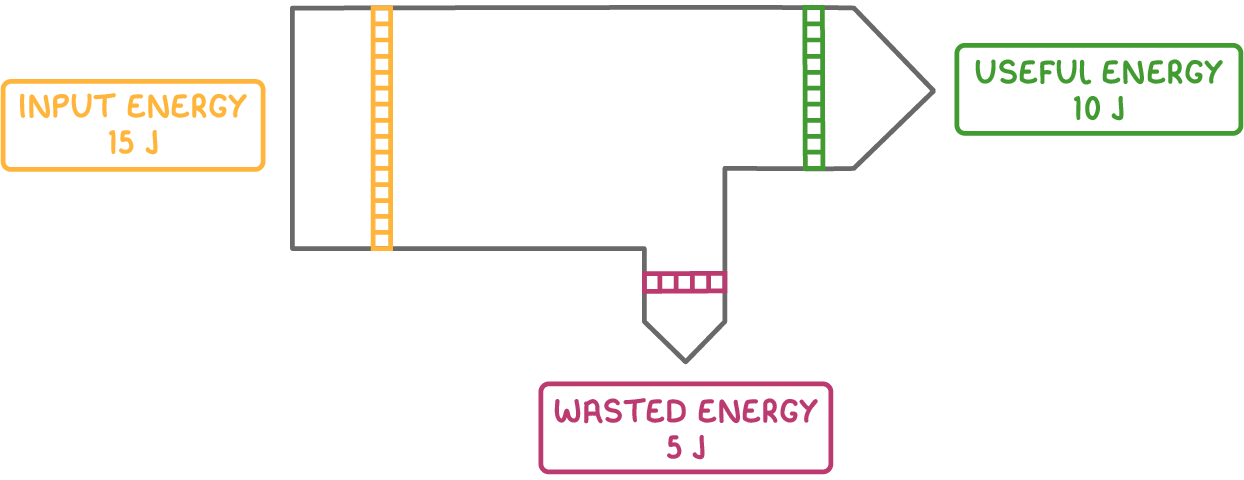
- Whenever a transfer happens, some energy is always dissipated: it spreads out into the surroundings and ends up in less useful stores.
- Dissipated energy is often called wasted energy, because it's no longer stored in a way you can usefully use.
- It almost always ends up in thermal energy stores, warming the device and the surrounding air.
- No transfer is perfectly efficient - Some energy is always wasted.
- Wasted energy isn't destroyed - It has simply spread out into the surroundings, making it very difficult to recover and use again.
Example: when a motor lifts a load, most of the input energy transfers usefully into the load's gravitational potential energy store, but some warms the motor and surrounding air as dissipated energy.
Closed and open systems
A system is an object or a group of objects.
Closed systems
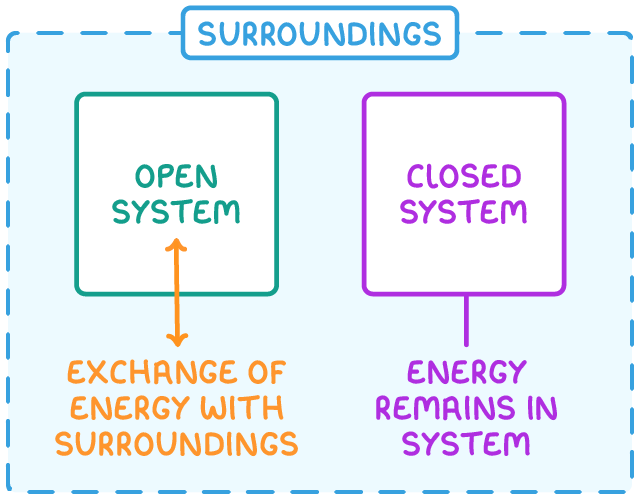
- In a closed system, no energy enters or leaves across the boundary.
- The total energy of a closed system is constant (the net change in total energy is zero), although energy can still transfer between stores inside it.
Open systems
- In an open system, energy can enter or leave across the boundary, so the system's total energy can increase or decrease.
- You can treat an open system as a closed system by widening the boundary to include everything that exchanges energy with it.
Dissipation in open and closed systems
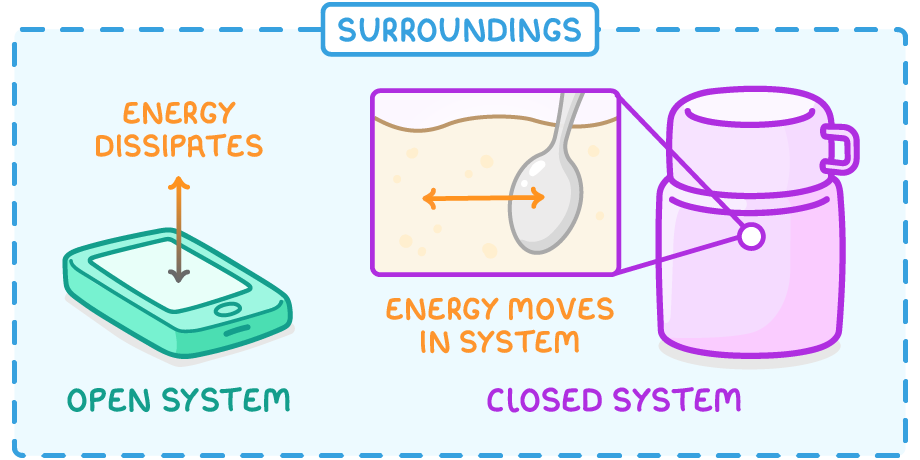
A mobile phone (an open system)
- As a phone is used, energy transfers usefully from the battery's chemical energy store to run the screen and processor.
- Some energy is dissipated to the thermal energy store of the phone and the surrounding air.
- Because energy leaves the phone into the surroundings, the phone alone is an open system and its total energy decreases.
A sealed flask of soup (a closed system)
- A cold spoon is placed inside an insulated flask of hot soup, and the flask is sealed.
- Energy transfers from the thermal energy store of the hot soup to the thermal energy store of the spoon, cooling the soup slightly and warming the spoon.
- Because no energy enters or leaves the insulated flask, it is a closed system and the net change in total energy is zero.
TermDefinition
Principle of conservation of energyEnergy can never be created or destroyed.
DissipatedDescribes energy that has spread out into the surroundings, usually by heating them, so it is less useful.
Wasted energyEnergy that has spread out into the surroundings and is no longer useful.
SystemAn object or a group of objects being studied.
Closed systemA system where no matter or energy can enter or leave, and no external forces act on it.
Open systemA system where energy can enter or leave across the boundary.
Key points to remember
How were these notes?