2.19 - Hooke's Law & Spring Constant
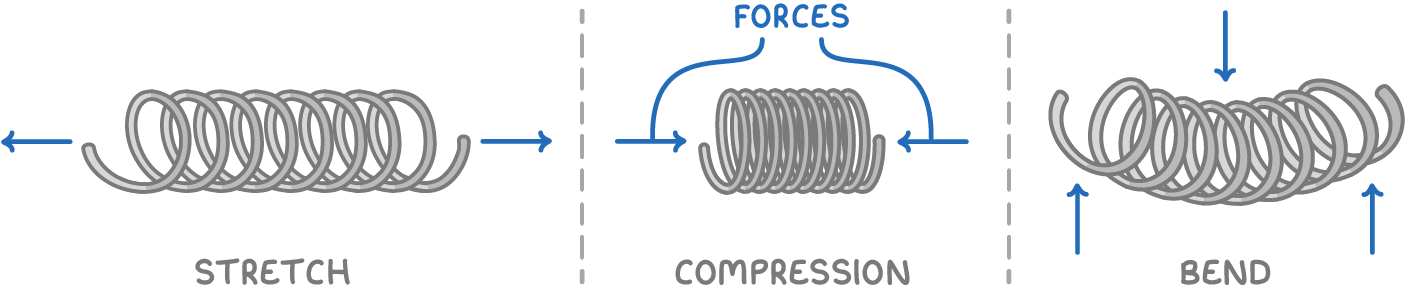
Stretching, compressing or bending an object
- Applying a force can change an object's shape - it can stretch, compress or bend.
- Changing an object's shape is called deforming it.
- You need more than one force to deform an object. A single force simply moves the object in that direction rather than changing its shape.
Two kinds of deformation
- Elastic deformation - The object returns to its original shape and length once the forces are removed. An object that does this is an elastic object (such as a spring).
- Inelastic deformation - The object does not return to its original shape and length after the forces are removed; it stays permanently deformed.
Energy and deformation
- Work is done when a force stretches, compresses or bends an object, transferring energy to its elastic potential energy store.
- If the deformation is elastic, all of this energy is transferred to the elastic potential energy store and can be recovered when the forces are removed.
- If the applied forces are too large, the deformation becomes inelastic and the object stays permanently deformed.
Hooke's law
- The amount an object stretches by is its extension - the difference between its stretched length and its natural length (its length with no force applied).
- For an elastic object, extension is directly proportional to the force applied, as long as the limit of proportionality is not exceeded. This is Hooke's law.
Formula for Hooke's law
Where:
- = Force applied, in newtons (N)
- = Spring constant, in newtons per metre (N/m)
- (or ) = Extension (or compression), in metres (m)
The spring constant
- The spring constant, , is the force needed per unit of extension. A stiffer spring has a larger spring constant and extends less for a given force.
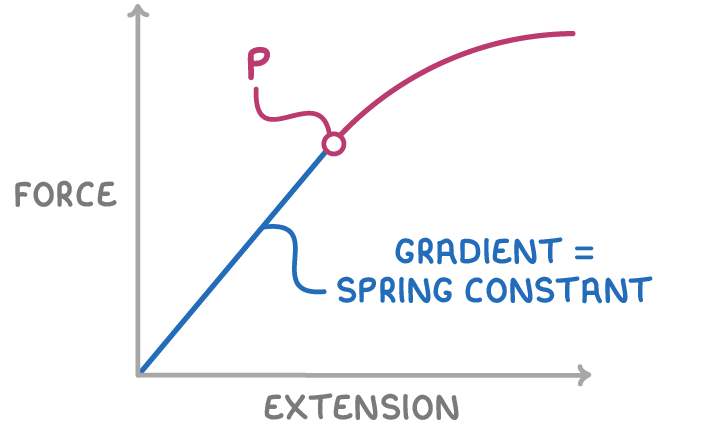
- While Hooke's law holds, a force-extension graph is a straight line through the origin, and its gradient equals the spring constant, .
The limit of proportionality
- Hooke's law only holds up to a certain point. Increase the force far enough and extension stops being proportional to force.
- On a force-extension graph, the line starts straight (where the spring obeys Hooke's law) and begins to curve once the force exceeds a maximum value.
- The point where the graph starts to curve is the limit of proportionality, often marked P.
- Beyond this point, the relationship is non-linear: each additional unit of force produces a larger increase in extension.
Elasticity versus Hooke's law
- An object can be elastic without obeying Hooke's law.
- A rubber band is elastic (it returns to its original shape when released), but its force-extension relationship is non-linear, so it does not obey Hooke's law.
The elastic limit
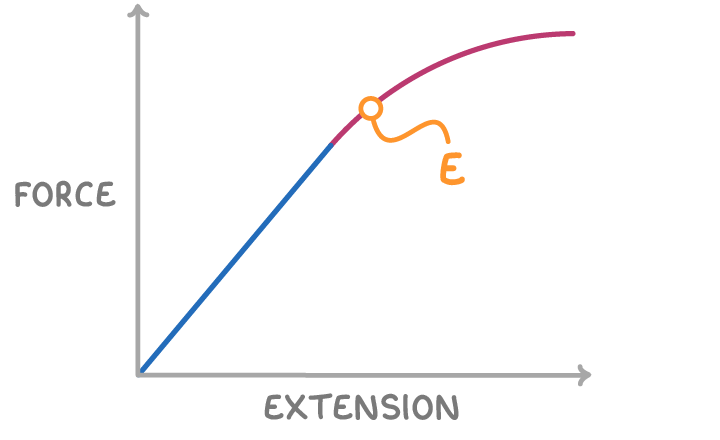
- Some materials continue deforming elastically past the limit of proportionality, but past a certain point the deformation becomes permanent.
- The elastic limit is the point at which an object stops deforming elastically and starts to deform inelastically.
- On a force-extension graph it's marked E, at or just beyond the limit of proportionality.
- If the force exceeds the elastic limit, the object is permanently stretched: when all force is removed, it stays longer than its original natural length.
Worked example - Finding a spring constant
A spring has a natural length of 10.0 cm. When a 9.0 N weight is hung from it, its total length becomes 28.0 cm. Find the spring constant, then predict the total length when the load is 6.0 N.
Step 1 - Find the extension caused by the 9.0 N weight
Step 2 - Rearrange F = ke and substitute to find k
Step 3 - Use the spring constant to find the extension at 6.0 N
Step 4 - Add the extension to the natural length
Total length = 10.0 + 12 = 22 cm
Work done in stretching a spring
- Stretching a spring requires a force, which does work on the spring.
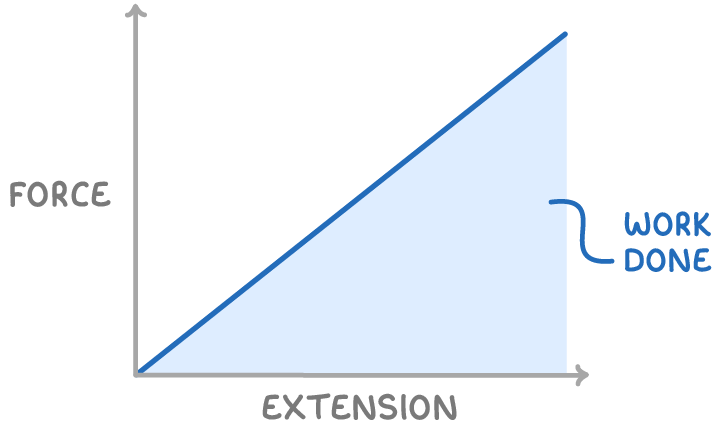
- The work done equals the area under the force-extension graph up to the extension reached.
- While the spring obeys Hooke's law, the graph is a straight line through the origin, so the area is a triangle.
Formula for work done in the linear region
Where:
- = Work done by the stretching force, in joules (J)
- = Force applied at the final extension, in newtons (N)
- = Extension, in metres (m)
The appears because the force increases steadily from zero, so the average force over the stretch is half the final force. Past the limit of proportionality the graph curves, and the area must be found another way (such as by counting squares).
Worked example - Work done in stretching a spring
A spring obeys Hooke's law. When a force of 12 N is applied, the spring has an extension of 0.15 m. Find the work done by the stretching force.
Step 1 - Identify the values
Step 2 - The work done is the area under the force-extension graph
While the spring obeys Hooke's law the graph is a straight line through the origin, so the area is a triangle with base and height .
Step 3 - Substitute the values
TermDefinition
Elastic deformationA change in shape where the object returns to its original shape and length once the forces are removed.
Inelastic deformationA change in shape where the object does not return to its original shape and length after the forces are removed.
ExtensionThe increase in length of an object when it is stretched, equal to its stretched length minus its original (natural) length.
Hooke's lawThe rule that the extension of an elastic object is directly proportional to the force applied, up to the limit of proportionality.
Spring constantA measure of an object's stiffness, defined as the force needed per unit of extension.
Limit of proportionalityThe point beyond which the extension of an object is no longer directly proportional to the force applied to it.
Elastic limitThe point at which an object stops deforming elastically and begins to deform inelastically.
Key points to remember
How were these notes?