2.9 - Resolving Vectors
Finding a resultant force by scale drawing
- Two or more forces acting on an object can be replaced by a single resultant force that has the same overall effect.
- Along the same straight line - Add forces acting in the same direction and subtract forces acting in opposite directions.
- At an angle to each other - Use a scale drawing.
Drawing the forces tip-to-tail
- Choose a sensible scale (e.g. 1 cm = 1 N).
- Draw each force to scale as an arrow, joined tip-to-tail - each arrow starts where the previous one ended.
- Draw a straight line from the tail of the first arrow to the tip of the last arrow. This line is the resultant force.
- Measure the length of the resultant and use the scale to find its magnitude.
- Measure the angle of the resultant with a protractor to find its direction.
The tip-to-tail method works for any number of forces, and for any vector quantity (such as displacement or velocity).
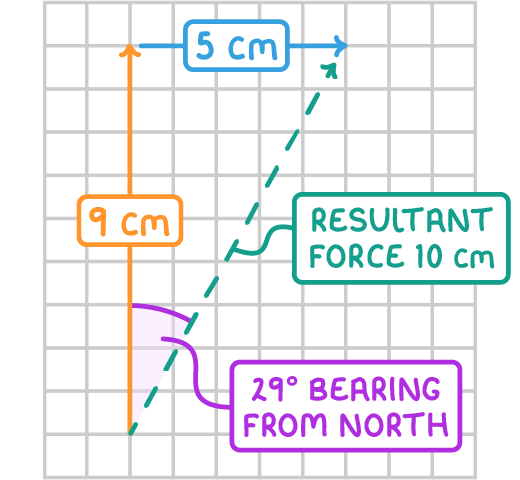
Worked example - Resultant force by scale drawing
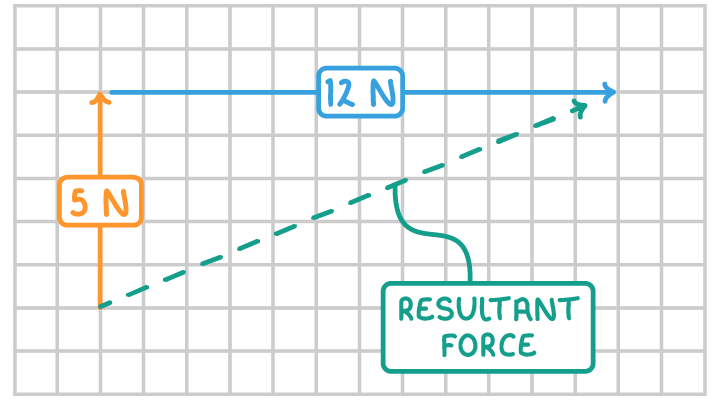
An object has a force of 5 N acting to the north and a force of 12 N acting to the east. Find the magnitude and direction of the resultant force.
Step 1 - Choose a scale
Use 1 cm to represent 1 N.
Step 2 - Draw the forces tip-to-tail
Draw the 5 N force as a 5 cm arrow pointing north. From its tip, draw the 12 N force as a 12 cm arrow pointing east.
Step 3 - Draw the resultant
Draw a straight line from the tail of the first arrow to the tip of the last arrow. Measuring gives a length of 13 cm.
Step 4 - Convert back to newtons
Using the scale, 13 cm represents a resultant force of 13 N.
Step 5 - Measure the direction
Measuring the angle with a protractor gives 67 degrees east of north.
The resultant force is 13 N at 67 degrees east of north.
Equilibrium and finding a missing force
- An object is in equilibrium when the resultant force acting on it is zero.
- An object in equilibrium is either stationary or moving at a constant velocity.
Equilibrium on a scale drawing
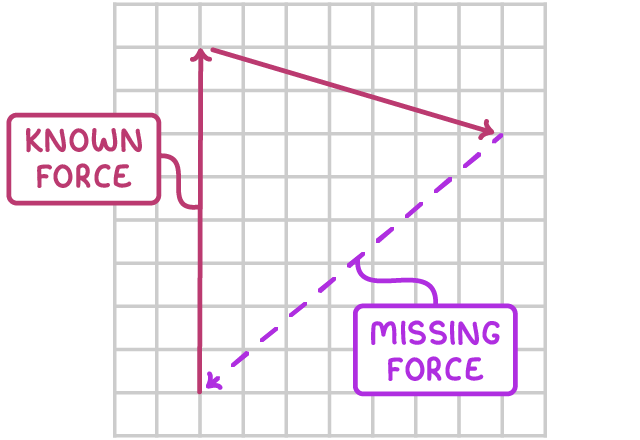
- If forces in equilibrium are drawn tip-to-tail, they form a closed loop - the tip of the last force ends at the tail of the first.
- Three forces in equilibrium form a closed triangle.
Finding a missing force
If an object is in equilibrium and all but one force is known:
- Draw the known forces to scale and tip-to-tail.
- Draw the missing force as an arrow from the tip of the last known force back to the tail of the first, closing the loop.
- Measure its length and angle to find its magnitude and direction.
The closing force runs in the opposite direction to a resultant: a resultant runs from the start to the end, while the balancing force runs from the end back to the start.
Resolving a force into perpendicular components
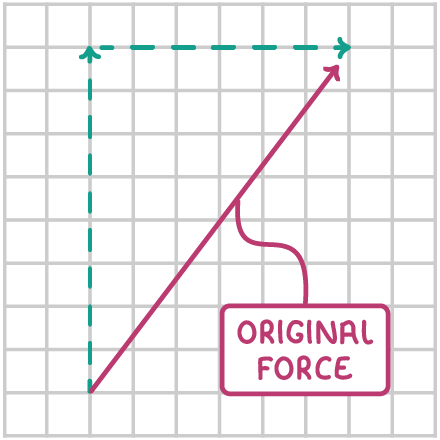
- A single force acting at an angle can be split into two perpendicular components (usually horizontal and vertical) that have the same overall effect.
- Splitting a force this way is called resolving it.
Resolving by scale drawing
- Draw the original force to scale as the hypotenuse of a right-angled triangle.
- Draw horizontal and vertical lines to complete the triangle.
- Measure the horizontal side and use the scale to find the horizontal component.
- Measure the vertical side and use the scale to find the vertical component.
Resolving is used when only the effect of a force in one particular direction is needed (such as the horizontal pull moving an object forward).