2.12 - Terminal Velocity
Drag and air resistance
- Drag is the frictional force on an object moving through a fluid (a liquid or a gas).
- Air resistance is a type of drag.
- Drag increases as speed increases - the faster an object moves, the more drag acts against it.
- For example, a car has much more drag to work against at 70 mph than at 30 mph, so the engine must provide a larger driving force to maintain that steady speed.

Streamlining and reducing drag
- The most important way to reduce drag is to give an object a streamlined shape.
- A streamlined shape lets fluid flow easily past it, reducing drag.
- A parachute is designed to do the opposite - its shape produces as much drag as possible.
Objects falling through a fluid reach a terminal velocity
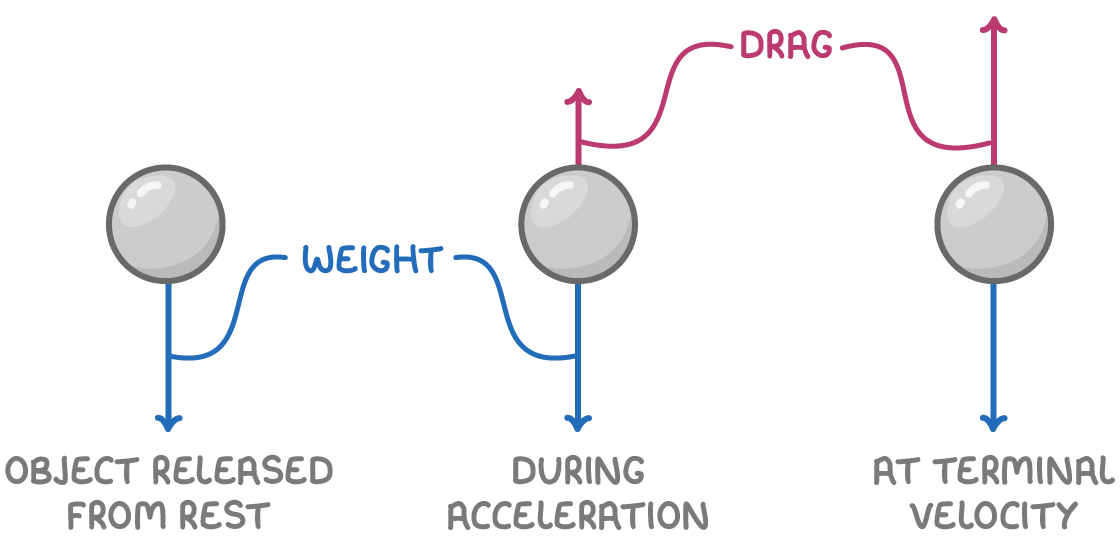
- When an object falls through a fluid, two forces act on it:
- Weight pulls it down.
- Drag (such as air resistance) pushes up against its motion.
- The object reaches a maximum constant speed called the terminal velocity.
How terminal velocity is reached
- At the start, weight is greater than drag, so there's a resultant force downwards and the object accelerates.
- As it speeds up, drag increases, which reduces the resultant force and decreases the acceleration.
- Eventually drag increases until it equals the weight. The resultant force is now zero, so the object falls at a steady speed - the terminal velocity.
Terminal velocity depends on shape and area
- A larger surface area produces more drag.
- An object with a larger area reaches terminal velocity at a lower speed, because drag balances its weight sooner.
The skydiver example
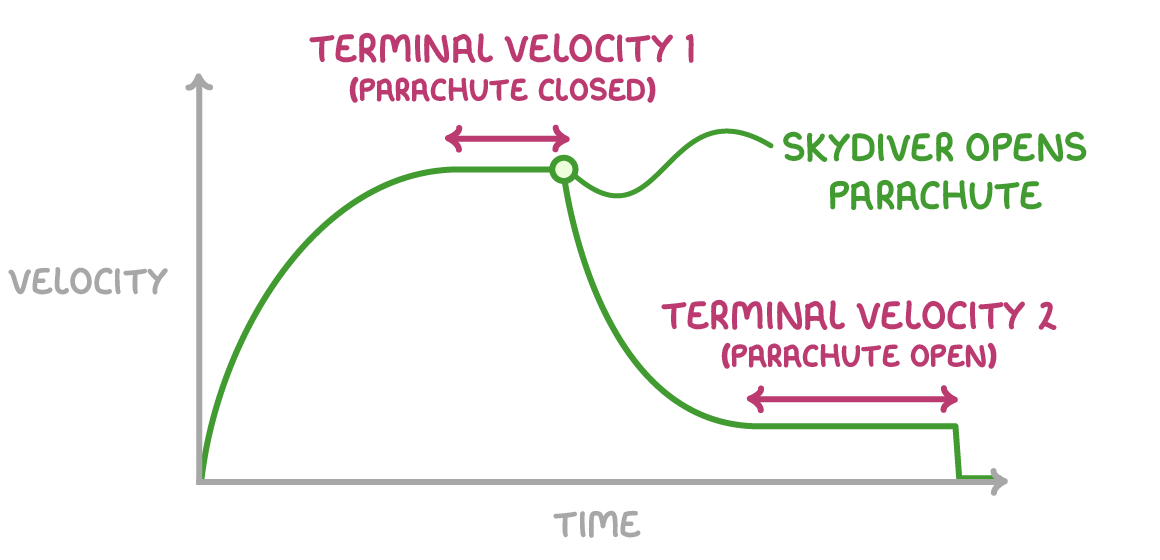
- Parachute closed - Small area gives low drag, so the skydiver reaches a high terminal velocity.
- Parachute open - Area is much larger, so drag is suddenly greater than weight and the skydiver decelerates. As speed falls, drag decreases until it equals weight again at a much lower, safe terminal velocity.
Practical - Terminal velocity of a toy parachute
Method
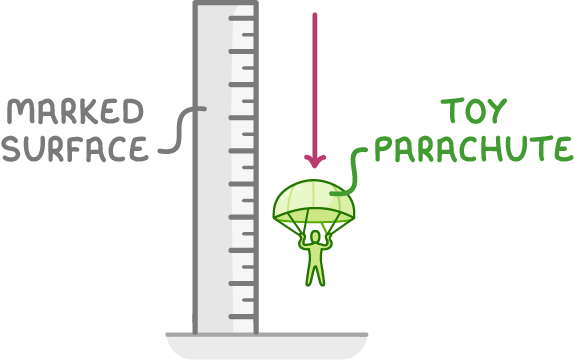
- Mark regular, set heights on a vertical surface (for example, every 0.5 m).
- Drop the toy parachute from a set height in front of the markings.
- Record the time at which the parachute passes each marking.
- Calculate the average velocity between each pair of markings using .
- Plot a graph of velocity against time.
Results
Velocity rises quickly at first, the curve becomes less steep as the parachute approaches terminal velocity, and it flattens into a horizontal line once terminal velocity is reached.
Improving accuracy
Film the fall and play the video back slowly to record the time at each marking more accurately.
TermDefinition
DragThe frictional force that acts on an object moving through a fluid.
FluidA liquid or a gas, whose particles can move past one another so it can flow.
Air resistanceA type of drag that acts on objects moving through the air.
StreamlinedDescribes a shape that lets a fluid flow easily past it, which reduces drag.
Terminal velocityThe maximum constant speed reached by a falling object when drag equals weight.
Key points to remember
How were these notes?