5.1 - Longitudinal & Transverse Waves
Waves transfer energy, not matter
- A wave transfers energy without transferring matter.
- As a wave travels through a medium, the particles vibrate and pass energy from one to the next, but overall the particles stay in the same place.
Examples
- Ripples spreading across a pool don't carry the water (or a floating twig) away.
- Sound waves reach a listener's ear without carrying the air away from the source.
- Waves can also carry information, such as light along an optical fibre or radio waves through the air.
Amplitude, wavelength, frequency and period
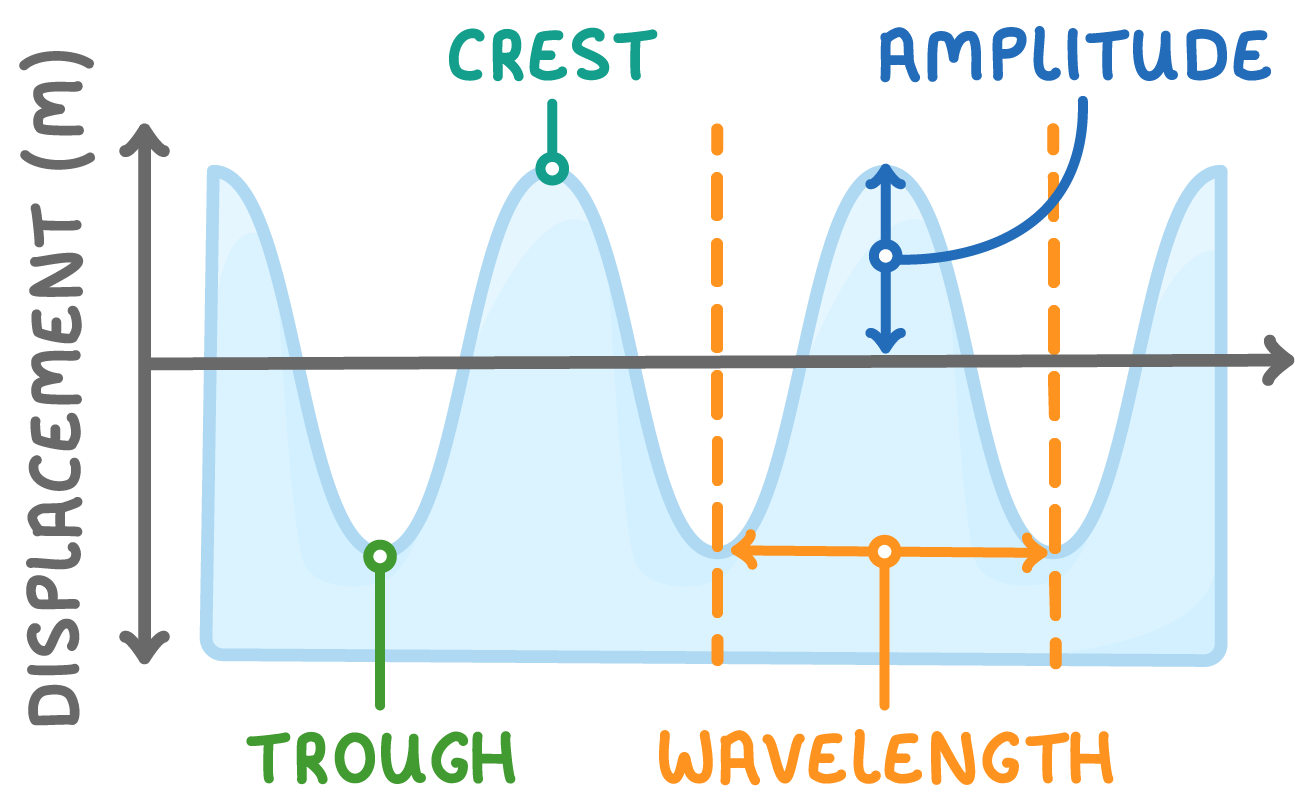
- Amplitude - The maximum displacement of a point on the wave from its undisturbed (rest) position.
- Wavelength () - The distance between the same point on two adjacent waves, such as crest to crest or trough to trough.
- Frequency () - The number of complete waves passing a fixed point each second.
- Period () - The time taken for one complete wave to pass a fixed point.
Reading properties from graphs
- A graph of displacement against distance shows wavelength and amplitude.
- A graph of displacement against time shows period and amplitude.
Wavefronts
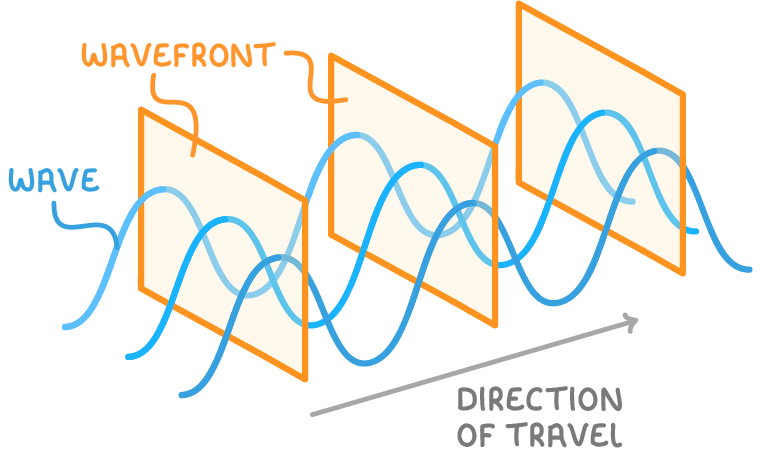
- A wavefront is an imaginary line or surface joining points on adjacent waves that are at the same point in their cycle (e.g. along a crest).
- The distance between one wavefront and the next equals one wavelength.
Transverse and longitudinal waves
Waves are classified by the direction the particles vibrate compared with the direction energy is transferred.
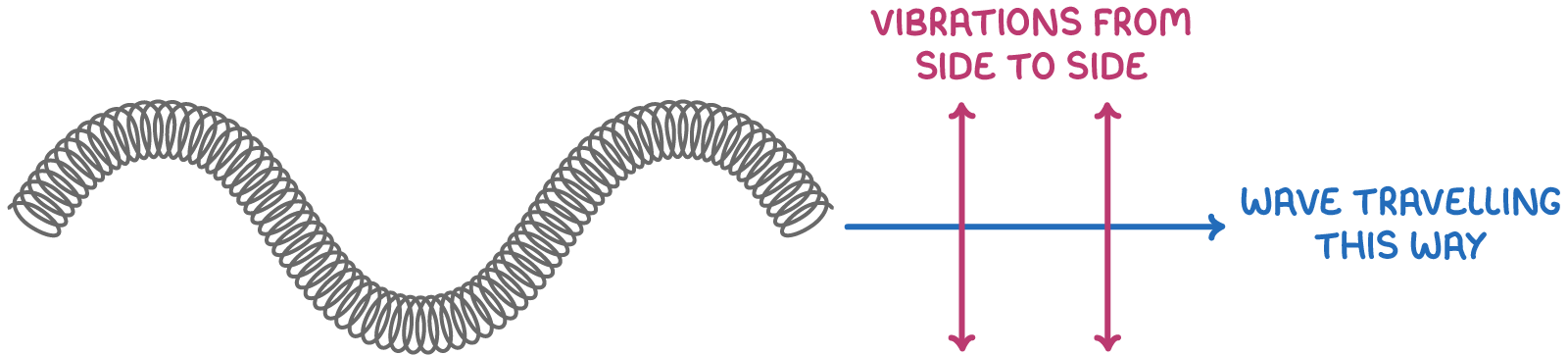
Transverse waves
- Vibrations are perpendicular (at 90°) to the direction of energy transfer.
- Examples:
- All electromagnetic waves (e.g. light)
- Ripples on water
- Seismic S-waves
- Waves on a string
Longitudinal waves
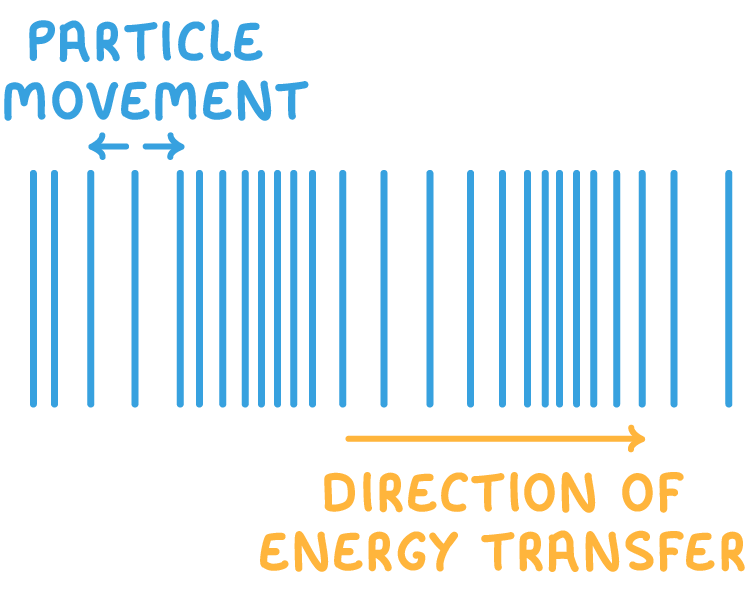
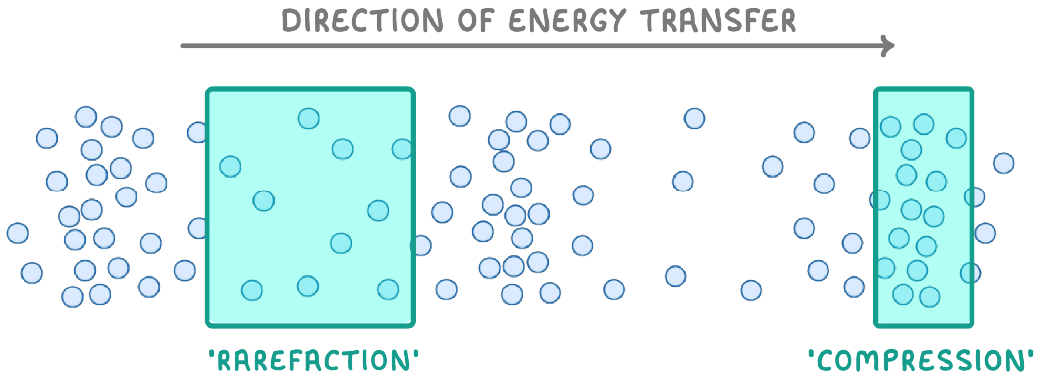
- Vibrations are parallel to the direction of energy transfer.
- Longitudinal waves show areas of:
- Compression - Where particles are squashed together
- Rarefaction - Where particles are spread apart
- Examples:
- Sound waves and ultrasound
- Seismic P-waves
The wave speed equation
- Wave speed is the speed at which energy is transferred through a medium.
- The wave equation applies to all waves.
Formula for wave speed
Where:
- = Wave speed, in metres per second (m/s)
- = Frequency, in hertz (Hz)
- = Wavelength, in metres (m)
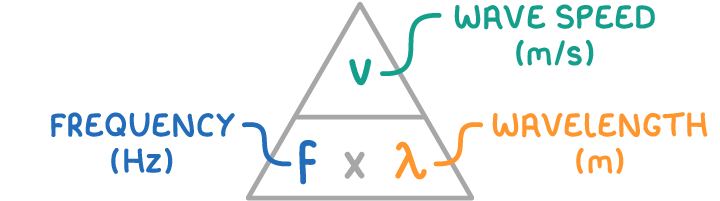
Cover the quantity you want to find to rearrange the equation.
Worked example - Wavelength from frequency
A radio wave has a frequency of 7.5 × 10⁶ Hz. The speed of radio waves in air is 3.0 × 10⁸ m/s. Find its wavelength.
Step 1 - Formula
Step 2 - Rearrange the formula
Step 3 - Substitution and calculation
The wavelength of the radio wave is 40 m.
TermDefinition
AmplitudeThe maximum displacement of a point on a wave from its undisturbed position.
WavelengthThe distance between the same point on two adjacent waves.
FrequencyThe number of times something happens each second. For a wave, it is the number of complete waves passing a point each second, measured in hertz (Hz).
PeriodThe time taken for one complete cycle of something that repeats, such as one complete wave passing a point, one swing of a pendulum or one orbit.
Transverse waveA wave where the vibrations are perpendicular to the direction of energy transfer.
Longitudinal waveA wave where the vibrations are parallel to the direction of energy transfer.
CompressionA region in a longitudinal wave where the particles are squashed close together.
RarefactionA region in a longitudinal wave where the particles are spread further apart.
Key points to remember
How were these notes?