3.4 - V = IR Equation & I-V Graphs
Formula linking p.d., current and resistance
Where:
- = Potential difference, in volts (V)
- = Current, in amperes (A)
- = Resistance, in ohms (Ω)
The greater the resistance of a component, the smaller the current that flows through it for a given potential difference across it.
Finding the resistance
The equation can be rearranged to find the resistance of a component from measured values of potential difference and current:
Worked example - Current through a resistor
A 5.0 Ω resistor in a circuit has a potential difference of 9.0 V across it. Calculate the current through the resistor.
Step 1 - Identify the values
- Potential difference: V
- Resistance:
Step 2 - Rearrange V = IR to make current the subject
Step 3 - Substitution and calculation
The current through the resistor is 1.8 A.
Ohmic conductors and the I-V characteristic
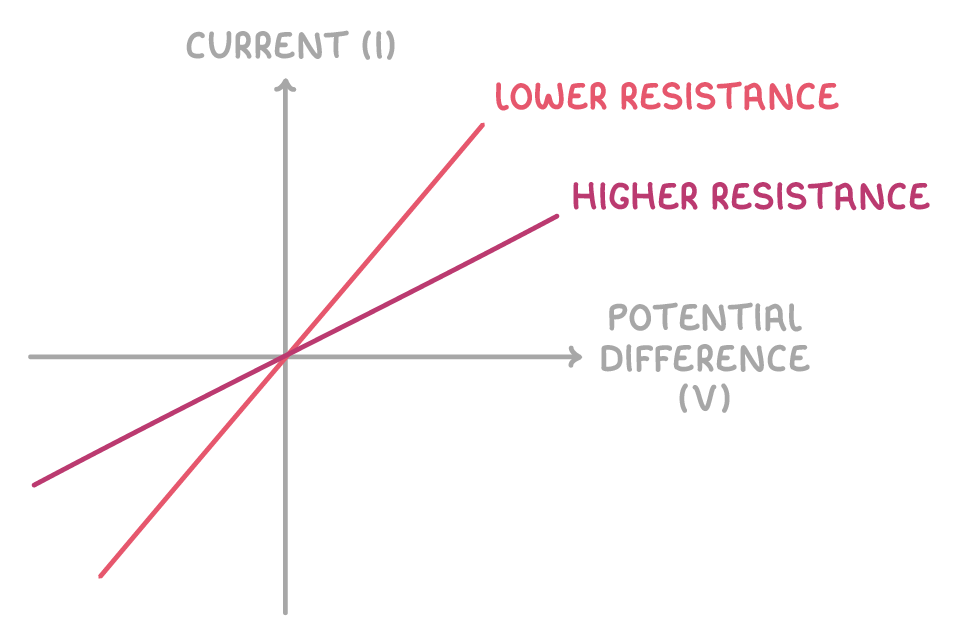
- An I-V characteristic (or current-voltage characteristic) is a graph showing how the current through a component changes as the potential difference across it is increased.
- The resistance of an ohmic conductor, such as a fixed resistor or a metal wire, does not change with the current through it - as long as its temperature stays constant.
- For an ohmic conductor at constant temperature, the current is directly proportional to the potential difference across it.
Shape of the graph
- A component whose resistance stays constant gives a straight line through the origin.
- Components with a straight-line characteristic are called linear components.
- The steeper the line, the lower the resistance.
Finding the resistance from the graph
- Read the potential difference and current at a point and use .
- For a linear component whose line passes through the origin, the resistance is the inverse of the gradient.
I-V characteristics of filament lamps and diodes
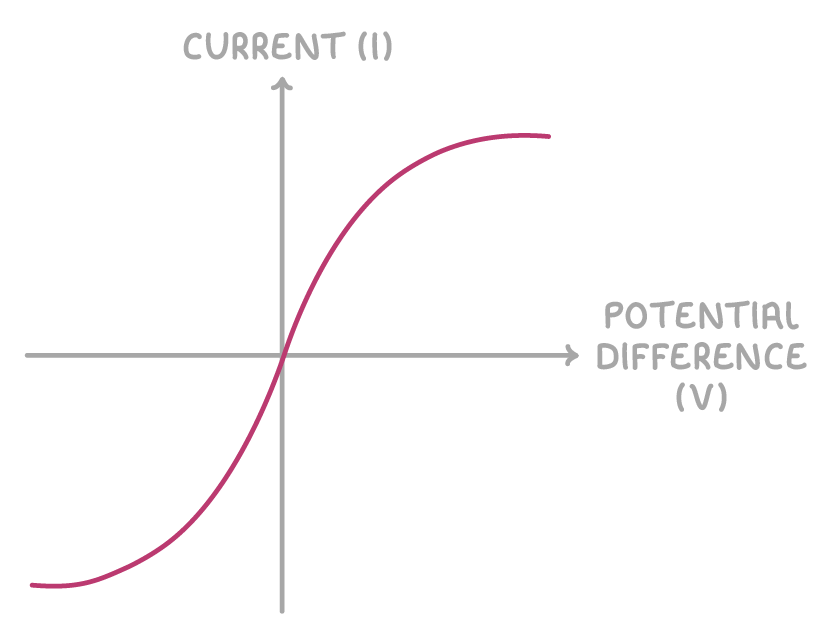
- Some components do not have a constant resistance, so their I-V characteristic is a curve rather than a straight line.
- Components with a curved I-V characteristic are called non-linear components.
The filament lamp
- As the current through a filament lamp increases, the moving charges transfer energy to the thermal energy store of the filament, so the filament heats up.
- As the temperature rises, the metal ions vibrate more, and electrons collide with them more often, so the resistance increases.
- Because the resistance rises, less current flows for each extra volt, so the characteristic gets shallower as the potential difference increases - giving a curve.
The diode
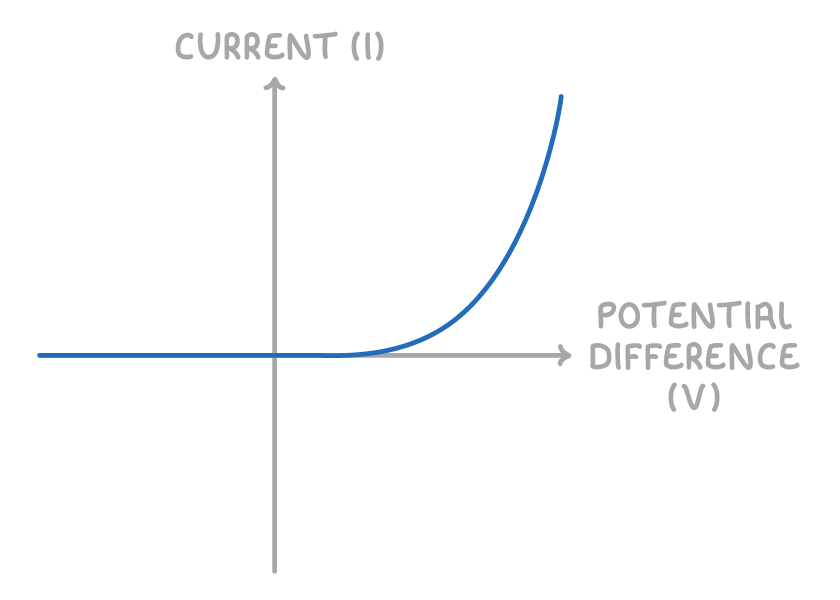
- A diode lets current flow through it in one direction only.
- It has a very high resistance in the reverse direction, so almost no current flows that way.
- The I-V characteristic is flat (zero current) for a reverse potential difference, then curves upwards once the potential difference is in the forward direction.
- A light-emitting diode (LED) is a type of diode that emits light when current flows through it in the forward direction.
TermDefinition
Ohmic conductorA component whose resistance stays constant as the current through it changes, provided its temperature is constant.
Linear componentA component whose current-voltage characteristic (its graph of current against potential difference) is a straight line.
Non-linear componentA component whose current-voltage characteristic (its graph of current against potential difference) is a curve.
DiodeA component that lets current flow through it in one direction only.
Light-emitting diode (LED)A diode that emits light when current flows through it in the forward direction.
Key points to remember
How were these notes?