6.7 - Electromagnetic Induction
The generator effect - Inducing a potential difference
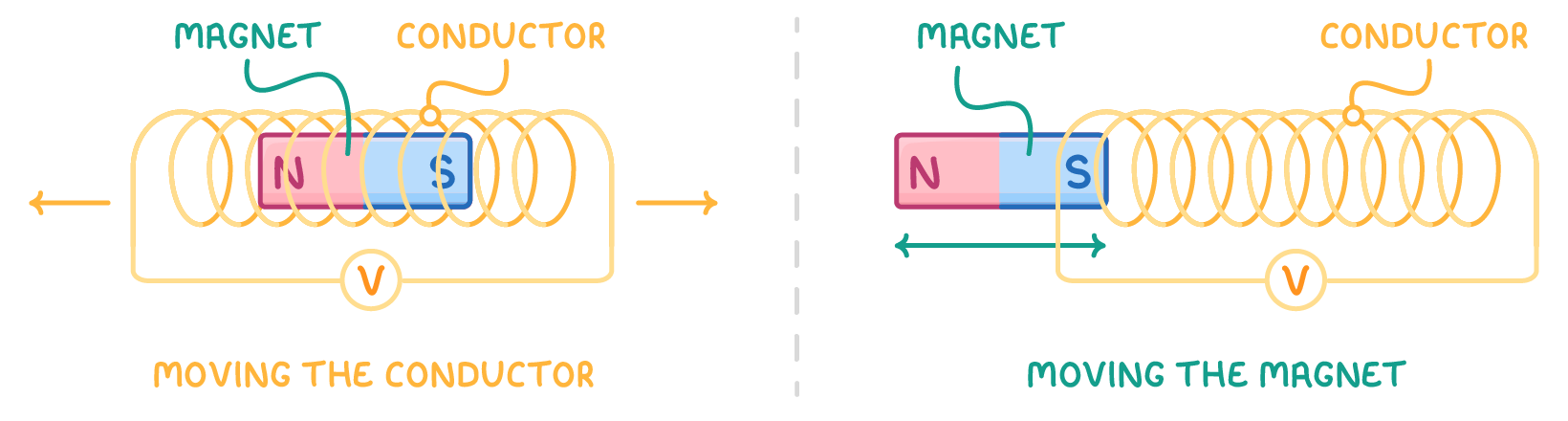
- The generator effect (or electromagnetic induction) is the production of a potential difference across a conductor when the conductor moves relative to a magnetic field, or when the magnetic field around the conductor changes.
- If the conductor is part of a complete circuit, this induced potential difference drives an induced current.
Situations that produce the effect
- A conductor and a magnetic field move relative to each other (e.g. moving a wire so it cuts across magnetic field lines, or moving a magnet in and out of a coil).
- The magnetic field through a conductor changes (getting stronger, weaker, or reversing), even without movement.
In both cases, field lines must be cut by the conductor.
- Moving a magnet into a coil gives a brief pulse of current while the magnet is moving.
- Once the magnet stops moving, there's no induced current because field lines are no longer being cut.
Direction of the induced potential difference and current
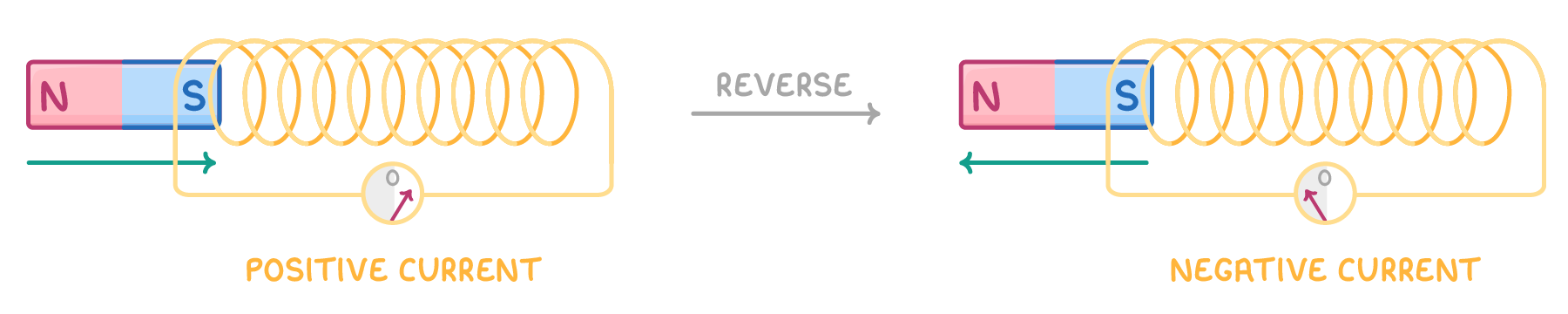
- Reversing the movement (pulling the magnet out instead of pushing it in) reverses the direction of the induced pd and current.
- Reversing the magnetic field (swapping the poles) also reverses the direction of the induced pd and current.
- Moving a magnet continuously backwards and forwards inside a coil produces an alternating current.
- Electromagnetic induction is the reverse of the motor effect: in the motor effect, a current in a field creates movement; in induction, movement in a field creates a current.
Inducing an alternating current by rotation
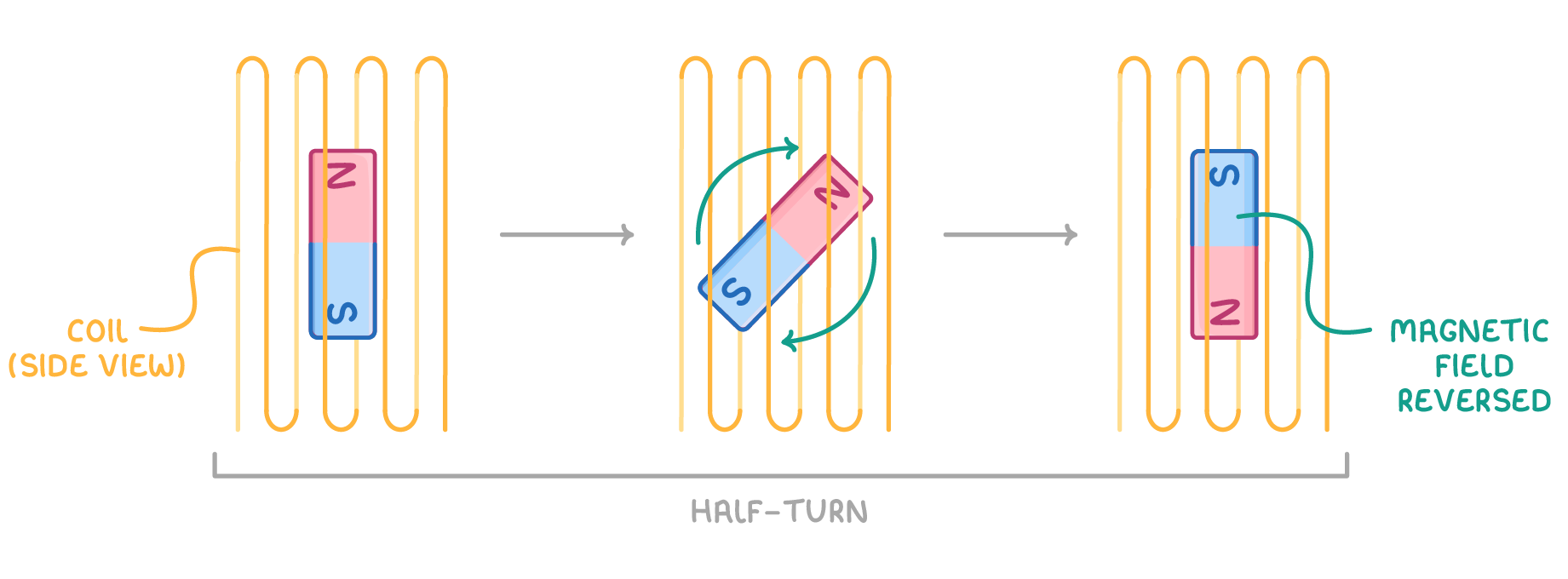
Rotating a coil inside a magnetic field, or rotating a magnet inside a coil, continually changes the magnetic field passing through the coil.
How rotation produces an alternating current
- As the magnet (or coil) turns, the magnetic field through the coil changes, inducing a potential difference (and a current in a complete circuit).
- After half a turn, the direction of the field through the coil has reversed, which reverses the direction of the induced pd and current.
- Continuous rotation makes the pd reverse every half turn, producing an alternating current.
This continuous rotation is the principle used in a generator.
Changing the size of the induced potential difference
The size of the induced potential difference and current can be increased by:
- Increasing the speed of the movement (or how fast the field changes)
- Increasing the magnetic field strength (e.g. using a stronger magnet)
- Increasing the number of turns on the coil
Each of these increases the rate at which magnetic field lines are cut.
TermDefinition
Electromagnetic inductionThe production of a potential difference (voltage) across a conductor when it moves relative to a magnetic field or when the magnetic field around it changes. It is also called the generator effect.