8.4 - Red-Shift & the Doppler Effect
The Doppler effect
- When a wave source moves relative to an observer, the observed wavelength and frequency change.
- This is called the Doppler effect, and it happens for all waves, including light and sound.
Why the wavelength changes
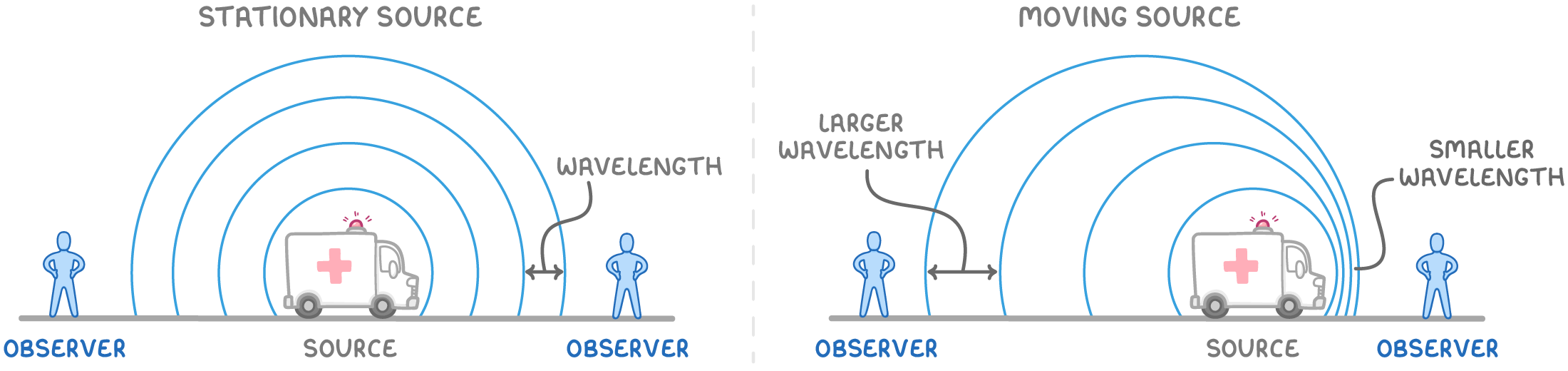
- The wave speed stays constant, so motion of the source changes the spacing of the wavefronts:
- Ahead of the source - Wavefronts are bunched together, giving a shorter wavelength and higher frequency.
- Behind the source - Wavefronts are spread out, giving a longer wavelength and lower frequency.
- For example, a passing siren sounds higher-pitched as it approaches and lower-pitched as it moves away.
The Doppler effect for light
- An object moving away from an observer has its light shifted to a longer wavelength and lower frequency - towards the red end of the spectrum (red-shift).
- An object moving towards an observer has its light shifted to a shorter wavelength and higher frequency - towards the blue end of the spectrum (blue-shift).
TermDefinition
Doppler effectThe change in the observed wavelength and frequency of a wave when its source moves relative to an observer.
Red-shiftThe increase in the observed wavelength of light from a distant galaxy or a source moving away.
Blue-shiftThe shift of light to a shorter wavelength and higher frequency when a source moves towards an observer.