Loudspeakers & Microphones - exam practice
Loudspeakers & Microphones
Question 1 of 3
This question is about the operation of a moving coil loudspeaker.
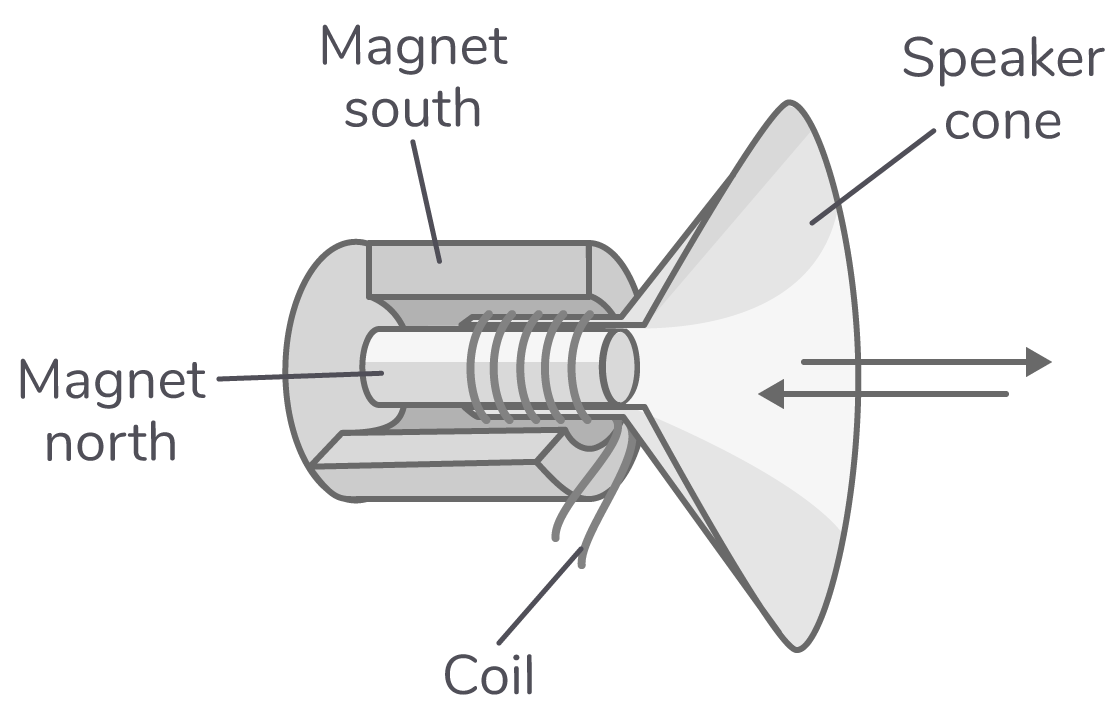
Explain how the moving-coil loudspeaker converts an electrical signal into a sound wave.
A student replaces the alternating current electrical signal with a direct current.
Explain why the student no longer hears the music output.
State two ways in which the force on the speaker cone could be increased.
This question is about the operation of moving-coil loudspeakers.

Which of the following would increase the force on the moving coil in a loudspeaker?
Which of the following correctly describes the sound wave produced by the loudspeaker?
Put the statements in correct order to describe the operation of a moving-coil loudspeaker.
This question is about the construction of a simple loudspeaker.
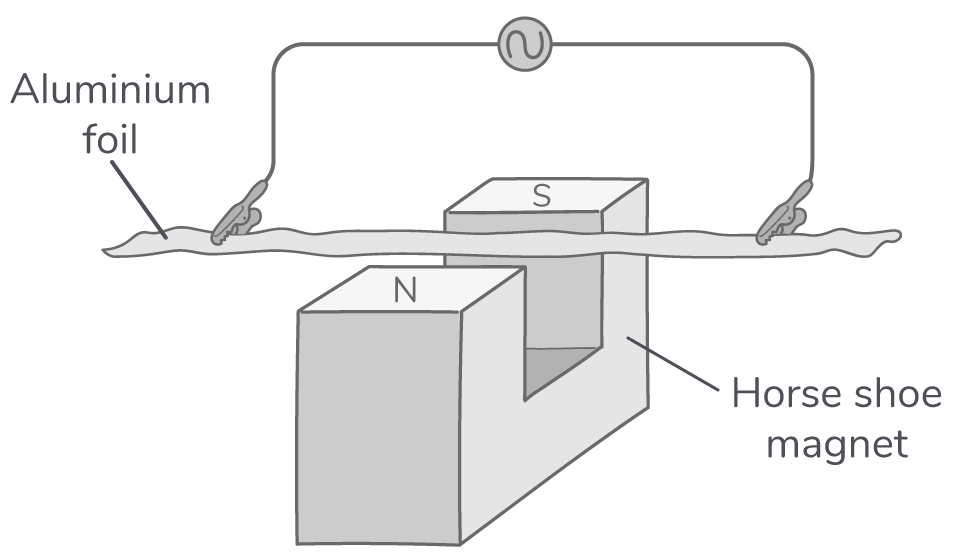
At the instant shown in the diagram above, the left hand electrode is positive and the right hand electrode is negative.
State the direction of the force acting on the aluminium foil.
The student connects the foil to a signal generator providing an alternating current at 40 Hz.
Explain why the aluminium foil emits a low pitched humming noise when connected to the signal generator.
State two ways in which the force on the aluminium foil could be increased.