1.13 - Stopping Distances
Stopping distance = thinking + braking distance
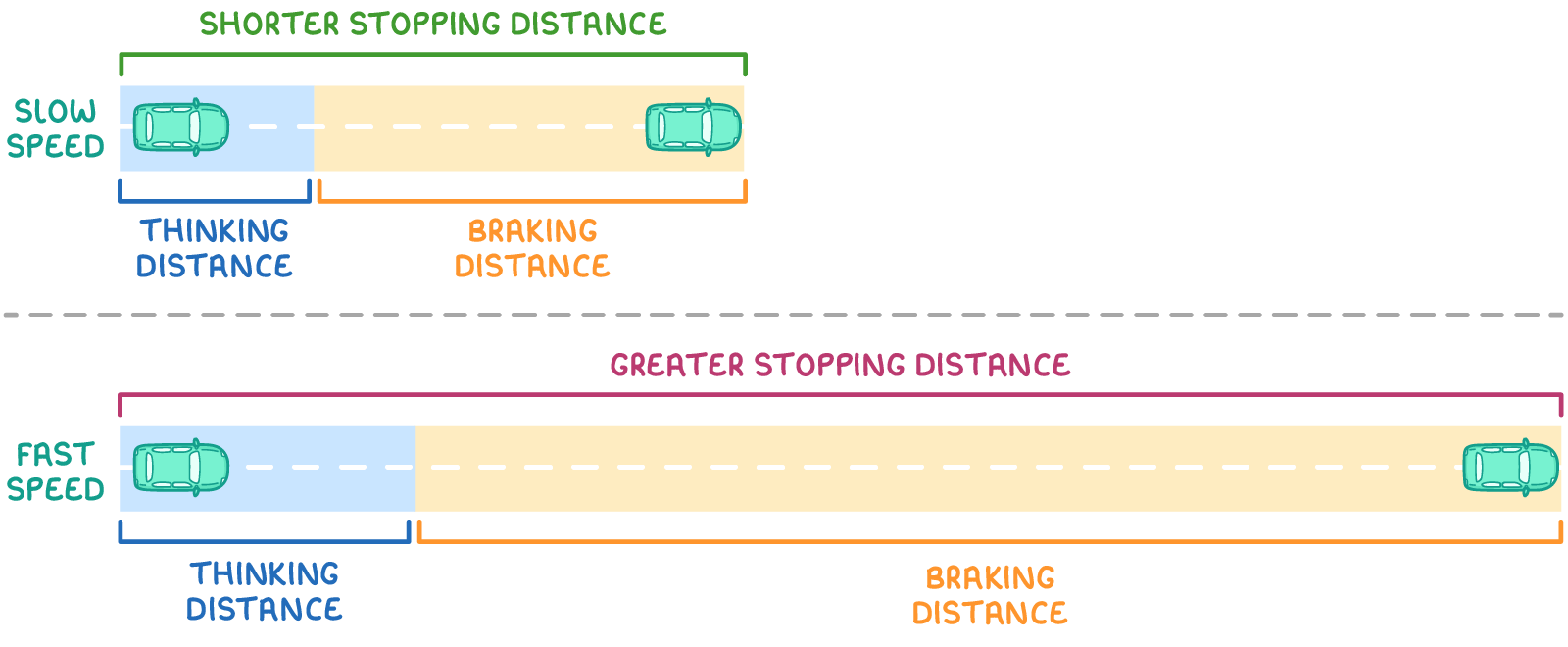
The stopping distance is the total distance a car travels from the moment a driver spots a hazard to when the car comes to a complete stop:
Stopping distance = thinking distance + braking distance
- Thinking distance - The distance the car travels during the driver's reaction time, between noticing the hazard and applying the brakes.
- Braking distance - The distance the car travels once the brakes are applied, while slowing to a stop.
In an emergency stop, the driver applies the maximum braking force to stop in the shortest possible distance.
What increases thinking distance
- Higher speed - The faster the car travels, the further it goes during the reaction time.
- Longer reaction time - Increased by tiredness, alcohol, drugs and distractions.
What increases braking distance
- Higher speed - A faster car travels further before the braking force brings it to a stop.
- Greater mass - A heavier car takes longer to stop under the same braking force.
- Worn or faulty brakes - These can't apply as much braking force.
- Poor road or tyre conditions - Wet or icy roads, dirt, or worn tyres reduce friction, making skidding more likely.
TermDefinition
Stopping distanceThe total distance a vehicle travels from the moment a driver spots a hazard to when it comes to a complete stop.
Thinking distanceThe distance a vehicle travels during the driver's reaction time, before the brakes are applied.
Braking distanceThe distance a vehicle travels from when the brakes are applied until it stops.
Emergency stopA stop where the driver applies the maximum braking force to halt the vehicle in the shortest possible distance.
Key points to remember
How were these notes?