10.1 - Specific Heat Capacity
The experiment
Aim
To find the specific heat capacity of water by heating a known mass of it with an electric heater and measuring how much its temperature rises for the energy supplied.
Background
- Heating a material transfers energy to its thermal energy store and raises its temperature.
- The specific heat capacity, , of a material is the energy needed to raise the temperature of 1 kg of it by 1 °C.
- The energy transferred, the mass, and the temperature change are linked by . Some boards write it as , which is the same relationship.
- You can't measure the specific heat capacity directly, but you can measure the energy supplied, the mass, and the temperature rise.
- So in this practical you heat a known mass of water, record the energy supplied and the temperature, and rearrange the equation to find .
Variables
- Independent variable - The energy transferred to the water by the heater.
- Dependent variable - The temperature of the water.
- Control variables - The mass of water, the heater and power supply, and the cup and lid.
Method
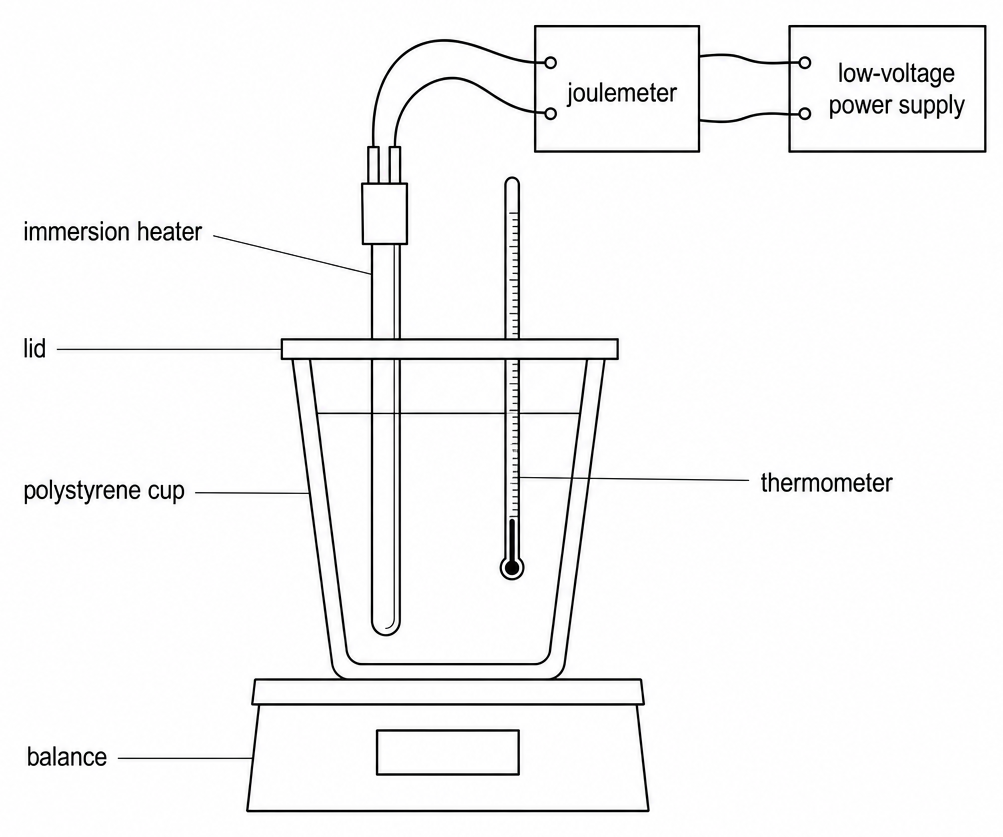
- Measure the water - Zero a polystyrene cup on a balance, pour in enough water to cover the heating element, and record its mass in kilograms.
- Set up the cup - Fit a lid, and put the thermometer and the immersion heater through its two holes, with the element fully under the water.
- Start heating - Record the starting temperature, connect the heater to a low-voltage power supply through a joulemeter, then switch on and start a stopwatch.
- Take readings - Every minute for about ten minutes, stir the water gently, then record the temperature and the energy shown on the joulemeter.
- Plot the graph - Temperature against energy supplied.
- Compare the insulation - Repeat with the cup wrapped in insulation, and again in a glass beaker with no lid.
Safety
- Hot heater - Only switch the heater on when its element is under the water, and leave it to cool in the water before lifting it out.
- Spills - Mop them up straight away, because water and electrical supplies don't mix.
Worked example - SHC of aluminium
A student heated a 2 kg aluminium block with an immersion heater. A joulemeter showed that 28,500 J had been transferred, and the block's temperature rose from 20 °C to 35 °C.
Find the specific heat capacity of aluminium, explain why the answer is a little too high, and show how a graph of temperature against energy supplied gives c instead.
Step 1 - Find the temperature rise
Step 2 - Rearrange the equation for c
Divide both sides of by .
Step 3 - Explain why the measured value is too high
The accepted value for aluminium is about 900 J/kg°C. Some of the 28,500 J was lost to the surroundings instead of heating the block, so the temperature rise was smaller than it would have been. Dividing the full energy supplied by that smaller rise gives a specific heat capacity a little higher than the true value. Good insulation reduces this error.
Step 4 - Use the graph instead
A graph of temperature against energy supplied is a straight line. Its gradient is , which equals . Rearranging gives this equation.
The gradient uses every reading, so a single anomalous reading has less effect than it would on one pair of readings.
Common exam questions
Question 1
Why is the metal block wrapped in insulation, or the water heated in a polystyrene cup with a lid?
To reduce the energy lost to the surroundings, so more of the energy supplied heats the material and the value of c is closer to the true value. Polystyrene is full of trapped air, which is a poor conductor.
Question 2
Why is a little oil put in the thermometer hole of a metal block, or the water stirred before each reading?
So the thermometer reads the temperature of the whole sample. The oil improves the thermal contact between the block and the thermometer, and stirring stops the water near the heater being hotter than the rest.
Question 3
A 50 W heater warms a 1 kg block for 5 minutes and the temperature rises by 15 °C. Calculate the specific heat capacity.
Energy supplied = power × time = 50 × 300 = 15,000 J. So c = 15,000 ÷ (1 × 15) = 1,000 J/kg°C.
Question 4
Why does the graph of temperature against energy supplied curve at the beginning, and what should you do about it?
The heater takes time to warm up and pass energy steadily into the material, and the part nearest the heater warms first. Take the gradient from the straight section and ignore the curved start.
Question 5
Why must the immersion heater never be switched on outside the block or the water?
The element relies on the block or the water carrying energy away from it. In air it overheats within seconds, which can burn it out and scorch or melt whatever it's touching.