2.2 - Gravitational Potential Energy
The gravitational potential energy store
- Lifting an object higher off the ground transfers energy to its gravitational potential energy store.
- Any object raised above the ground has energy in this store, and the higher it is, the more energy it holds.
- Lifting takes a force acting against gravity - this is what transfers the energy into the store.
- When the object is lowered or allowed to fall, energy is transferred back out of the store again.
What gravitational potential energy depends on
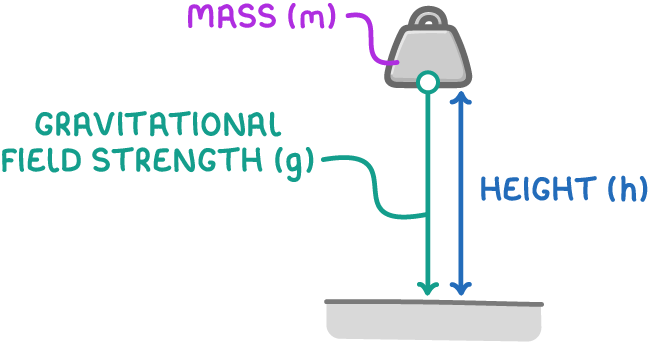
- Mass - A heavier object has more energy in its gravitational potential energy store than a lighter one at the same height.
- Height - The higher an object is raised, the more energy is transferred to its gravitational potential energy store.
- Gravitational field strength - The stronger the gravitational field the object is in, the more energy is stored for the same mass and height.
The gravitational potential energy formula
For a change in height, the same equation is written .
Where:
- (or ) = Gravitational potential energy (or change in gravitational potential energy), in joules (J)
- = Mass, in kilograms (kg)
- = Gravitational field strength, in newtons per kilogram (N/kg)
- (or ) = Height (or change in vertical height), in metres (m)
Gravitational field strength on Earth is about 9.8 N/kg (sometimes rounded to 10 N/kg or given as 9.81 N/kg), so always use the value given in the question.
Worked example - GPE of a rucksack
A rucksack of mass 4.0 kg is lifted onto a luggage rack 1.8 m above the floor. Gravitational field strength is 9.8 N/kg. Calculate the energy in the rucksack's gravitational potential energy store.
Step 1 - Formula
Step 2 - Substitution and calculation
So the rucksack has about 70.6 J of energy in its gravitational potential energy store.
TermDefinition
Gravitational potential energy storeThe energy an object has because of its position in a gravitational field, such as its height above the ground.
Key points to remember
How were these notes?