7.8 - How Appliances Transfer Energy
Appliances transfer energy electrically
- A moving charge transfers energy because it does work against the resistance of a circuit.
- Electrical appliances transfer energy electrically from a power source to their components, and from there to other stores:
- A battery stores energy in its chemical store.
- The mains supply delivers energy from a power station.
Examples of energy transfer
- Kettle - Transfers energy electrically from the mains supply to the thermal energy store of its heating element.
- Handheld fan - Transfers energy electrically from the battery's chemical store to the kinetic energy store of the fan's motor.

Not all energy is useful
- No appliance transfers all of its energy to useful stores.
- Some energy is always dissipated to the thermal energy stores of the wires and components, and then to the surroundings.
The heating effect of a current in a resistor
- When there's a current in a resistor, energy is transferred that heats the resistor up.
- The energy is dissipated to the thermal energy stores of the resistor and then to its surroundings.
Why the resistor heats up
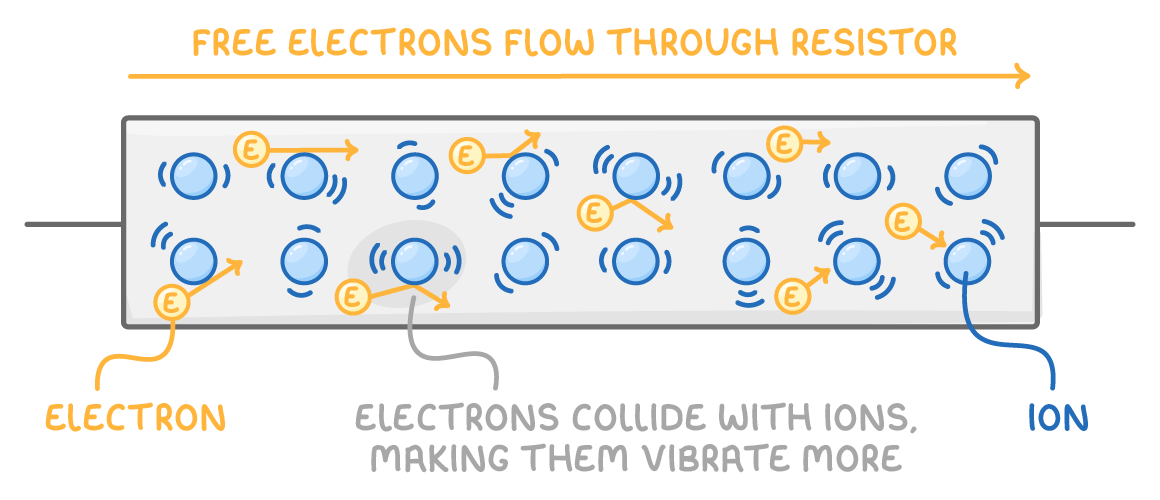
- As free electrons flow through the resistor, they collide with the ions in the metal lattice.
- Each collision transfers energy to the ions, making them vibrate more.
- The more the ions vibrate, the hotter the metal becomes.
Advantages and disadvantages
- Advantage (heat is useful) - A heater or toaster uses high-resistance wire that gets hot to transfer energy to its surroundings. A fuse uses the heating effect deliberately, melting to break the circuit if the current gets too high.
- Disadvantage (heat is not useful) - Energy transferred to thermal stores is wasted, reducing efficiency. Components that get too hot can be damaged, and heating can change how the circuit behaves.
Reducing wasted energy with low-resistance wires
- When a current flows through a wire, some energy is transferred to the thermal energy store of the wire and its surroundings.
- In connecting wires, this heating is wasted energy and lowers the efficiency of the circuit.
- Wasted energy is reduced by giving connecting wires as low a resistance as possible.
Ways to lower a wire's resistance
- Making the wire thicker - A larger cross-sectional area gives charge more room to flow, reducing resistance.
- Using a good conductor - Such as copper, which has low resistivity.
- Keeping the wires short - A shorter wire has less resistance than a longer one of the same thickness.
Power ratings of appliances
- An appliance's power rating is its maximum operating power: the maximum energy it transfers each second when in use.
- The lower the power rating, the less energy transferred in a given time, so the cheaper it is to run.
- The higher the power rating, the faster the energy transfer.
- For example, a 1,200 W heater transfers twice as much energy each second as a 600 W heater.
A higher power rating isn't always better
- A higher power rating does not always mean more useful energy is transferred.
- An inefficient appliance with a higher power rating can transfer the same or less useful energy than a lower-power, more efficient one, because more of its energy is wasted to thermal stores.
TermDefinition
Power ratingThe maximum power an appliance works at, which is the most energy it can transfer each second.
Key points to remember
How were these notes?