9.6 - Factors Affecting Gas Pressure
Gas pressure comes from particle collisions
- The particles in a gas move constantly in random directions at a range of speeds.
- As they move, they collide with each other and with the walls of their container.
- A gas's particles take up very little space - most of a gas is empty space - so particles travel far between collisions.
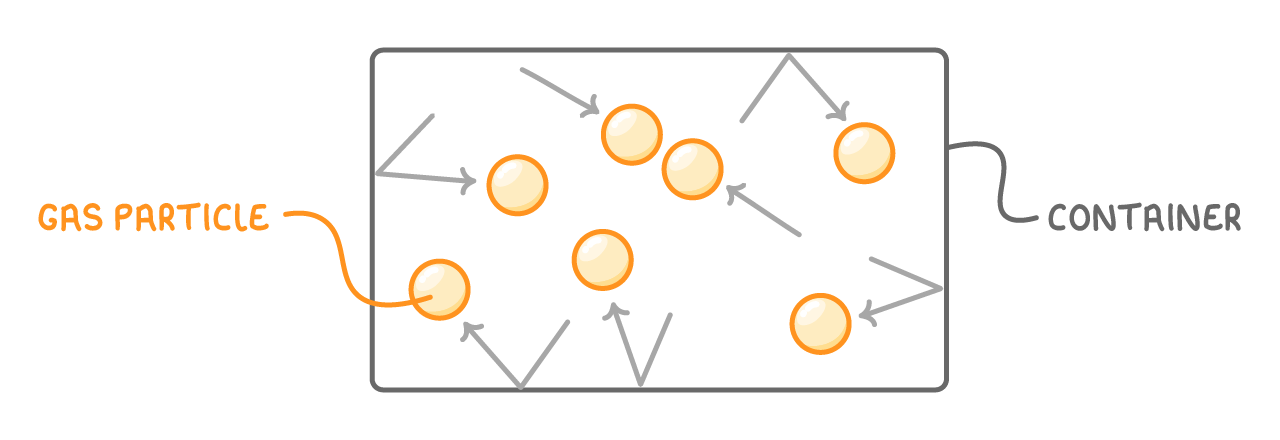
How collisions create pressure
- When a particle collides with a surface it changes direction, so it changes momentum.
- A change in momentum means a force is exerted on the surface.
- Each collision is in a random direction, but together the collisions give a net force at right angles to the wall.
- Pressure is the force acting per unit area of a surface. Gas pressure is the total force of all colliding particles on each unit area of the walls.
- The more often particles hit the walls, and the harder they hit, the greater the pressure.
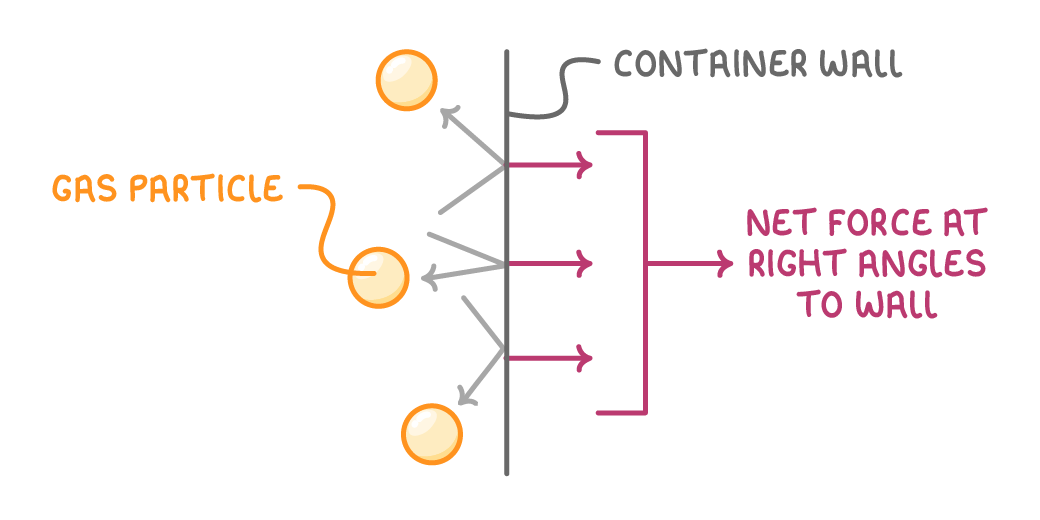
Absolute zero and the Kelvin temperature scale
Absolute zero
- The coldest temperature possible is -273 degrees C, called absolute zero.
- At absolute zero the particles have as little energy in their kinetic stores as possible - they are very nearly still.
- A gas cooled towards absolute zero exerts less and less pressure, because its particles strike the walls less often and less hard; at absolute zero an ideal gas would exert no pressure at all.
The Kelvin scale
- Absolute zero is the starting point of the Kelvin scale, where it is 0 kelvin (0 K).
- A change of 1 degree C is the same size as a change of 1 K - the scales differ only in where their zero sits.
To convert between them:
- From degrees Celsius to kelvin, add 273.
- From kelvin to degrees Celsius, subtract 273.
| Absolute zero | Freezing point of water | Boiling point of water | |
|---|---|---|---|
| Celsius scale | -273 degrees C | 0 degrees C | 100 degrees C |
| Kelvin scale | 0 K | 273 K | 373 K |
Temperature and average kinetic energy of gas particles
- The temperature of a gas measures the average energy in the kinetic energy stores of its particles.
- The hotter the gas, the more energy its particles have on average, so the faster they move on average.
- The Kelvin temperature of a gas is directly proportional to the average kinetic energy of its particles - double the temperature in kelvins and you double the average kinetic energy.
Heating and cooling a gas
- Heating transfers energy into the kinetic energy stores of the particles, increasing their average speed.
- Cooling transfers energy out of their kinetic stores, so they move more slowly on average.
- Particles always have a range of speeds, so this is an average across all particles, not a single speed shared by every particle.
How temperature and volume change gas pressure
- Two things change the pressure of a fixed mass of gas: its temperature and its volume.
- Both act by changing how often particles hit the walls and how hard they hit.
Changing the temperature (at constant volume)
- Heating makes particles move faster on average - they hit the walls more often and with greater force each time, so the pressure increases.
- Cooling makes particles move slower - they hit the walls less often and with less force, so the pressure decreases.
Changing the volume (at constant temperature)
- Squeezing the gas into a smaller volume packs the same particles into less space - they hit the walls more often, so the pressure increases.
- Letting the gas expand into a larger volume spreads the particles out - they hit the walls less often, so the pressure decreases.
TermDefinition
PressureThe force acting at right angles to a surface per unit area of that surface.
Absolute zeroThe lowest possible temperature (-273 °C), where particles have the minimum possible kinetic energy.
Kelvin scaleA temperature scale that starts at absolute zero, where a change of 1 K is equal to a change of 1 °C.
TemperatureA measure of the average kinetic energy of the particles in a substance.
Key points to remember
How were these notes?