9.1 - Density
What density is and what it depends on
- Density is the mass per unit volume of a substance - a measure of how tightly packed its particles are.
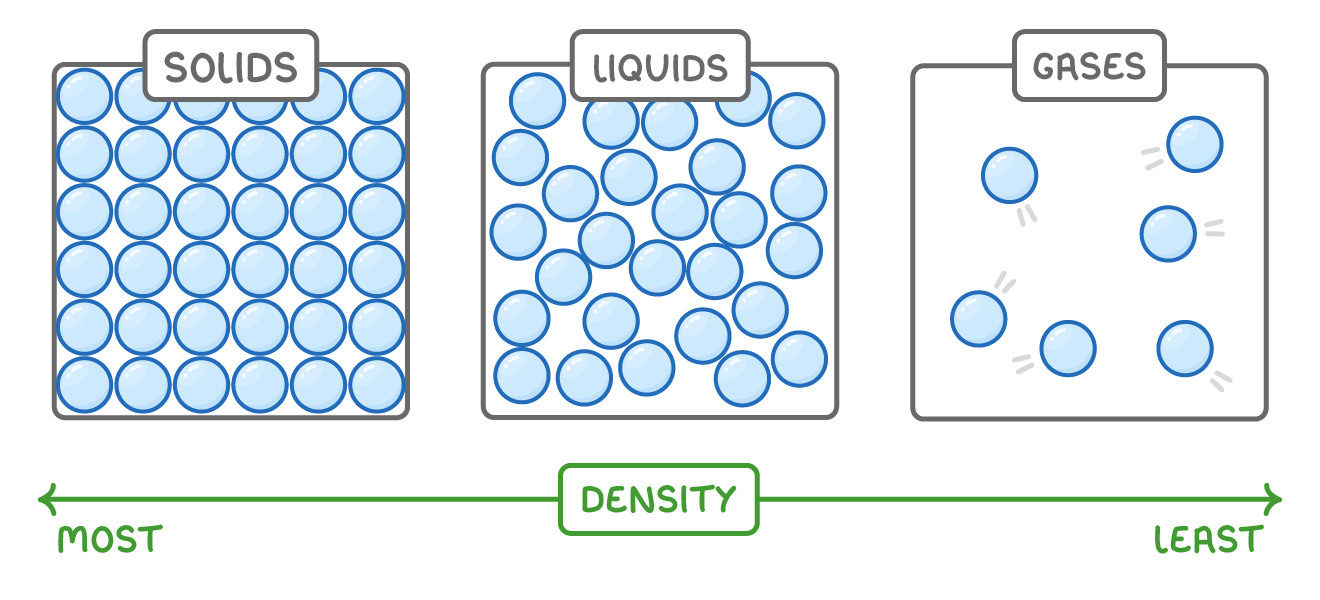
- Density depends on what a material is made of and how its particles are arranged - the more tightly packed the particles, the denser the material.
- Solids are generally the densest state of matter, liquids slightly less dense, and gases much less dense.
Density depends on the material, not the size or shape
- Density is a property of the material itself.
- A large block of iron and a small iron nail have the same density, even though their masses and volumes are different.
- Cutting an object in half halves both its mass and its volume, so its density stays the same.
Formula for density
Where:
- = Density, using the Greek letter rho, in kilograms per cubic metre (kg/m3) or grams per cubic centimetre (g/cm3)
- = Mass, in kilograms (kg) or grams (g)
- = Volume, in cubic metres (m3) or cubic centimetres (cm3)
Converting between units
1 g/cm3 = 1,000 kg/m3
For example, water has a density of 1 g/cm3, which equals 1,000 kg/m3.
Worked example - Using the density formula
Copper has a density of 9.0 g/cm3. Find the mass of 5 cm3 of copper.
Step 1 - Formula
Step 2 - Rearrange the formula
Make mass the subject:
Step 3 - Substitution and calculation
So 5 cm3 of copper has a mass of 45 g.
The mass and volume must be in units that match the density. Here density is in g/cm3, so mass is in grams and volume in cubic centimetres.
TermDefinition
DensityThe mass per unit volume of a substance.
Key points to remember
How were these notes?